Rains intensify across Kenya as saturated ground raises flood risk
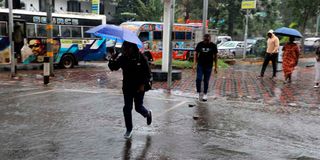
Nairobi residents shield themselves from the rain in the city centre. Continued downpours are raising concerns about the risk of flash floods.

Kenya is at the peak of its October-November-December rainy season, with significant rainfall already recorded in several parts of the country.
However, the continued downpours are raising concerns about the risk of flash floods as the ground becomes increasingly saturated and loses its capacity to absorb more water.
This comes as the Kenya Meteorological Service Authority (KMSA) maintains that the climate conditions behind the ongoing rainfall remain strong, with November expected to mark the peak of the season.


David Koros, the Assistant Director of Forecasting Services at KMSA, says rainfall observations from across the country show that the season is unfolding largely as anticipated.
"Rainfall observations from across the country show that significant amounts have already been recorded in nearly all regions,” he said.
In areas of South-Eastern Lowlands such as Machakos, some weather stations have recorded more than 50 millimetres (mm) of rainfall within 24 hours.
Parts of northern Kenya have received more than 30 mm while Nairobi has recorded rainfall exceeding 20 mm.
"Nairobi has also been receiving rainfall,” he said, “although the amounts recorded have not been as high as in some other parts of the country.
These figures come as forecasters warn that the prevailing conditions are likely to persist, particularly in western Kenya and several other parts of the country.
But the accumulating rainfall presents a growing challenge.
When soil absorbs water over an extended period, it gradually loses its capacity to take in additional moisture. Any further rainfall is more likely to flow over the surface, increasing the possibility of flash floods.
Koros says the risk is likely to grow as the ground becomes increasingly saturated.
"As the ground becomes increasingly saturated,” he explained, “the impacts are likely to intensify, including the risk of flash floods."
The warning is significant for communities living in low-lying areas, near rivers and in settlements with inadequate drainage systems.
In such locations, heavy rainfall can quickly turn roads into waterways, flood homes and disrupt movement.
In urban centres, the risk is heightened by extensive construction and paved surfaces, which leave little room for rainwater to seep into the ground.
When heavy downpours overwhelm drainage systems, water quickly accumulates on roads and in residential areas, triggering flash floods and disrupting movement, even after relatively short spells of rain.
Prolonged rainfall also threatens agricultural production, as excessive water can leave fields waterlogged, destroy crops, wash away fertile topsoil and disrupt harvesting, putting farmers' livelihoods at risk.
The continued rainfall is being driven by a combination of global climate patterns and local atmospheric conditions, with both El Niño and the positive Indian Ocean Dipole (IOD) remaining active, according to Koros.
Warmer sea temperatures in the western Indian Ocean are sustaining the positive IOD.
Locally, atmospheric instability, abundant moisture and favourable wind patterns are creating conditions for continued rainfall.
Atmospheric instability, measured in part through Convective Available Potential Energy (CAPE), provides the energy needed for warm, moist air to rise, cool and form rain-bearing clouds.
“The combination of these factors is expected to sustain rainfall,” Koros said, “particularly in western Kenya and several other parts of the country, over the coming weeks.”
According to KMSA, rainfall was recorded in most parts of the country last week, with amounts increasing compared with the previous week.
Kalungu Rainfall Station in Kitui County recorded the highest seven-day rainfall total at 147.7mm.
The automatic weather station (AWS) at Irbaan Primary School in Narok County recorded 108.4mm, which KMSA noted that it was the highest rainfall amount within 24 hours on November, 12th 2026.
“Comparing 2nd to 8th November 2026 and the 9th to 15th November 2026 review periods,” KMSA stated, “it is noted that rainfall amounts increased across the country.
According to KMSA, rainfall is expected to continue in major parts of the country.
“The prevailing conditions remain favourable for continued rainfall,” Koros said, “particularly in western Kenya and several other parts of the country.”
Follow ourWhatsApp channel for breaking news updates and more stories like this.