UN biodiversity summit: Kenya scientists call for modern farming tools to save land, species
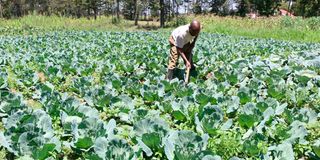
A farmer weeds cabbages at his farm in Mugathika, Ol Kalou, Nyandarua County on August 22, 2026.

What you need to know:
- Agricultural land in Kenya is increasingly being subdivided as families grow.
- At the same time, Climate variability is disrupting crop and livestock production.
In Yerevan, Armenia
The world is currently failing nature; that is the key message as countries gather this week for COP17, the 17th UN Conference of the Parties on Biological Diversity, the most significant global review of biodiversity commitments since the landmark Kunming-Montreal framework was adopted in 2022.
Countries are not on track to meet 22 of the 23 goals set out in the Kunming-Montreal framework, a draft UN report has shown.


For Kenya, where agriculture is simultaneously the country’s largest employer and one of the biggest drivers of habitat loss, the gap between promise and practice is wide.
Agricultural experts here are arguing that the answer lies not in choosing between protecting nature and feeding people, but in using technology to do more with less land.
David Tarus, a senior project officer at the African Agricultural Technology Foundation (AATF), says Kenya must combine traditional farming systems with modern innovations to address the growing pressure on arable land, an expanding population, and the compounding effects of climate change.
“We need a toolkit of technologies that includes traditional farming systems and modern innovations that can help us develop improved crop varieties within a shorter period because Kenya needs to preserve what it already has while embracing new innovations that enable farmers to produce more,” Tarus said.
Agricultural land in Kenya is increasingly being subdivided as families grow and farms are parcelled between heirs, leaving smallholders with shrinking plots.
At the same time, climate variability is disrupting crop and livestock production, with prolonged droughts affecting the availability of animal feed and squeezing milk production in regions like the North Rift.
The pressure to clear more land to compensate for falling yields is what COP17 negotiators are trying to address.
“Farmers need technologies that will help them grow crops that can withstand drought, diseases and pests and the government needs to work closely with scientists to deploy technologies that will support farmers despite these challenges,” said Tarus.
COP17 in Yerevan, Armenia, running from October 19 to 30, is focused on assessing global progress toward implementing the Kunming-Montreal framework and accelerating the shift from high-level commitments to concrete, measurable action, under the theme “Taking Action for Nature.”
One of the central tensions at the talks is how countries with high food insecurity can be expected to protect biodiversity when agricultural expansion remains a survival strategy for millions of smallholder farmers. That tension is felt in debates over agricultural biotechnology.
Tarus points to genetically modified BT maize as an example of the kind of technology that could help farmers produce more without breaking new ground. The BT maize variety, which is engineered to resist the maize stem borer and fall armyworm, two pests that devastate yields across East Africa, was approved by the National Biosafety Authority in 2025 after more than a decade of field trials by KALRO and AATF.
However, the road to farmers’ fields remains blocked. The Kisumu High Court is currently hearing a petition challenging the decision to allow the open-field cultivation and market release of the genetically modified maize, with the case now expected to proceed to written submissions before a final determination is made.
A report by a coalition of agricultural and science organisations, including AATF, estimated that five years of delay in approving three key crop varieties, among them BT maize, cost Kenya Sh8.7 billion in maize losses alone, equivalent to roughly a quarter of the country’s 2022 maize imports.
Those are losses that push smallholder farmers toward expanding their plots rather than intensifying production on existing land, precisely the outcome biodiversity negotiations are designed to prevent.
But Tarus is careful not to oversell technology as a standalone fix. The cost of improved seeds remains a barrier for smallholders who operate on thin margins and have little room to absorb the price premium of a new variety, however productive it might prove to be.
He argues that if regulatory approvals move faster and more companies enter the seed market, competition could bring costs down. The value of the technology, he says, also needs to be understood through what it prevents: the crop losses to armyworm or drought that can wipe out a family’s entire harvest in a single season.
“Funding is needed to deploy these technologies and build farmers’ capacity to adopt them quickly. If the technologies are available, more companies invest in the market and distribution improves, their costs can come down. The value of these technologies is also seen in the losses farmers avoid when crops are affected by pests or drought,” Tarus said.
An IUCN policy brief on Kenya’s agriculture sector argues that aligning Kenya’s agricultural policies with the Kunming-Montreal framework, particularly targets on sustainable agriculture, food systems, and the elimination of harmful subsidies, is essential for reversing biodiversity loss in agricultural landscapes.
The government, Tarus says, must work more closely with scientists and agricultural research institutions to ensure that technologies are designed around the realities facing farmers in arid and semi-arid areas, where both food insecurity and ecological fragility are most acute.
While the world is likely to reach an estimated 27.5 per cent of land under protection by 2030, scientists say many of the broader goals needed to halt biodiversity loss remain well off track, and who pays and how much toward a US$30 billion public finance goal remains deeply contested at COP17.
Follow our WhatsApp channel for breaking news updates and more stories like this.