For almost ten years, Josphat Kipkurui Ngetich grew maize and potatoes on his two-acre plot in the Kapsinendet area of Mariashoni in Nakuru County. However, due to low production and the high cost of farm inputs such as seeds and fertiliser, he decided to stop growing crops as he was making losses and spending a lot at the end of the season.
“While considering what to grow in the next planting season, I visited a friend in 2025 who was growing tree tomatoes on a similar plot of land, just metres from my farm. After a lengthy conversation, he convinced me to cut half an acre of my plot and start growing tree tomatoes, as I learnt that they were in demand and labour-intensive,” said Kipkurui.
During a visit to his farm a couple of days ago, the 50-year-old farmer said that his friend had revealed to him that he harvested over 300kg every two weeks and sold them at the local market for between 70 and 80 shillings per kilo. Kipkurui bought two kilograms of tree tomato fruits from his friend for 200 shillings, removed the seeds and allowed them to dry for two months before setting up a seedbed.
“After another two months, I prepared the half-acre plot of land I had set aside and transplanted my seedlings. I dug holes measuring two-and-a-half metres deep and spaced 2m by 3m wide to allow enough space for management tasks such as weeding and spraying, and to give the leaves room to spread and produce more fruit,” said Kipkurui, adding that he had mixed livestock manure from his cows and sheep and poured 24 kg into each hole.
He planted 350 seedlings, but some of them died due to climate change and inconsistent rainfall. However, he replanted the affected area with seedlings from the seedbed, as he had enough left. After eight weeks, he sprayed his crop to control a disease that affects the plants, especially when it rains heavily, and continued to spray depending on the weather conditions, every week if necessary.
He noted that, during the dry season, fruit is affected by whiteflies, which is the main challenge that fruit farmers in the area encounter. To combat this, he buys pesticides from local agrovet and farm input shops.
Mr Kipkurui added that tree tomatoes start to flower after six months. Here, he applied foliar fertiliser to increase the number of flowers that produce fruit. Between the rows, he has planted potatoes and nitrogen-fixing crops such as peas, which mature after three months. To care for his fruit trees, Kipkurui adds organic manure twice a year to strengthen the stems and support the fruit when it matures.
He prefers livestock manure as it retains the soil better than other fertilisers sold at Agrovet shops.
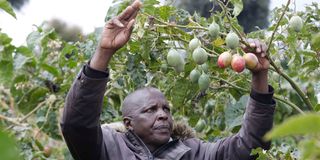
Josphat Kipkurui Ngetich displays tree tomato fruits harvested from his farm in Kapsinendet, Mariashoni, Molo, Nakuru County, on September 19, 2026. He sells the fruits for between Sh80 and Sh150 at the local market, depending on the season.
Photo credit: John Njoroge | Nation Media Group
“In June this year, I harvested my first 50kg bunch, but production increased at the second harvest, which occurred two weeks later. I sold the fruit at the local market for 80 shillings per kilogram. Each subsequent harvest, occurring every 14 days, yields increased production, depending on crop management and consistent rainfall, as fruits require sufficient rain to thrive,” said Kipkurui.
He added that the sales enabled him to continue managing his fruit trees through consistent spraying, and motivated him to immediately plant more tree tomatoes after harvesting the remaining maize crop. He has also been able to pay his children’s school fees and provide for other domestic needs.
He intends to extend his planting of tree tomato fruits to cover his entire two-acre plot by next year, after harvesting the maize, which is now mature. Kipkurui says that fruit is an income-generating crop when given the required nutrients and good management. He plans to grow the fruits on a large scale — around five acres — and sell his produce in local and international markets once production increases.
Before switching to tree tomato fruits, he says he grew passion fruits for two years before clearing them from the farm in 2024, as they were affected by diseases that caused the leaves and stems to dry out. He says that tree tomato fruits are disease-resistant and thrive during the dry season, despite white mites attacking the leaves.
The farmer has enjoyed success since planting passion fruits and tree tomatoes, adding that he has no regrets about giving up potato and maize farming. “When the season is good, farmers can harvest over 600 kg and earn more than 40,000 Kenyan shillings every month. In one year, I can earn close to 600,000 shillings, which is more than I could earn from growing maize on a similar plot of land over the course of one year, after harvesting and selling bags of threshed dry maize, each weighing 90 kg and retailing at 3,000 shillings per bag,” said Kipkurui, adding that one acre produces at least 20 bags of threshed dry maize. He says that potato and maize farming is dominated by brokers, unlike fruit farming, where buyers come directly to the farm, reducing the number of middlemen.
Kipkurui says that the main challenge farmers face is the inadequacy of extension officers in the area. He added that the county government should dispatch enough officers to work at a grassroots level, educating farmers about soil testing, crop management and pest and disease control.
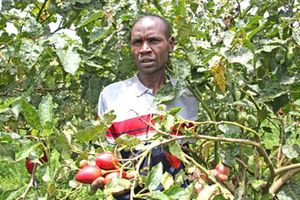
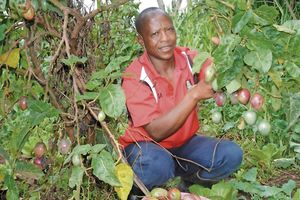
Josphat Kipkurui Ngetich at his farm in Kapsinendet, Mariashoni, Molo, Nakuru County, where he grows tree tomatoes on September 19, 2026. He switched to fruit farming after maize and potato yields declined in recent years.
Photo credit: John Njoroge | Nation Media Group
“I urge the agricultural department officers to research diseases and pests that mostly affect leaves, causing low fruit production,” he said. He also urged the county government to enhance packaging and establish standard prices to prevent middlemen, as well as to seek better local and international markets for their products, since fruit grows well in Molo Constituency and the surrounding areas.
To improve his farming skills, Kipkurui learns online via his mobile phone and reads newspapers that publish agricultural articles. He says that attending seminars and field days in the area has been challenging because the relevant authorities rarely share information with small-scale farmers.
He encourages farmers to grow tree tomatoes and other fruits, as this will enable them to access better local and international markets and set their own prices, particularly when they grow and produce them in large quantities. He said that during the dry season, the price of tree tomatoes rises to 150 shillings per kilogram. He added that when farmers fail to spray at the right time, production decreases.
“With as little as 100 shillings, young people can invest in fruit farming in a small area and generate income quickly because harvesting continues as the fruit matures,” said Kipkurui. He added that he will not buy other seedlings to plant in the next season, as he propagates his own and sells the surplus to other willing buyers.