Principal Secretary, State Department for Forestry, Gitonga Mugambi, has defended the government's push to undertake major infrastructure projects in forests and protected areas, insisting that Kenya cannot put its development agenda on hold in the name of conservation.
Mugambi's remarks came as the dispute over proposed developments inside Nairobi National Park moved to the Environment and Land Court, which on Tuesday, July 21, 2026, conducted a site visit at the park amid a standoff between conservation campaigners and the Kenya Wildlife Service.
Speaking at a roundtable forum with stakeholders on sustainable forestry and climate resilience, Mugambi said the country must pursue economic growth and job creation while protecting its forests and other natural ecosystems, describing the balance between development and conservation as delicate.
“We must develop. We must grow our economy, but at the same time, we must conserve.” He said.
Forestry Principal Secretary Gitonga Mugambi.
Photo credit: Bonface Bogita | Nation Media Group
The PS warned against what he termed ‘negative activism,’ arguing that conservation should not be used to advance personal interests or to block projects the government deems necessary for the country's economic development.
“It is a delicate balance and we should not be misled by what I would call negative activism,” Citing examples such as the ongoing construction of Talanta Sports City and the planned expansion and relocation of the Nairobi Animal Orphanage, he argued that the projects should not be stopped simply because they have raised conservation concerns.
An exterior view of the under-construction 60,000-seater Raila Odinga Talanta Stadium in Nairobi.
Photo credit: File | Nation Media Group
“This country needs Talanta, and we must build Talanta.” He emphasised. “We also need to expand the animal orphanage.”
However, the events surrounding the Nairobi National Park site visit offered a glimpse into just how deep the disagreement has become.
Co-petitioners in one of Kenya's largest citizen-led cases challenging developments inside the park said they were initially blocked from accessing the site on Tuesday despite a court order directing the Deputy Registrar of the Environment and Land Court to visit the park in the presence of all parties.
The petitioners, more than 4,600 Kenyans who have challenged what they describe as ongoing development and destruction within Nairobi National Park, arrived at the designated time for the visit.
They allege that they were instead confronted by armed Kenya Wildlife Service personnel and initially denied access while court officials, KWS representatives and members of the media proceeded into the park.
“We arrived at the park at the designated time, only to be subjected to intimidation and threats by masked, armed service personnel of KWS.” They explained.
The petitioners were eventually allowed into the park after the other parties had completed the site visit, according to their account.
In an exclusive interview with Nation, Akshay Vishwanath, Executive Director of JustAct and a co-founder of the Pacific Nairobi National Park Campaign, said the petitioners had expected to participate in the visit alongside the other parties to the case.
“We as petitioners showed up on site to be part of the team with our legal representatives,” he said, “all parties should have been allowed to enter the site together and verify the facts before the court.”
He further added that the exclusion was particularly troubling because the visit had been ordered by the court.
“It was a court-mandated visit, a court-supervised visit,” he said.
The petitioners' position is that the proposed development represents a broader threat to Nairobi National Park, which they say has faced repeated pressure from infrastructure projects and other forms of encroachment.
Members of the public queue viewing a caged lion at the Nairobi Animal Orphanage on December 25, 2021.
Photo credit: Evans Habil | Nation Media Group
The current dispute centres partly on plans to relocate and expand the Nairobi Animal Orphanage within the park.
The Nairobi National Park has three sites, namely the Athi River, Southern Bypass and the Galleria site. The proposed facility, according to Kenya Wildlife Service (KWS), will be around the Galleria site and would take up close to 84 acres of Nairobi National Park.
“The expansion is necessary to provide better facilities and improve animal welfare.” Duncan Juma, Head of Corporate Communication at KWS, emphasised.
However, conservationists say that they are not opposed to improving the welfare of rescued wildlife. Their objection, they argue, is about the location.
According to Vishwanath, there was no justification for taking a significant portion of a national park that provides a natural habitat for free-ranging wildlife and using it to establish a facility for caged animals.
“The issue here is not so much whether animals deserve better welfare and whether they should be in a better facility like an expanded orphanage,” he said. “The question is, you could literally build that orphanage anywhere else in the city or even the country and you would still meet the objectives of that animal welfare and proper visitor facility without destroying a natural habitat.”
A lioness walking in the Nairobi National Park.
Photo credit: Shutterstock
Nairobi National Park is particularly sensitive because of its proximity to the capital and its role as one of the few major wildlife ecosystems located next to a modern city.
PS Mugambi insists that the two priorities, conservation and development, should not be treated as competing choices.
“We cannot say that we will never develop simply because there are forests. We must develop while conserving our forests.” He emphasised. “We have to strike that balance, and that is what the government is doing.”
Across the country, forests and other ecosystems are under increasing pressure from infrastructure expansion, settlement, agriculture, logging and competing demands for land.
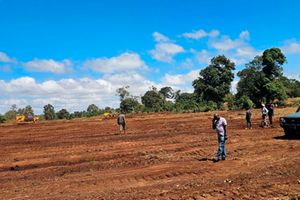
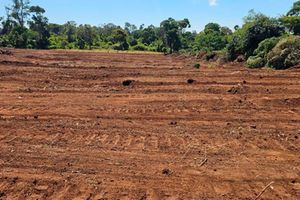
In Imenti Forest, Meru County, activists and residents have opposed plans to excise land for state projects despite a court order suspending the works, Kenya Forest Service rangers guarded bulldozers as they cleared sections of the forest,
In Nairobi, conservation groups have flagged the shrinking of green spaces around the city, warning that projects such as the 60,000-seater Talanta Stadium add to a pattern of encroachment on public land, while construction has reportedly continued in Ngong Road Forest and Upper Imenti Forest despite High Court orders suspending the activities.
Elephants in the Imenti Forest in Meru. Counties hosting game parks and national reserves are reaping billions of shillings in entrance fees every year from the facilities.
Photo credit: File | Nation Media Group
Mugambi, however, argued that the government is not abandoning conservation.
“We are looking for additional areas that can be gazetted as forests so that we can expand our forest cover,” he said.
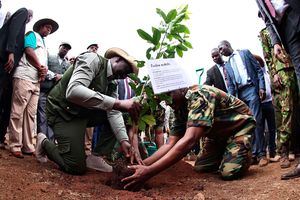
He also pointed to the government's 15 billion tree-growing target as evidence of its commitment to environmental restoration.
So far, he said, about 1.8 billion trees have been grown.
“The satellite imagery over the past three to five years showed that Kenya was experiencing a positive greening trend, which he attributed to the country's tree-growing efforts.” Mugambi explained.
But conservationists argue that increasing tree cover should not be used to justify the loss of existing natural ecosystems.