Why women's access to land remains agriculture's missing link
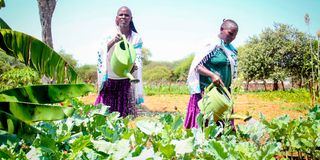
Women from Topolul mother to mother support group MMSG water crops at their kitchen garden in Kodich,West Pokot County ,a project that helps them fight malnutrition and hunger through climate smart agriculture.

What you need to know:
The latest Kenya Demographic and Health Survey data show that access to land ownership remains unequal. Findings from a pool of 10,843 never-married women reveal that 98.3 per cent do not own land. Of the 1.7 per cent who own land, only 1.4 per cent own it independently.
Dr Miruka says agricultural interventions need to consider not only whether women are being reached, but also whether they are able to use and benefit from the resources provided.
Across the country, women are changing how they farm in response to a changing climate. They are switching crops as rainfall becomes less predictable, diversifying farms, joining savings groups and turning to table banking to raise money for seed and other inputs.
Yet delegates at the recently concluded 20th session of the Africa Food Systems Forum in Kigali, Rwanda, were confronting a reality that continues to shape agricultural production across the continent: the women doing much of the work do not always have equal control over the resources needed to adapt.
A 2025 report by the Food and Agriculture Organisation (FAO) shows that 76 per cent of working women in Africa are employed in agrifood systems, where women account for 49 per cent of the workforce.


When Rose Muthoni, a farmer in Embu, decided to try a drought-tolerant variety of maize on her farm, she was thinking about one thing: the weather.
A crop that could withstand a dry spell, she thought, could mean the difference between having enough maize to feed her family and having to buy food at the market.
But the seed was only one part of the equation.
“I don't have my own land. It belonged to my husband, which is ancestral land. Sometimes, I would agree on what to plant, buy the maize, then he would have a change of mind. We went our separate ways, and the land, I hear, is currently bare,” she says.
Her experience mirrors wider patterns in land ownership.
The latest Kenya Demographic and Health Survey data show that access to land ownership remains unequal. Findings from a pool of 10,843 never-married women reveal that 98.3 per cent do not own land. Of the 1.7 per cent who own land, only 1.4 per cent own it independently.
Among 908 widows, 51.4 per cent do not own land. The survey also found that of 2,989 women who are divorced or separated, 89.3 per cent do not own land. Overall, 75.2 per cent of women do not own agricultural land.
The issue has gained prominence as governments, researchers and development organisations promote climate-smart agriculture across Africa.
At the forum, discussions focused on how farmers can adapt to rising temperatures, unpredictable rainfall, drought and other climate pressures while improving productivity and profitability.
But agricultural innovations, delegates heard, do not enter empty fields.
They enter households and communities where access to land, finance, information and technology is often shaped by gender.
“It's one thing to adopt the technology,” says Dr Maureen Miruka, Director for Gender Equity, Youth and Social Inclusion at the International Maize and Wheat Improvement Centre (CIMMYT). She spoke to Climate Action at the sidelines of the forum.
“It's another to get the proceeds that come.”
For years, agricultural development programmes have often been assessed by the number of farmers who received improved seed, attended training sessions or gained access to new technologies.
According to Dr Miruka, those measures do not always capture who controls the resources associated with those interventions.
“A woman can attend a training session without controlling the farm on which the technology will be used. She can receive information on her phone without controlling household finances. She can obtain a loan without deciding how the money is spent. And she can grow a profitable crop without necessarily controlling the income from its sale,” she says.
The Covid-19 pandemic, she adds, affected progress that had been made in several sectors.
“Covid-19 pandemic, for instance, really made us lose a lot of the gains that we had had on gender equality in food systems, in health, and other sectors. And again, we cannot afford to think of farmers as just farmers. They are people who access healthcare services and education.
"So there are a whole lot of natural and man-made crises and disasters that have taken us back with regard to gender equality and equity, and that really want us to just put in more work, more investments.”
Dr Miruka says agricultural interventions need to consider not only whether women are being reached, but also whether they are able to use and benefit from the resources provided.
The questions, she says, begin with basic resources: Who controls the land? Can a woman obtain credit without a formal land title? Does she control the phone, cash and transport needed to use technology? Can she decide whether to adopt it? And once it generates income, does she retain control over that income?
Land, she notes, affects more than agricultural production.
It can influence a farmer's ability to invest, use property as collateral and make decisions about activities on the farm.
The machinery lesson
Similar dynamics have emerged in discussions around agricultural mechanisation.Women perform substantial amounts of agricultural labour while also carrying out unpaid care and domestic work. Yet research by CIMMYT in Ethiopia and Kenya found that heavy workloads did not automatically translate into demand for machinery.
“Women's labour was often undervalued. Household finances could be controlled by someone else. And machinery service providers tended to prioritise agricultural tasks traditionally performed by men. In other words, the machine was available,” says Dr Miruka.
She says approaches explored through various programmes have included machinery-as-a-service models, collective leasing arrangements, smaller and more affordable equipment packages, alternative forms of collateral and delivery through women's groups.
“When I previously worked at Kenya Agricultural and Livestock Research Organisation (KALRO), we worked with financial service providers to tailor financial products to women's needs rather than making access dependent on collateral.
"We also looked at the agricultural cycle. If you are growing maize or wheat, for example, there is a period between planting and harvesting when you are not generating income. You cannot give a farmer a loan in January and expect them to repay it in February.
"Instead, repayment needs to be aligned with the agricultural cycle. Farmers should be able to begin repaying at harvest, when they have proceeds from their crops.
"That means tailoring financial products not only to the needs of women who may not have collateral, but also to the crops or agricultural enterprises they are engaged in.”
Agricultural financing, Martin Fregene, Director of Agriculture and Agro-Industry at the African Development Bank, argued at one of the forum's side events, needs to take those constraints into account.
As discussions at the forum showed, efforts to expand climate-smart agriculture increasingly intersect with questions of land ownership, access to finance and decision-making within households. For many women farmers, those factors continue to shape how agricultural technologies and services are adopted and used.