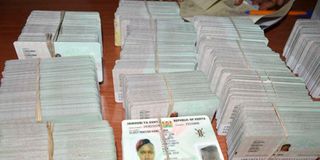
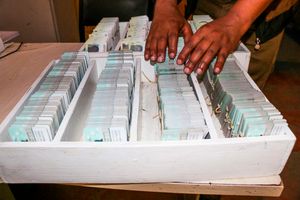
More than 161,000 people in Baringo County are without national identity cards (IDs), a crucial document that aids access to government and other services.
According to Interior Cabinet Secretary Kipchumba Murkomen, Tiaty is the most affected area, with over 45,000 people lacking this crucial document.
“It is a major concern that more than 161,000 people in Baringo County have no IDs. This denies them access to essential services and opportunities,” the CS said during his Jukwaa La Usalama engagement forum at Baringo National Polytechnic over the weekend.
“It is a tragedy that even people aged over 70 in Tiaty do not have ID cards, this is gross marginalisation. Perhaps they don’t see the need for it since they are cut off from government services,” the CS said at the forum, which brought together residents and local leaders, chiefs and security officials.
Among other things, the lack of IDs has also prevented many children from obtaining birth certificates, the CS said, emphasising the government’s commitment to resolving the issue through reforms, including free issuance for first-time applicants and the rollout of new live-capture unit technology, which will accelerate the application process.
“With the new system, applicants will be able to receive their ID cards within three working days once the technology is fully implemented nationwide,” he stated.
Residents cite insecurity as the reason many have shied away from registration out of fear of being profiled.
“Many fear being linked to banditry. As a result, they avoid acquiring IDs or birth certificates, which has had a ripple effect in schools and other government services,” said local resident Mr Paul Todopong.
Kapedo East Location Chief Lomonasiwa Lopeleng'uria said some individuals deliberately avoid registration to evade identification and arrest.
“Some youths involved in criminal activities avoid getting IDs so they cannot be tracked. Others use fake names to confuse authorities,” said the chief.
He emphasised that without an ID, many are unable to access vital services, especially in remote villages like Ameyan, Toplen, Riong’o, Nadome, Chesitet, Adomeyon, Natan, Napukut, Naudo, and Akwichatis.
“The community is pastoralist and mobile, making it difficult for them to access distant government offices. We need mobile registration units to address this gap,” he said.
Tiaty MP William Kamket supported the CS’s concerns, explaining that many residents in remote villages have never had access to ID registration services.
“Tiaty has the capacity to register over 100,000 voters, but many residents still lack IDs. We are appealing to the government to bring these services closer to the people so we can register more voters in future elections,” said Mr Kamket.
On a recent visit to a remote village in his ward, Silale MCA Clement Lomaring’oria was shocked to learn that hundreds of residents, including the elderly, had never obtained ID cards.
“They asked me why I was visiting them, yet they had not been able to vote for me in the 2022 General Election because they lacked IDs,” said the MCA.
“I followed up with county officials, and we deployed two officers to register locals. In one village alone, we registered more than 100 people—many of them over 60 years old,” he said.
He lamented the lack of access to government services in such areas and called on the government to decentralise service delivery.
“In my remote ward, thousands of adults, including senior citizens, have never acquired IDs. I urge the government to take services directly to the people,” he stated.
Head teachers in Tiaty have previously raised concerns that thousands of pupils don’t have birth certificates, and many could not be registered in the National Education Management Information System (NEMIS) because their parents lack ID cards.
NEMIS is the national portal used to manage education data and administer national examinations. Without registration, learners cannot be supported by government capitation programs.
Kositei Primary School head teacher Mr John Apetole explained that only 89 out of 302 pupils had been registered in NEMIS.
“Only about a quarter of our pupils are captured in government data. The rest are not supported because they lack birth certificates, which are tied to their parents’ IDs,” said Mr Apetole.
He attributed the problem to high illiteracy levels, with many parents unaware of the importance of acquiring ID cards or registering their children.
Other challenges cited include perennial insecurity, the nomadic lifestyle of the community, and the long distances residents must travel to reach registration centres in Kabarnet, Chemolingot, or Tangulbei.