Kenya accounts for the highest number of documented Africans recruited by Russia to fight on the frontlines of its war with Ukraine, a new report has revealed.
The report shows how the recruitment operation has left a trail of financial losses, disputed earnings and deaths, with intermediaries accused of embezzling the millions Russia promised foreigners who went to the war frontlines in Russian fatigues.
The investigative report has identified 841 Kenyans among thousands of Africans recruited into Russia's military to fight in the war against Ukraine, exposing a recruitment network that allegedly used promises of civilian employment to lure unsuspecting jobseekers into military service.
The report, titled Death Contracts: How Russia Recruits Africans to Fight and Die in Ukraine, published in August 2026 by Journalists for Justice (JFJ), documents the recruitment of 3,034 Africans from 40 countries.
Kenya accounts for the largest number of documented recruits, followed by Egypt with 407, Nigeria with 214, Ghana with 337 and Uganda with 108.
The investigation shows how some Kenyans were promised civilian jobs, only to end up on the war frontlines.
The report says the recruitment was not simply a case of Kenyans voluntarily joining a foreign army. It describes a network involving recruitment agents, intermediaries, travel facilitators and military-linked contacts who allegedly presented opportunities in Russia as civilian employment.
“Recruitment operated through overlapping networks of licensed agencies, informal brokers, personal connections and institutional contacts. Russia was being sold as a path to money, status, and advancement,” it read.
According to the investigation, some candidates were promised jobs in security, construction, logistics and other sectors. They were then taken through visa processing, medical examinations, travel arrangements and the signing of military service contracts.
It says recruitment meetings took place at KICC, a State-owned facility in Nairobi, while officials from immigration, criminal investigations, intelligence and employment services were accused in Parliamentary proceedings of having facilitated the trafficking.
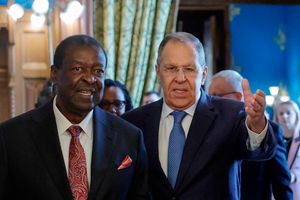
Members of the delegations, led by Russian Foreign Minister Sergei Lavrov and Kenyan Foreign Minister Musalia Mudavadi, hold talks in Moscow, Russia, March 16, 2026.
Photo credit: Reuters
The government had previously announced the deregistration of approximately 600 labour recruitment companies following public outcry and parliamentary questions.
However, JFJ's review of the National Employment Authority register found that, by late March 2026, only 569 employment agencies were registered, while another 786 had expired licences.
The report questions the effectiveness of the government's regulatory system, saying some companies reported in the media as having been deregistered were not even listed in the authority's information management system.
It further says none of the government officers identified in the parliamentary proceedings had been prosecuted at the time of the investigation. The director of the recruitment agency implicated in the Kenyan pipeline was facing prosecution under counter-trafficking laws, but not under the foreign enlistment provision of the Penal Code.
The investigation also highlights the legal implications for Kenyans who enlisted in the Russian military without government authorisation.
Section 68 of Kenya's Penal Code criminalises the recruitment or enlistment of Kenyan citizens into a foreign military without presidential authorisation, with offenders facing up to 10 years in prison.
However, the law provides a defence if an accused person can show the enlistment was not voluntary.
JFJ argues that Kenyans who were deceived into signing military contracts should be treated as victims of trafficking rather than voluntary foreign fighters.
It warns against selectively applying the law to recruits while failing to hold accountable the agencies, intermediaries and other actors involved in their recruitment.
The report also points to a November 2025 Employment and Labour Relations Court judgment in which recruitment agency Gratify Solutions International Ltd and three directors were ordered to pay a Kenyan trafficking victim Sh5 million in compensation for human trafficking, forced labour and modern slavery.
It says Russia's recruitment model evolved from targeting prisoners and students to exploiting unemployed civilians and licensed employment agencies.
The report draws on recruitment agency contracts, financial records, visa and travel documents, WhatsApp communications, interviews with recruits and their families, missing persons records and Ukrainian military intelligence data.
“During May and June 2025, Global Face Human Resources Limited held frequent recruitment meetings at the Kenyatta International Convention Centre in Nairobi. Some drew 40 or 50 men. Recruits recalled others with as many as 80. They had been summoned through WhatsApp messages advertising a ‘rare opportunity’ abroad,” it reads.
“NYS graduates, former soldiers, prison officers, security personnel, drivers, athletes, and men now serving through informal work.” It adds
It cautions that the 3,034 documented cases do not represent the full extent of African recruitment, noting that Russia has not published a comprehensive account of foreign nationals enlisted in its armed forces.
The report identifies Global Face Human Resources Limited as a key recruitment agency in Kenya. It says recruitment meetings were held at the Kenyatta International Convention Centre (KICC), with candidates receiving instructions through WhatsApp and being connected to Russian-based handlers.
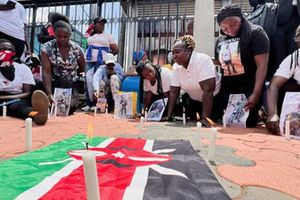
Relatives of Kenyans recruited to fight in Ukraine for Russia pray outside Parliament Buildings, calling for clarity on the suspected involvement of State officials in the recruitment.
Photo credit: Reuters
“In May 2025, Global Face Human Resources Limited booked rooms at Nairobi’s Kenyatta International Convention Centre (KICC) for almost daily meetings,”
It identifies Festus Omwamba as the agency's director and describes other individuals involved in the recruitment chain.
The investigation also documents cases in which recruits said they did not fully understand the Russian-language contracts they signed.
The scale of the recruitment is reflected in the human cost. JFJ documented at least 76 Kenyan deaths, with 502 African recruits from 40 countries recorded as killed in action by the end of June 2026.
The report also identifies cases of Kenyans who were wounded, captured or reported missing after being deployed to the battlefield.
One of the cases documented is that of Evans Kibet, a Kenyan recruit who travelled to Russia in 2025 after being promised employment. He was later deployed to the frontline and subsequently captured by Ukrainian forces.
The investigation says some recruits received only a few days of military training before being sent into combat, raising concerns about their preparedness and exposure to danger.
The report traces the recruitment network to October 2024, with a significant expansion in 2025. It identifies at least 276 named Kenyan recruits among the 841 documented cases.
A batch of 15 men travelling on a single day in February 2025 marked the first evidence of large-scale organised recruitment, according to the investigation. Recruitment continued throughout the year, with 38 cases recorded in September, 35 in October, 32 in November and 39 in December.