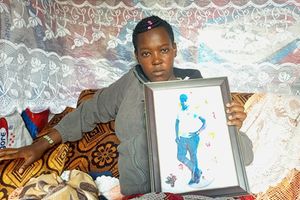
A family from Kolowa in Tiaty has accused the Baringo County Referral Hospital of medical negligence after their son died while receiving treatment at the facility.
According to the relatives, Joseph Lotuk, who was a student at Tiaty School, complained of persistent stomach pain while at school on June 1 and was taken to a local facility for treatment.
However, the condition of the 18-year-old worsened after a few hours and his stomach began to swell. He was then taken to Kolowa Health Center where he was diagnosed with intestinal obstruction, a condition in which digested material is prevented from passing normally through the bowel.
The following morning, he was referred to Baringo County Referral Hospital in Kabarnet, located hundreds of kilometers away, for specialised treatment.
Lotuk’s brother, Daniel Tepangura, said it rained heavily that day, making the roads impassable and forcing the student to spend the night at the health center.
Mr Tepangura said they arrived at the hospital at 2 pm, but health workers insisted that the patient must first be enrolled under the Social Health Authority (SHA) before being attended to, a process that took more than two hours as the boy writhed in pain at the casualty area.
After a clinical officer reviewed his condition, they were directed to a private hospital in Kabarnet town for an X-ray as the referral hospital’s imaging equipment was not functional.
“Despite his deteriorating condition, we were not given an ambulance and had to use a boda boda to get the X-ray done. The results confirmed an acute intestinal obstruction. The clinical officer handed the results to a medical officer who informed a consultant that the case was an emergency requiring immediate intervention,” said Mr Tepangura.
However, the consultant requested a CT scan despite the X-ray findings. The patient was kept at the casualty unit overnight, complaining of difficulty in breathing and worsening abdominal swelling. Tepangura said the patient was not even put on oxygen.
The student’s sister, Mercy Achong’olima, said when they returned from the private facility, there were no drugs available at the hospital and she had to buy them at a chemist in town.
“At around 10pm, we were told to take him to another private facility for additional lab tests. When we returned two hours later, his condition had significantly worsened. He couldn’t walk, and we pleaded with the health workers to intervene because his breathing had weakened and his stomach was severely swollen,” she said.
Ms Achong’olima added that despite the urgent situation, the staff insisted on conducting a CT scan the following morning before any surgery could be done.
“The CT scan machine at the hospital was not working either. Even after pleading for immediate surgery, he died 14 hours after arriving. This death was preventable,” she said.
Solomon Lochoit, another relative, blamed the hospital for delays and negligence.
“This was clearly an emergency. How long does it take to prepare a patient for surgery? He died in the casualty area, not during referral or surgery. He was taken in circles for 14 hours, yet we brought him all the way from a remote area, hoping to save his life,” he said.
“If he had died en route or on the operating table, we would understand. But to die at the casualty while waiting for surgery is unacceptable,” he added.
Baringo County Referral Hospital Medical Superintendent Dr Gerishon Abakalwa confirmed the student died of intestinal obstruction.
“The boy was referred with clear signs of intestinal obstruction. Treatment was initiated, including conservative management of stopping oral feeding, relaxing the gut via a gastric tube, administering antibiotics and IV fluids, all in preparation for surgery,” said Dr Abakalwa.
He explained that the patient died during the preparation phase and not due to lack of care, although he acknowledged that the hospital’s X-ray and CT scan machines were faulty.
“This was an unfortunate incident. The surgeon had a long list of patients that day, including the deceased. We need to expand our theatre facilities to prevent such delays,” he said.
Dr Abakalwa said that intestinal obstruction is indeed an emergency, but it requires pre-operative procedures. The patient was admitted at 6 pm and died at 4.30 am during conservative management. The student had been scheduled for surgery, he added.
He also reiterated that SHA enrollment is mandatory for all patients, which is why the process had to be completed before treatment began.