For thousands of transitioning learners wishing to change the career paths they initially chose for senior school, last week’s release of the Kenya Junior School Education Assessment (KJSEA) results was pivotal.
The results give students an opportunity to reconsider and realign their academic paths, underscoring a key success of competency-based education (CBE), where choices are guided by demonstrated aptitude rather than aspiration alone.
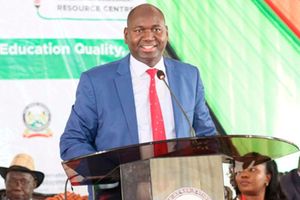
Education Cabinet Secretary Julius Migos at the media briefing during the release of the 2025 Kenya Junior Schools Education Assessment results at Mitihani House.
Photo credit: Francis Nderitu | Nation
Education Cabinet Secretary Julius Ogamba said a two-week window will be opened for revising candidates’ career pathways “in case they feel they have been placed in the wrong pathway or school and wish to transfer or change.”
The CS further revealed that a team had been established to address potential challenges in placing learners into schools and career pathways. Basic Education Principal Secretary Julius Bitok said candidates would be allowed to revise their chosen pathways.
“The revision window accommodates changing preferences and consultations with parents and relatives. Similar to how the Kenya Universities and Colleges Central Placement Service allows students to adjust their choices, we will give learners the opportunity to revise theirs based on the released results,” said Prof Bitok.
He added that, by Christmas, every learner will know the senior school they will join. The 1.1 million Grade Nine candidates will have reported to school by January 12, 2026.
Jayden Nderitu of Nyali School, who had initially selected the highly popular Science, Technology, Engineering, and Mathematics (STEM) pathway, is among hundreds of candidates who are revising their career pathways.
“Initially, I had chosen STEM because of the vast career opportunities... being an engineer, a doctor, a scientist, among others,” Jayden explained.
Cynthia Muthoni Kimani (left) and Jayden Nderitu of Nyali School in Mombasa together with the Deputy Head Teacher Omar Babu, celebrate their performance after the release of the Kenya Junior School Assessment results on December 12, 2025.
Photo credit: Kevin Odit | Nation Media Group
However, the KJSEA results proved to be a moment of clarity.
“I am a debater, I am good at public speaking, and after the results, I realised I excelled in other subjects. Now I want to pursue law,” said the 13-year-old learner.
Having consulted with his parents and teachers, Jayden is now confidently pivoting to the Social Sciences pathway. He emphasised the importance of self-reflection.
"I have done a little soul-searching after the results, so I want to change my selection,” he said.
Jayden, who selected schools like Nairobi School and Mang’u High School (both offering all three pathways), maintained that, while parental influence is natural, especially when parents are professionals in STEM fields, coercion is harmful.
“I would like to tell parents that it’s your child’s choice, you can only be supportive,” added the Nyali School president.
Jayden’s mother, Ms Anne Kerigo, supports his review.
“The competency-based education is good. It has a lot of experimentation, unlike 8-4-4, which was more of cramming. CBE has helped our learners understand what they want,” she said.
Mr Daniel Omollo, an accountant, expressed dismay that his daughter had opted to follow his profession, despite his subtle attempts to steer her toward a less time-consuming and potentially more lucrative career.
"I wanted her to be free and independent to choose another career pathway and not what I am doing... I know the field I am in, Artificial Intelligence, is catching up with the world. But she is insisting she wants to pursue my career. More so, she is very good at mathematics,” he revealed.
Mr Omollo, who works in Malindi while his daughter attends school in Kisumu, acknowledged that the distance meant teachers were initially more involved in the pathway selection than he was. He now values the second chance for revision provided by the Ministry of Education.
"I want to thank the government for this chance. Parents will now sit down with the candidates and discuss their career pathways,” he said, adding that he will involve other professionals to counsel her. On her part, Mr Omollo’s daughter, Phoebe Shanize, who attended Joel Omino Primary and Junior School, said she hopes to follow in her father’s footsteps. The 13-year-old has chosen Moi Girls High School.
“My career interest is in medicine. I will not revise my choice because my parents are not influencing me; I have always wanted to be a doctor,” said Valery, a pupil at St Paul’s Ejinja Primary School in Kakamega.
Her father, Mr Alvin Amakobe, a teacher, said he does not want to interfere with Valery’s career interests, as she has always aspired to be a doctor. He stressed that learners should not be misguided or pressured, noting that some qualify for multiple pathways but have a passion for only one.
“Mine is to support and pray for her. I am glad she attained good points to pursue her chosen course, so I will leave it to her to decide her specialisation. Some parents influence the choice because of competition with their peers,” said Mr Amakobe, deputy head teacher at Miritini World Bank Primary School.
He added that teachers should guide learners based on their abilities, but the final choice rests with the child.
Precious Njeri Wainaina of Hill School Primary in Eldoret City who scored 67 points in the Kenya Junior School Education Assessment. She aspires to be a neurosurgeon.
Photo credit: Jared Nyataya | Nation Media Group
“You can advise a learner, but you cannot decide for them. We are not allowed to make that choice. Some learners excel both academically and in sports, so we guide them to balance the two,” he said.
Private institutions are actively supporting the review process. Mr George Gitonga, Director of Fairfield Academy, emphasised the importance of the revision window.
“Some candidates performed exceptionally well in STEM but had initially chosen Social Sciences. We will meet parents, guardians, and candidates—both physically and online—to either review or confirm their selections,” said Mr Gitonga, an education expert.
He added that stakeholders have learned much from this first cohort, which recorded high performance, including one student who achieved 72 points.
Michelle Cherop, 14, who chose STEM, said: “I am sticking with this pathway because I want to be a doctor. But it is good that we have a chance to revise after the results. Candidates who perform well and initially chose another pathway can now change their minds, based on interest and performance. I want to join Alliance Girls.”
Mr Gitonga also called for urgent investment in facilities and specialised teachers for Junior School to ensure a seamless transition for the next cohort. The opportunity to review pathways is proving crucial in ensuring that the transition to senior school is guided by aptitude, interest, and results, rather than external pressure or premature decisions.