When Moses Kiprono, 31, graduated from the Eldoret National Polytechnic with a Diploma in Electrical Engineering in 2017, he, like many young graduates, had hoped to land a good job.
However, the reality on the ground was different, as he embarked on tarmacking for a job without success.
After ‘idling’ in his village for a while, he decided to join his father Joseph Chesire, who was rearing tortoises at a sanctuary on their farm.
It is while assisting his father at the tortoise sanctuary that he landed his venture of rearing the monitor lizards.
Baringo family turns monitor lizard and tortoise rearing
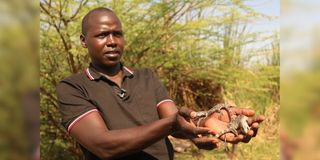
Nation.Africa caught up with Kiprono and his father on World Wildlife Day celebrations at Lake Bogoria in Baringo South on Monday, where they were among exhibitors at the event presided over by Tourism Cabinet Secretary Rebecca Miano.
Locals thronged the exhibition tent and marveled at how people could keep such wild animals to earn a living.
Kiprono’s venture has grown steadily, and his clients are mostly foreign nationals from Asia, Thailand, Hong Kong and China who purchase them at between Sh1,500 to Sh2,500 each, depending on the size.
“Most of our clients come from reptile-eating countries, and they purchase them for food and as pets,” he told Nation.Africa.
His father had maintained the tortoise sanctuary as a way of conserving the creatures and attracting tourists who flocked to their home in Mogotio, Baringo County, located along the Equator line, a main attraction in the area.
He said his father developed an interest in putting up a sanctuary for the tortoises after he discovered that they were facing extinction due to human activity and predators in the wild.
It is while assisting his father at their Equator Tortoise Sanctuary that he discovered and appreciated the importance of wildlife conservation, as tourists, both local and international, trooped it and paid to watch the animals.
In 2021, he discovered that locals in the semi-arid who mostly practiced livestock keeping were killing monitor lizards because they attacked and killed goats. The creatures also preyed on chickens.
Moses Kiprono from Baringo displays a monitor lizard at an exhibition during the World Wildlife Day in Lake Bogoria on March 3, 2025.
Photo credit: Florah Koech | Nation Media Group
To mitigate the human- wildlife conflict, he decided to start rearing the reptiles at his farm to conserve them. He went ahead and applied for a permit from relevant authorities.
With the help of his father and his younger brother, he allocated approximately half an acre of land, partitioning two plots for the monitor lizards and secured a permit from the Kenya Wildlife Service (KWS) and the National Museums of Kenya (NMK), respectively, who also helped him identify the type of species he could rear.
“In 2022, I secured an operating licence from KWS, who collaborated with NMK to help us identify the kind of species we should rear and advised us to conserve the Savannah monitor lizard,” he told Nation.Africa.
Initially, KWS allowed him to rear a maximum of 10 monitor lizards, and he complied. He began by catching them manually in the bush.
When they started the venture, his community members were skeptical and wondered why they chose to rear such reptiles. Most suspected the family to be witches, he told Nation.Africa.
With time, however, they embraced his venture and his father’s after appreciating that they were doing it to conserve wildlife and also as an economic venture targeting tourists who visit the sanctuary.
“When we started keeping the reptiles, locals wondered what we were up to, and some even mistook us for being witches, but with time, they have embraced our venture,” he said.
In the two partitions, he separated the bigger lizards from the smaller ones. He also has an incubator where he breeds the eggs.
Monitor lizards at an exhibition during the World Wildlife Day in Lake Bogoria on March 3, 2025.
Photo credit: Florah Koech | Nation Media Group
“We have constructed a cage for them to wade them off from escaping,” he said.
In a week, he spends more than Sh3,000 on feeding the reptiles that feed on eggs, meat, and blood.
“We get the feed from farmers who keep broilers. We feed the reptiles only twice a week,” explained the lizard entrepreneur and conservationist.
At the moment, he has more than ten adult reptiles, eight of them female and two males, specifically for breeding, and close to 100 hatchlings.
“The reptiles are so friendly and not poisonous when they accidentally bite you, and some people have trained and domesticated them and turned them into pets,” he said.
“Let us embrace wildlife conservation for future generations, because if we don’t, they will be extinct as people kill them and even destroy their eggs when they come into contact. We should conserve them for posterity,” he said.
The unique tourism by Kiprono and his father caught the eye of Kenya Wildlife Services Director General Erastus Kanga who lauded them for embracing conservation and earning a living from it.
“We want to encourage Kenyans to support the community conservancy movement, particularly here in Baringo. We have to do what is normally called pesa mashinani, pesa mfukoni ,” he said.
Moses Kiprono from Baringo displays a monitor lizard at an exhibition during the World Wildlife Day in Lake Bogoria on March 3, 2025.
Photo credit: Florah Koech | Nation Media Group
“This country is natural resource dependent and in the exhibitions, you saw the tortoise and monitor lizard farming business, and the youth was proudly saying he can't sleep hungry courtesy of the venture, as people go for them as pets,” said Prof Kanga.
He said ecotourism projects exemplify how conservation can generate economic benefits while protecting biodiversity.
“Investing in community-led ecotourism initiatives creates sustainable livelihoods while preserving wildlife habitats,” he said, noting that youth and women are key drivers of conservation efforts.
“Their inclusion ensures that our initiatives are inclusive, sustainable, and impactful,” he said, noting that partners like the Wildlife Clubs of Kenya engage young people in conservation activities, while women-led bee-keeping cooperatives provide sustainable livelihoods and promote biodiversity conservation.
“These initiatives not only empower communities but also foster a sense of ownership and responsibility toward our natural resources,” said Prof Kanga.