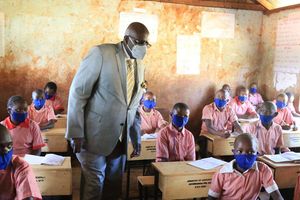
At 10, Loremoi Kamama had already learnt that a classroom could mean more than books and lessons because in Napukut, a remote village in Tiaty East, Baringo County, it meant food.
Raised in a polygamous family of 12 children, Kamama, now 20, remembers a childhood marked by hunger and deprivation.
While boys his age trekked deep into the bush to herd livestock, his mother sent him to the local Early Childhood Development Education (ECDE) centre, where the school feeding programme offered a meal, and education came second.
“I am the last-born in a family of 12 and was raised in a polygamous family. At the time, getting even basic necessities, including clothing and food, was a challenge,” he told the Daily Nation.
“To cushion me from starvation, my mother decided that instead of going to herd livestock with my peers further afield on an empty stomach, I should go to Napukut ECDE centre. It was not basically to get an education, but at least to get a single meal from the school feeding programme,” he said.
For two years, the classroom offered him refuge.
Then came Grade One, and with it, a journey that would bring his education to an abrupt end.
Napukut had an ECDE centre but no primary school. The nearest option, Nasorot Primary School, was more than 10 kilometres away, leaving Kamama with no choice but to walk.
Every morning, he set off across rough terrain under the scorching sun, making the long trek to school and back.
There was no transport and, unlike at the ECDE centre, there was no school feeding programme to draw him back when hunger set in. He lasted only a month.
“I was forced to trek every day to the neighbouring Nasorot Primary School, approximately 10 kilometres away. You can imagine enduring the scorching sun in this area, with very poor terrain, walking a long distance on an empty stomach,” he said.
The journey became too much, and school stopped making sense to him.
He dropped out and returned to what children in the area were expected to do: herding his father’s livestock.
Kamama’s story offers a glimpse into a wider education crisis unfolding across the vast, arid Tiaty region, where children enter ECDE centres in relatively large numbers but steadily disappear as they move up the education ladder.
The journey from one level to the next is becoming increasingly difficult in the region for various reasons.
For some children, the next school can be many kilometres away. Some schools do not offer all the grades. For others, hunger, drought, pastoralism, poverty and cultural practices eventually pull them out.
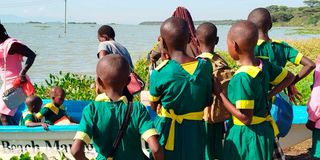
Learners at Loruk Primary School, on the border of Baringo North and Tiaty East waiting to board a boat on May 7,2026.
Photo credit: Florah Koech | Nation Media Group
Girls face the additional threat of early marriage and female genital mutilation (FGM), which often mark the end of their education. Boys, meanwhile, are frequently withdrawn from school when they become old enough to herd livestock.
The result is an education ladder with missing rungs, where classrooms that start with dozens of young learners grow progressively emptier as children advance through the grades.
At Dunyasas Primary School, the numbers tell the story. The ECDE centre has 68 learners this year. By Grade One, the number has fallen to 20.
It drops further to 16 in Grade Two, nine in Grade Three and six in Grade Four. Grade Five has 12 learners, while Grade Six has none this year.
Head teacher Mathew Chesire attributes the decline to the pastoralist lifestyle, parental illiteracy, retrogressive cultural practices and the long distances children have to cover to reach school.
But he says the high ECDE enrolment can also be deceptive because some children are drawn to school primarily by food.
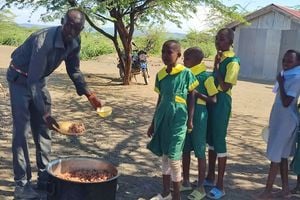
“There are many ECDE learners in school now because of drought, such that the learners come to school at least to benefit from the school feeding programme. Sometimes you find that the learners bring along their younger siblings, some as young as one year, to also get food. That is why the number is high,” Mr Chesire said.
For some families, the feeding programme is not simply an incentive to attend school. It is a lifeline.
Baringo’s school feeding programme covers Tiaty and other arid areas, with the national programme designed to support attendance and retention in food-insecure regions.
But once children grow old enough to herd, priorities can change.
“Most of the children come to school at an early age, but when they reach an age where they can herd, they are pulled out of school for the chore,” Mr Chesire said.
A spot check by the Daily Nation found primary schools in parts of Tiaty East, Tiaty West and Kolowa sub-counties scattered far apart, leaving children to walk long distances across rugged terrain.
Some schools established decades ago have also struggled to expand beyond the lower primary grades because of teacher shortages, inadequate feeding programmes and frequent disruption caused by drought.
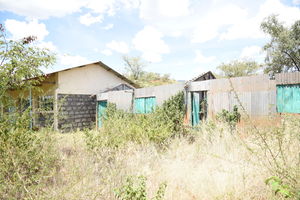
At Nasorot Primary School, permanent structures stand largely underused. The school has facilities that can accommodate eight classes, yet fewer than 20 ECDE learners are currently enrolled and are taught by a volunteer.
Learners at Loruk Primary School in Baringo North boarding a boat at the submerged Loruk- Chemolingot road on May 8,2025.
Photo credit: Florah Koech | Nation Media Group
Tiaty East ECDE coordinator Osman Katikit says the lack of schools along the education pathway is one of the biggest obstacles to transition.
“Grade One children are forced to walk more than 15 kilometres to Nasorot Primary School, which is far. This has forced most of the children to drop out when they transition to the next class,” Mr Katikit said.
The problem continues further up the education ladder. Nasorot Primary School only goes up to Grade Four, after which learners are expected to proceed to Akwichatis, more than 15 kilometres away.
“How can a child be able to walk more than 20 kilometres every day? They resort to dropping out. That is why the transition of learners here is still a major challenge,” Mr Katikit said.
Tiaty East Deputy County Commissioner Samuel Gichohi said prolonged dry spells force pastoralist families to move in search of water and pasture, often taking their school-going children with them.
“During drought, there are very few children in schools in this region because most of them migrate with their parents, who go in search of pasture and water for their livestock,” Mr Gichohi said.
Some children, he said, never return to school after such migrations. Girls may be married off, while boys are absorbed into livestock herding.
Mr Gichohi also pointed to the attitude of some parents who, because of limited education, do not see the long-term value of schooling.
“There is also a misconception in this area that when they take their children to school, their livestock will decline because they will be forced to sell them to cater for their education,” he said.
The government, he added, was using public barazas to persuade parents to embrace education.
Cultural ceremonies such as FGM and boys’ circumcision can also disrupt learning, particularly when they take place during the school term.
“Most of the children in this region are normally out of school, especially when there are cultural ceremonies, including the female cut and circumcision. These ceremonies are normally held when there are good harvests, mostly during the second term.
“During such periods, it is hard to get children in school because they attend them. Those who undergo FGM do not come back to school either because they are married off,” Mr Losutan said.
County Director of Education Kipruto Kosgei similarly attributed poor transition to a combination of cultural and socio-economic challenges, including early marriage, FGM, circumcision, poverty, parental attitudes and teacher shortages.
“Cultural issues have compounded the challenges of learner transition in Tiaty, ranging from FGM and circumcision, where learners cannot go back to school after going through them. Teacher shortages have also contributed to the problem,” Dr Kosgei said.
He said the education department was trying to bridge the gap by sensitising parents and children, particularly in far-flung areas, on the importance of schooling.
“We are also using stakeholders, including chiefs, political and religious leaders during their public barazas, and non-state actors advocating against FGM and other social ills that are harmful to education,” he added.