You risk being jailed for 10 years and fined up to Sh5 million if you are found smoking shisha in the country, if the Alcoholic Drinks and Drugs Control Laws (Amendment) Bill, 2026 is enacted.
This comes as the popular local brew, chang’aa, gets new packaging requirements before it can be sold for consumption, in a move aimed at complying with the Public Health Act.
The Bill, sponsored by National Assembly Majority Leader Kimani Ichung’wah, seeks to amend the Tobacco Control Act by making the manufacture, sale or promotion of shisha illegal.
“A person who contravenes subsection 1 or 2 commits an offence and shall upon conviction be liable to a fine not exceeding five million shillings or to imprisonment for a term not exceeding ten years or both,” reads the Bill.
“A person shall not allow, promote, facilitate or encourage or do anything to allow, promote, facilitate or encourage the smoking of shisha or the use of nicotine pouches in Kenya,” further reads the Bill.
Introduced for first reading on Thursday, the Bill defines shisha as any tobacco product that may be flavoured or non-flavoured and may contain molasses, honey, vegetable glycerol or any other natural or artificial flavour.
While the proposed law does not outlaw the production of chang’aa, it sets stringent conditions for its manufacture, packaging and distribution.
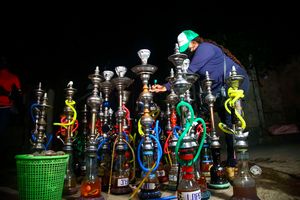
Shisha smoking equipment seized during Nacada raids on residential homes in Nyali, Mombasa on January 14, 2024.
Photo credit: Wachira Mwangi | Nation Media Group
Clause 25 of the Bill, which amends Section 31 of the current Alcoholic Drinks Control Act, provides that chang’aa will now be packaged in a glass bottle sealed with a non-refillable cap.
Under the new rules, the glass bottle containing chang’aa will have a label bearing a unique security feature of the manufacturer to help determine the authenticity of the alcoholic drink.
Currently, the law provides that chang’aa or any other distilled alcoholic drink shall only be manufactured, packed, sold or distributed in glass or polyethylene terephthalate bottles or metallic containers.
As MPs prepare to consider the Bill, the Alcoholic Beverages Association of Kenya (ABAK) has called for its withdrawal, warning that thousands of jobs will be lost if it is implemented in its current form.
The association warned that, if enacted, the Bill would drive consumers towards unsafe illicit alcohol.
Assistant Chief pour illicit brew during a raid on Chang’aa dens in Nairobi.
It noted that while it supports the fight against illicit brews, measures taken to curb the vice must be proportionate, evidence-based and developed through meaningful consultation with county governments, legitimate businesses, public health stakeholders and other affected parties.
“The proposed Bill will disproportionately increase compliance burdens for legitimate alcohol manufacturers while potentially enabling more illicit alcohol players to thrive,” the association said in a statement.
According to the National Authority for the Campaign against Alcohol and Drug Abuse (Nacada), shisha smoke contains high levels of chemicals and poisons, including carbon monoxide and tar.
Several of these chemicals are known to cause mouth and lung cancers, heart disease, respiratory diseases and other illnesses.
If implemented, Kenya will become the fourth country in East Africa to prohibit shisha, after Uganda, Tanzania and Rwanda.
The Bill also introduces a digital tracking system for all types of alcohol manufactured or imported into the country, in a move aimed at ending the sale of killer brews.
“A manufacturer, importer or exporter, distributor, retailer or supplier of any alcoholic drink shall comply with the requirements of the track and trace system as prescribed in the regulations,” reads the Bill.
Shisha bongs confiscated during a crackdown by the National Campaign Against Alcohol and Drug Abuse in Kilimani, Nairobi.
Photo credit: Wilfred Nyangaresi I Nation Media Group
Mr Ichung’wah said the tracking system would enable authorities to trace the origin of killer brews.
“The digital track and trace system will help us so that when a drink kills people, details such as date of manufacture and the origin can be traced,” Mr Ichung’wah said.
Under the new Bill, a person who smokes in a prohibited area would, upon conviction, be liable to a fine not exceeding Sh100,000 or imprisonment for a term not exceeding 12 months, or both.
Currently, smoking in a prohibited area attracts a fine of Sh50,000 and imprisonment for six months, or both.
The prohibited areas include offices and workplaces, such as corridors, lounges, eating areas, reception areas, lifts, escalators, foyers, stairwells, toilets and laundries. They also include court buildings, factories, cinema halls, theatres, health institutions, children’s homes, places of worship, prisons, police stations and cells.
Other prohibited areas include public service vehicles, aircraft, passenger ships, commuter boats, trains, educational facilities, ferries, railway stations, airports, airfields, ports and other public transport terminals.
The current Act also lists markets, shopping malls, retail and wholesale establishments, stadia, and sports and recreational facilities.
The Bill has also doubled the fine and jail term for those found selling cigarettes in packages containing fewer than 10 units, raising the fine from Sh50,000 to Sh100,000 and the jail term from six months to one year.
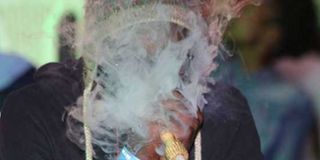
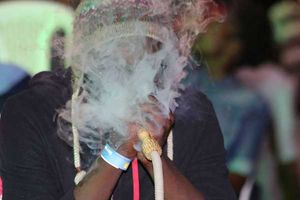
A reveller smokes shisha at a bar.
Photo credit: File | Nation Media Group
Section 18(3) of the current Tobacco Control Act provides that no person should sell cigarettes in single units or in packs of one or two, but that a package should contain at least 10 cigarettes, or such other minimum number of cigarettes, not being less than 10, as may be prescribed.
“No person shall sell a tobacco product other than cigarettes that is prescribed for this subsection, except in a package that contains at least ten units of the product or such other minimum number or units of the product not being less than ten as may be prescribed,” reads the Bill.
Subsection 3 of the current law provides for a fine of Sh50,000 or imprisonment for a term not exceeding six months, or both, for a retailer who contravenes the provision.
However, under the proposed amendment, both the fine and jail term have been doubled.
“Section 18 of the Tobacco Control Act is amended by deleting subsection (3) and substituting thereof the following new subsection. A person who contravened this subsection commits an offence and is liable upon conviction to a fine not exceeding one hundred thousand shillings or to imprisonment for term not exceeding twelve months,” reads the proposed amendment.
The Bill also doubled the fine for those found guilty of falsely promoting tobacco or any tobacco product, raising it from the current Sh500,000 to Sh1 million. However, it retained the three-year jail term.
Section 26 of the current Tobacco Control Act bars the promotion of tobacco or a tobacco product through deception or misleading information likely to create an erroneous impression about the characteristics, health effects, health hazards or social effects of tobacco or its emissions.
Following its introduction for first reading, Parliament will now conduct public participation on the Bill in line with Article 118 of the Constitution before it is debated by the House and any subsequent amendments are considered.