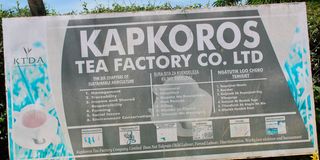
The Kenya Tea Development Agency (KTDA) has initiated a process to grant autonomy to several satellite tea factories in the South Rift region. This move follows shareholder resolutions for total separation at Kapkoros Plc in Bomet County, and Litein and Tegat factories in Kericho County.
KTDA has advertised for consultancy services to handle the valuation and allocation of assets and liabilities involved in the separation of the smallholder tea factories in Bomet and Kericho counties. The application deadline is July 22, 2025.
“KTDA Management Services Limited intends to onboard a qualified consultant to undertake valuation and allocation of assets and liabilities in the separation of smallholder tea factories in Region 5 (Kericho and Bomet). This is to enable their subsidiaries to operate as fully independent entities,” reads a statement in KTDA’s advertisement.
In Bomet County, Motigo, Olenguruone and Tirgaga factories have requested full separation. In Kericho County, Chelal and Toror factories have voted to operate independently from their parent firms. The decision carries both financial and administrative implications.
KTDA currently manages 71 factories across Kenya's tea-growing region, which are registered as 54 units, with 17 operating under parent factories. The factories pushing for separation fall within KTDA’s West of Rift zone classification, covering Bomet, Kericho, Narok, Nandi, Nakuru, Nyamira and Kisii counties.
Across the country, KTDA-managed factories serve approximately 680,000 smallholder tea growers in 21 counties.
Tea collection truck delivering green leaves to Mogogosiek tea factory in Bomet county in this photo taken on July 31, 2024
Photo credit: Vitalis Kimutai | Nation Media Group
Kapkoros shareholders voted for separation on January 9, 2025, following a resolution passed during their Annual General Meeting (AGM) on December 12, 2024. A special AGM held on May 2, 2025, formally confirmed the decision, following a directive issued by Agriculture Cabinet Secretary Mutahi Kagwe on April 8, 2025.
Kapkoros Plc Chairman Robert Rono Kipng'eno said KTDA, being an ISO-certified firm, will adhere to all operational, financial, and management standards.
“We are confident that the separation will be handled professionally, in line with International Accounting Standards (IAS) and International Financial Reporting Standards (IFRS), as governed by the Institute of Certified Public Accountants of Kenya (ICPAK),” Mr Kipng’eno said on Monday.
He added that a seven-member committee had been formed to delineate factory boundaries and compile a list of Kapkoros Plc’s assets and liabilities.
Mr Kipng’eno emphasised the agency’s focus on enhancing tea quality—from farm to factory—to help farmers secure better market prices.
“Plucking two leaves and a bud is key to producing high-quality tea that fetches premium prices. We are headed in the right direction with the support of small-scale tea growers,” he noted.
Tea pluckers harvest tea at a farm in Kiptagich in Kuresoi-South on May 7, 2025.
Photo credit: Boniface Mwangi | Nation Media Group
Director of Olenguruone Tea Factory David Korir said the separation, voted for by farmers, will increase healthy competition and drive up quality production.
“Each factory will now strive to produce superior tea to attract premium prices. As board members, we are committed to ensuring that farmers profit from their investments,” said Mr Korir.
Ms Lorna Koech, a director at Chelal Tea Factory in Bureti Constituency, Kericho County, said the separation was long overdue.
“As separate companies, we sell our teas independently, but Chelal still issues bonuses jointly with Litein, even though monthly payments are made separately. This has caused confusion and dissatisfaction among shareholders,” she explained.
Tea prices at the Mombasa auction and international markets are determined primarily by quality, with tea tasting playing a central role in product grading.
Hot masala tea poured into glass mug
Photo credit: Shutterstock
Traditional markets for Kenya’s black Cut, Tear and Curl (CTC) tea include the United Kingdom, Sudan, Poland, Kazakhstan, and Egypt.
Emerging markets for Kenyan tea, especially the highly demanded Orthodox tea, include Russia, Japan, China, Nigeria, India, Korea, Switzerland, South Africa, Germany, Iran, France, Australia, and several countries in the Middle East and Eastern Europe.