At the heart of Nakuru City, Governor Susan Kihika's administration has installed solar-powered street lights along major streets to improve security.
In the past months, the Nakuru County Government has been solarising street lights in Nakuru City and other towns, in a bid to cut down electricity costs.
The devolved unit has also installed solar in some of its offices as well as boreholes across the region.
"We are tapping into solar energy to cut down on electricity costs. The solarisation of street lights, boreholes and other projects aimed at tackling high electricity expenses," revealed Governor Kihika.
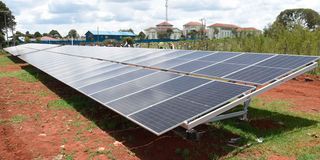
Solar panels mounted on a commercial building building in Nakuru City.
Photo credit: Boniface Mwangi | Nation Media Group
Governor Kihika's administration now joins the long list of county governments, higher learning Institutions, businesses and even State entities that are turning to solar energy to cut costs and reduce reliance on the national grid.
In a move that could deny Kenya Power billions of shillings, various counties and institutions across the country have turned to solar energy to tame expenditure on "costly" electricity bills, which have been eating into the budgets of the entities.
Records show some county governments have been spending between Sh80 million and Sh100 million a month.
A recent report by Auditor General Nancy Gathungu for the year ending June 2025, for instance, revealed that county governments owe Kenya Power Sh5.67billion in unpaid electricity bills.
The debt represents nearly 15 percent of the utility company's total outstanding bills, which stood at Sh39.03 billion as of June 30, 2025.
Stung by ever rising debts of electricity bills, several county governments have kicked off plans to embrace solar power to reduce electricity costs.
Several Governors have started installing solar panels in key establishments, including county buildings, water projects and on street lighting projects to save their budgets from "costly" electricity bills.
This means Kenya Power would soon be denied the billions it has been raking in from the devolved units as payments for electricity bills.
Nairobi City County, for instance, is leading the pack and plans to save at least Sh80 million a month and Sh1 billion annually by using solar energy in county buildings and street lighting.
"Nairobi County is putting up measures for harnessing solar power in more than 80per percent of its facilities and establishments. The implementation of solar energy in county buildings and street lighting will save the county government at least Sh80 million per month," revealed Governor Johnson Sakaja.
While appearing before the Dr Oburu Oginga-led Senate Standing Committee on Energy recently, Governor Sakaja revealed plans to embrace solar power as a strategy to cut the electricity bill from Sh100 million monthly.
But Nairobi is not alone; several other counties are seeking to tame "costly" electricity bills that have been adding to the ever-rising pending bills.
In Bomet, the solarisation of water projects is ongoing in a bid to cut down on high electricity costs that have led to perennial disconnection over pending bills running into tens of millions of shillings.
Solar panels mounted on the roof of a commercial building.
Photo credit: Francis Nderitu | Nation Media Group
In Murang'a, Governor Irungu Kang'ata says he will install solar panels in key installations to cut huge power bills.
The county has already started the installation of solar pumps in boreholes, Early Childhood Development Education centres and street lighting projects.
Governor Kang'ata said more solar connections have been planned, as a strategy to tame "costly" electricity and inject more resources into development programmes that impact the community.
"Installation of solar energy will save the county government huge power bills and allow my administration to inject more resources into the development projects," said Governor Kang'ata.
Samburu County is also using solar energy to reduce its power bills, with the aim of saving Sh4 million annually.
Governor Lati Lelelit plans to lower the county’s Sh50 million electricity costs and reinvest savings into solar projects like street lighting. Solar power is already being used in Achers Post and Maralal towns.
Turning to use of solar power
Kiambu County Government has also turned to solar lighting systems, after revelations that it has been spending Sh1.7 billion annually on electricity bills for street lights.
Governor Kimani Wamatangi said the county gets a monthly electricity bill of Sh142 million for street lighting, and it could soon get to Sh200 million a month due to rising power tariffs.
He said if they fail to introduce a solar lighting system, electricity bills will take up most of the county’s budget.
Nyeri County, which has been spending Sh120 million in electricity bills for streetlights every year, has also turned to solar power.
Other counties that are turning to the use of solar power include: Nyandarua, Bomet, Uasin Gishu, Mombasa, Machakos, Kisumu, Homa Bay, Migori, Vihiga, Kajiado, Narok, and Kericho, among others.
Solar panels at Moi University in Kesses, Uasin Gishu County.
Photo credit: Jared Nyataya | Nation Media Group
Moi University, in Uasin Gishu County, has, for instance, embraced solar, to cut down on its operational costs.
The institution is collaborating with the RheinMain University of Applied Sciences in Germany to invest in solar energy.
Nakuru-based Kabarak University and its sister institutions, owned by the family of Former President Daniel arap Moi, are the latest to adopt the use of solar power.
Kabarak University management revealed plans of transitioning off-grid, alongside its sister institutions, Moi High School Kabarak and Moi Primary School Kabarak.
The institutions have already embarked on the installation of solar power, bringing to an end many years of reliance on Kenya Power.
"Kabarak University and its sister institutions will transition off grid, guided by biblical principles, by switching off Kenya Power and adopting natural solar energy, "revealed Kabarak University Chancellor and Kanu chairman Gideon Moi a few months ago.
"This is a historic milestone for our institutions and a bold step towards a sustainable future. The first phase of the transition will be commissioned in 2026, providing reliable, clean power to support uninterrupted learning and advanced research. This reinforces our ambition to lead in sustainable education in Africa, pioneering initiatives of this kind in Sub-Saharan Africa, by reducing our carbon footprint and contributing to the Sustainable Development Goals," added Mr Moi.
The institutions' move to embrace solar power and ditch Kenya Power is now set to deny the State-owned firm millions of shillings that it has been receiving as electricity bills.
Apart from embracing the use of clean energy, the institution says the move is projected to save about Sh500 million annually. Mr Moi said providing clean energy for education is part of advancing practical approaches to innovative and smart renewable investments.
Kabarak University was later established in 2000 by its founding chancellor, the late President Daniel Moi.
Solar panels mounted on a building adjacent to Kenya Power offices in Nakuru City on May 3, 2026.
Photo credit: Boniface Mwangi | Nation Media Group
The Institution was granted a Letter of Interim in October 2000 and later opened its doors for its first batch of students in 2002.
On May 16, 2008, the University was awarded the Charter by the third President of Kenya, Mwai Kibaki, making it a fully-fledged accredited University.
In July 2020, the university installed Kanu chairman Gideon Moi as its 2nd Chancellor after the death of his father.
Kabarak University is the latest private higher learning institution to adopt the use of solar energy. Strathmore University has also fully embraced the use of solar energy.
The university has installed a large-scale solar power system that not only meets its own energy needs but also allows it to sell excess power back to the national grid.
The university has installed a 1MW grid-connected solar power system, composed of 2,400 solar panels.
In January 2026, Cooperative University of Kenya also announced plans to generate 40 megawatts of electricity through a mega solar-powered initiative valued at Sh6.5 billion.
The initiative, according to university chancellor Dr Benard William Chitunga, would help serve the needs of the institution and its neighbourhood.
Under the arrangement, the partner firm Dahai Shandong China would finance, construct, and run the solar power plant for an agreed period before handing it over to the university.
Dr Chitunga revealed that the project would generate a small revenue for the university and reduce its electricity bills.
The project, he said, was aimed at providing electricity to the national grid, while demonstrating an operationally innovative financing model.
"The solar power project will be commissioned later in the year. The power from the project will help reduce electric costs for the university and pump more megawatts to the national grid," stated Mr Chitunga.