Until January, the Solio Ranch Settlement Farmers Cooperative Society (SRSFCS) in Laikipia County was in a dilemma about how to address the persistent high cost of electricity, which was systematically crippling the society’s operations.
Milk collection from members was also on the decline due to low milk production attributed to unpredictable weather patterns.
Apart from the unpredictable, persistent blackouts, the electricity bills had become a headache for the society’s management.
“We were buying tokens worth over Sh30,000, yet we had scaled down the use of electricity. But the worst part was the huge losses incurred during power blackouts; a lot of milk was spoiled; at times, we had to hire power generators to save the situation; it was very costly. It affected the farmers’ payments, making brokers take advantage of the challenges to convince our members to sell milk to them,” says Mr Maina Mungai, the SRSFCS chairperson.
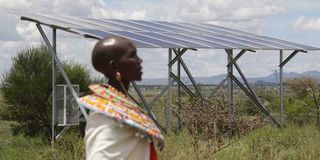
Fortunes are changing for the better after the installation of a modern solar system. This was achieved through the society’s partnership with development partners promoting smart climate farming. These partners include the Dairy Training Institute (DTI), the Distributed Renewable Energy Ecosystem Model (DREEM) Hub, a programme supported by the Charles Stewart Mott Foundation and implemented by the Kenya Climate Innovation Centre (KCIC) and its partners.
Ms Bilha Wangechi, in charge of the society’s milk cooling plant, says the society has drastically reduced the cost of electricity bills and post-harvest losses since the installation of the solar system.
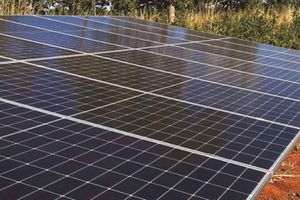
“Since January, we have been spending about Sh1,000 per month on electricity. Through the partnership with DREEM and KCIC, the society installed a digital solar system. It now runs the entire cooling system, including the water heating tank, the cooling tanks, water from the borehole, the office, and all other functions at the society,” says Bilha.
A farmer sets up a solar-powered water pump in his farm
Photo credit: File | Nation Media Group
Motivated by the accrued benefits of renewable energy, the farmers in the dry area are installing the same.
“The climate in Laikipia is suitable for dairy farming, but the weather patterns are unfriendly. I have twelve dairy cows whose milk production is on average 15 kilogrammes per cow. After witnessing how the solar system is operating in our society, I have installed a similar system at home, which I am using to grow pasture and maize for my cows. Encouragingly, the technology will guarantee my livestock sustainable quality feed. DREEM, KCIC, and the DTI are training the farmers on crop and pasture growing for maximum production,” said the farmer.
Mr Michael Kaguta from the Dairy Training Institute says farmers’ and dairy cooperative societies’ milk value addition capacity is hindered by the high cost of electricity.
“The Ministry of Agriculture is keen on value addition, whose full potential cannot be realised without embracing renewable energy by farmers and cooperative societies. With the installation of the solar systems, we have reduced carbon emissions, realised lower use of electricity, drastically reducing the cost of production, effectively increasing the farmers’ earnings,” said Mr Kaguta.
Mr James Gatimu, the DREEM manager, says the Solio Settlement Farmers Cooperative Society was among the societies that benefited from phase one of the renewable energy programme, which covered several counties, including Laikipia, Isiolo, and parts of Eastern Kenya. He says the achievement in phase one was a critical milestone for the DREEM Hub programme, an initiative that aims to transform Kenya’s agricultural sector by replacing costly, unreliable energy sources with affordable, sustainable solar power.
“The new demonstration facility at Solio Society will serve as a living classroom, providing hands-on training and showcasing practical solar technologies designed to boost productivity and income for dairy and horticulture farmers. We are now moving to other counties, including Nyandarua, Nyeri, Nakuru, and Kajiado, and we are already in Mwingi and Makueni counties working with cooperative societies. The Solio Agri-solar Expo is a practical case of solar technologies like milk cooling, irrigation, and processing,” said Mr Gatimu.
He says that climate change and climate variability have negatively affected smallholder farms, effectively increasing the agricultural cost of production while at the same time negatively affecting the costs of agricultural value addition.
“Agricultural value addition is very limited in rural areas, which also contributes to post-harvest losses. The remedy to this is the use of renewable sources of energy readily available in the rural areas, and the sun becomes the most underutilised energy resource,” said the DREEM manager.
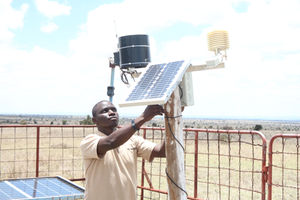
Jonah Kitetu displays the solar panels that pump water for his farm
Photo credit: ISAIAH ESIPISU| NATION MEDIA GROUP
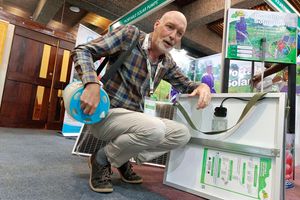
Ms Wangechi Kuria, a senior associate with CLASP, an international body dealing with electric appliances, notes that more than 600 million people in Africa do not have access to electricity, while in Kenya, about 75 per cent of the population has access to electricity, but having access to electricity is not enough, and extra efforts must be made so that the communities can fully utilise and benefit from it.
“Having access to electricity is not enough. We need to see how our people can turn this electricity into something usable. How can they transform that into an income? How can they use it to improve livelihoods? The solar power system we have installed at Solio Ranch Society is meant to show the communities how they can benefit from renewable energy. Here, the solar system is used to operate a milk chilling plant, water heater, and irrigation, which translates into direct incomes and savings on operational costs,” says Wangechi.
She notes that the cost of solar electric appliances is dropping, but there is a need to ensure quality is maintained.
“At CLASP, we are experts in showing how efficient appliances are solutions for some of the energy problems facing the communities in Africa. We work a lot with the government, innovators, cooperative societies, companies, and other stakeholders, doing a lot of research to ensure that the appliances that are available in the market are compliant with international energy standards. We test the equipment to see its energy efficiency and certify it as such so that farmers and other users can confidently embrace renewable energy in the rural areas,” says Wangechi.