Over the past year, several contractors have abandoned sites where they were constructing 11 pre-primary school classrooms, citing debts of Sh6 million that the county government failed to settle.
The affected classrooms are located in Kaplop, Kaburwo, Chesakam, Chemayes, Noswo, Borokwo, Sau, Mwal, Ketukoi and Toplen.
During the same period, Baringo County spent Sh9 million on airtime for its officials, which is a recurring expense that consumes more than half of the devolved unit’s annual budget.
In the Maji Mazuri area of the same county, Sh510,000 was spent on constructing a single pit latrine.
This contrast, revealed in a Controller of Budget report, scratches the surface of spending priorities in most counties, where the development budget struggles to compete with the funds allocated to recurrent expenses such as salaries, allowances and other benefits.
The report also shows that Governor Benjamin Cheboi’s administration spent a further Sh500,000 on two boda-boda shelters at Hilltee and Maji Mazuri, in a county grappling with high poverty and illiteracy rates.
According to the latest County Governments Budget Implementation Review Report for the first nine months of the financial year ending June 30, 2026, Baringo County is one of nine counties that spent less than 20 per cent of their annual budget on development activities during this period.
These counties include Kajiado (nine per cent), Lamu (11 per cent), Siaya and Uasin Gishu (13 per cent), Baringo and Tana River (17 per cent), Nakuru (19 per cent) with Migori and Mombasa counties rounding off the list at 20 per cent.
The report indicates that 43 counties continued the annual trend of spending more than half of their annual budget allocations on salaries, wages and allowances at the expense of development activities.
At the same time, many of these counties are struggling with multiple stalled projects, denying taxpayers value for the billions spent on initiating that infrastructure.
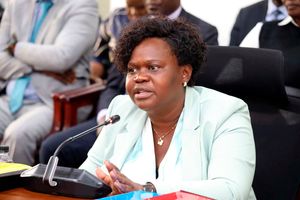
“County governments should prioritise stalled projects that can be completed and operationalised in subsequent budget cycles, allocate adequate resources for completion and resolve outstanding contractual issues in accordance with the law, including through relevant dispute-resolution or oversight agencies where applicable,” said Controller of Budget Margaret Nyakang’o.
Controller of Budget Margaret Nyakango,
Photo credit: File | Nation Media Group
Only Nandi (55 per cent), Meru (54 per cent), Wajir (54 per cent) and Marsabit (51 per cent) spent more than half of their budget on development in the 2025/26 financial year.
Overall, counties spent a Sh72 billion out of Sh234.3 billion annual development budget as of March 31, 2026. In the same period, counties recorded 237 stalled projects with a value of Sh8.55 billion, which now risks going up in smoke.
Interestingly, the counties used Sh259.57 billion (65 per cent of their annual budget) on employee compensation and operations. Salaries and wages alone accounted for Sh171.36 billion.
Nairobi, Meru, Machakos and Marsabit were the biggest recurrent spenders with more than 75 per cent of their total expenditure during the period under review going to recurrent activities.
While Marsabit spent more than half of the funds it earmarked for development, it still spent more than 75 per cent of its overall budget on recurrent activities.
“Development expenditure during the first nine months of FY 2025/26 represented a 31 percent absorption rate against the annual development budget of Sh234.33 billion,” the report reads in part. “Some 19 counties recorded development absorption rates of 25 percent or lower, another 24 recorded rates between 26 and 50 percent, and four recorded rates above 51 percent.”
For instance, Kajiado Governor Joseph Ole Lenku’s administration spent Sh438.4 million on development but used Sh5.3 billion for salaries and operations.
Lamu spent Sh251.5 million on development activities, against Sh1.89 billion on recurrent expenditure. Siaya spent Sh761.7 million on development, against Sh3.76 billion for recurrent expenditure.
Baringo, a county lagging behind in development, spent Sh3.45 billion on recurrent expenditure, against Sh640.4 million for development.
Baringo recorded 24 stalled projects, with pending bills hitting Sh1.19 billion. Among the stalled projects is Kipsaraman Museum and Mogotio Information Centre, which could both be completed if the required Sh47.6 million was released.
The construction of Kabarnet Stadium has stalled due to inadequate appropriation of funds, with only Sh47 million being paid out of the Sh1.16 billion.
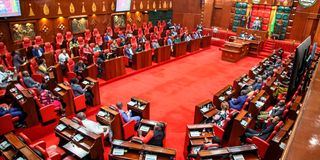
Nairobi County Assembly during deliberations on the county government's Finance Bill, 2026, at City Hall, Nairobi, on June 23, 2026.
Photo credit: Wilfred Nyangaresi | Nation
According to the report, 22 counties reported a total of 237 stalled projects during the period under review with an estimated value of Sh13.66 billion, of which Sh5.11 billion had already been paid.
But the devolved units are still burdened by pending bills amounting to Sh156.84 billion, comprising Sh116.50 billion for recurrent activities and Sh40.34 billion for development activities.
The largest trade payables were reported by Nairobi City (Sh81.79 billion), Kilifi (Sh6.40 billion), Kiambu (Sh5.55 billion), Machakos (Sh5.46 billion), and Turkana (Sh4.81 billion).
Dr Nyakang’o pointed out that counties reported mixed outcomes in budget implementation and service delivery, saying that while progress was observed in implementing development programmes and selected projects, significant challenges persisted, including inadequate financial controls, delayed project implementation, and weak institutional coordination.
She said several county governments did not adhere to their scheduled payment plans for the outstanding debts contrary to the law.
According to Regulation 55(2)(b) of the Public Finance Management (County Governments) Regulations, 2015, county governments are required to prioritise the settlement of all eligible trade payables in the budget as a first charge for the fiscal year 2025/26.