Allocations for mega infrastructure projects like roads and the Standard Gauge Railway (SGR) are part of Sh4.8 trillion budget for the last full financial year under President William Ruto before the 2027 General Election.
Treasury Cabinet Secretary John Mbadi will today deliver a speech on this year’s budget, which the government has argued is modest in new taxes in an attempt to pre-empt public anger with the looming anniversary of Finance Bill 2024 protests later this month.
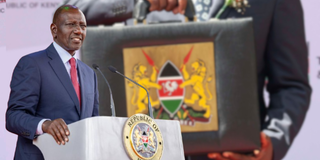
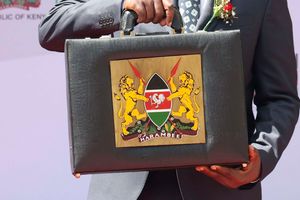
National Treasury Cabinet Secretary John Mbadi displays his briefcase before the reading of the National Budget on June 12, 2025.
Photo credit: Sila Kiplagat | Nation Media Group
The upcoming budget cycle starts next month and runs until July next year, ending barely a month before Kenyans head to the polls. Rarely does a budget cycle coincide so neatly with the campaign season.
It would not be a stretch to suggest that for President Ruto — who will be seeking re-election in August next year — implementation of the budget will be his most important campaign platform, and perhaps the clearest measure of his administration's performance.
As part of its Sh4.8 trillion election-year budget, the government has ramped up spending on mega infrastructure projects through novel financing strategies, enabling the Ruto administration to deploy billions of shillings to flagship projects as it seeks to bolster its development record.
In the 2026/27 financial year, the State plans to spend Sh4.8 trillion, up from Sh3.98 trillion in the current fiscal year ending this month.
Development expenditure, through which the State finances infrastructure and other capital projects, is projected at Sh840.6 billion, with a significant share of the allocation earmarked for roads and related transport infrastructure.
The State Department for Roads has been allocated Sh176.9 billion for development, up from Sh92.8 billion for the current year ending June.
This makes roads one of the biggest beneficiaries of capital spending, reflecting a push to expand connectivity across the country, particularly through low-volume sealed roads that are cheaper and quicker to roll out in rural constituencies.
The State Department for Transport has been allocated Sh63.9 billion, including Sh56.9 billion for development, up from Sh5.3 billion in the current financial year.
The bulk of the billions will help fund the extension of the SGR to Western Kenya and the upgrade of the older metre-gauge railway network in Nairobi, Central Kenya and the Coast.
With Kenyans squeezed by a high cost of living aggravated by expensive fuel, the Kenya Kwanza administration seems to have mellowed on the aggressive tax-raising strategies that saw it introduce several new tax measures in its initial Finance Bills, culminating in the June 2024 anti-government protests.
But with just over a year to the General Election, the government has even suggested that it may offer salaried workers tax relief on their payslips by revising the Pay As You Earn (PAYE) bands.
Indeed, the amount the government intends to raise from the new tax measures contained in the Finance Bill 2026 has dropped to Sh120 billion, compared to a record high of Sh345 billion in the Finance Bill 2024 that caused youth unrest. This means that the government will rely largely on tax administration as opposed to new tax measures.
The renewed push for mega infrastructure projects such as roads and the extension of the railway, coupled with a slowdown in the introduction of new taxes, marks a significant shift for an administration that initially distanced itself from large-scale public works, arguing that they had contributed to the country's unsustainable debt burden.
At the same time, the government asked Kenyans to tighten their belts, introducing a raft of tax measures —including the 1.5 per cent Affordable Housing Levy and the doubling of Value Added Tax (VAT) on petroleum products to 16 per cent — which, it said, were necessary to prevent the country from defaulting on its debt obligations.
On expenditure, as the government races to impress voters with high-profile infrastructure projects , financing them within a constrained fiscal environment has proved challenging, given the country's elevated debt levels and limited borrowing headroom.
To overcome this hurdle, the Ruto administration has increasingly turned to alternative financing models, including public-private partnerships (PPPs), under which private investors design, build and operate projects. Already, the 175-kilometre stretch from Rironi to Mau Summit and the Rironi–Maai Mahiu–Naivasha and Naivasha–Gilgil sections are being upgraded under a PPP arrangement.
Under the 30-year concession, private investors will charge motorists toll fees to recover their estimated Sh184 billion to Sh200 billion investment. The government insists that the project will open up Western Kenya and strengthen transport links with neighbouring countries.
The government has also moved to securitise revenue streams from levies such as the Road Maintenance Levy, Railway Development Levy, Tourism Fund levy, Sports Development Levy and Affordable Housing Levy to raise upfront capital for priority projects.
State officials have also reckoned that the extension of the SGR from Naivasha to Malaba will also be done through securitisation of the Railway Development Levy.
The Naivasha Standard Gauge Railway (SGR) and Metre Gauge Railway (MGR) link at the Naivasha Inland Container Depot (ICD).
Photo credit: Dennis Onsongo | Nation Media Group
The preference for a securitised bond for the SGR expansion signals China's reluctance to fund the project amid Beijing's reduced appetite for large infrastructure lending.
Construction of the SGR from Mombasa to Naivasha was funded mainly through loans from China, amounting to around Sh700 billion.
The geographic distribution of many of these projects also carries political significance, particularly in the vote-rich Mount Kenya region where President Ruto is seeking to rebuild support ahead of the polls.
Already, several road projects have been launched or revived in the region. Shengli Engineering Construction (Group) Company Limited of Shengli Oilfield has been awarded a Sh4 billion contract to tarmac the Uplands–Githunguri–Ruiru road.
The 42-kilometre road will connect the Nairobi–Nakuru Highway at Uplands with the Nairobi–Thika Superhighway at Ruiru, linking two major transport corridors within the Nairobi Metropolitan Region. Construction is expected to begin on March 18 and run until April 2030.
The contract for the Sh2.47 billion Rumuruti–Nanyuki road has been awarded to WAK Construction, while H Young & Company has begun works on the Thika–Magumu road under a Sh3.4 billion tender awarded by the Kenya National Highways Authority (KeNHA).
China Wu Yi Company Limited has been awarded a Sh7.5 billion contract to realign the accident-prone Nithi Bridge in Meru County, marking a major milestone for President Ruto's administration, which has repeatedly promised residents that work on the project would begin.
Dr Ruto is keen to win back support in the Mount Kenya region, which is estimated to account for more than five million registered voters.
President William Ruto's government has argued this year's budget is modest in new taxes in an attempt to pre-empt public anger with the looming anniversary of Finance Bill 2024 protests later this month.
Photo credit: NMG
The administration has used the current budget to channel resources to programmes and projects expected to have a direct impact on the region, including the National Youth Opportunities Towards Advancement (NYOTA) programme, whose allocation has been increased in the new budget.
The State Department for Housing and Urban Development has been allocated Sh138.3 billion, of which Sh132.7 billion is earmarked for development and Sh5.5 billion for recurrent expenditure.
Within this allocation, Sh118.1 billion will go towards housing development and human settlement, while Sh19.7 billion is set aside for urban and metropolitan development.
Funding for the construction of affordable houses has been increased to nearly Sh300 billion as the government races to complete more low-cost units under the Affordable Housing Programme, which is financed through the 1.5 per cent levy charged on workers and matched by employers.
The government has also revealed plans to use proceeds from the Affordable Housing Levy as collateral for a Sh100 billion loan through a process known as securitisation, signalling that the controversial deduction could become a near-permanent feature on workers' payslips.
Disclosures by a parliamentary committee show that the State Department for Housing plans to take the loan to partly plug a Sh118 billion funding gap in the affordable housing programme as President Ruto steps up the rollout of the low-cost home ownership scheme ahead of his re-election bid next year.
The Kenya Kwanza administration has set a target of building one million affordable housing units by the end of 2027, largely using funds raised through the Affordable Housing Levy, under which salaried workers contribute 1.5 percent of their gross pay, matched by an equal contribution from employers.
The budget offers a glimpse into the Ruto administration’s political priorities. From roads and railways to affordable housing and youth programmes, the government is betting that visible development projects—rather than new taxes—will provide its strongest case for a second term.