An audit of Homa Bay County’s books of accounts has opened a trail of queries—from long-standing debts whose status runs afoul of the law, to irregular use of over Sh700 million collected by hospitals, and use of verbal instructions to spend on fuel.
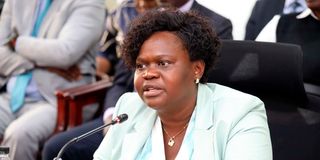
On Tuesday, Governor Gladys Wanga was before the Senate’s County Public Accounts Committee (CPAC) to respond to multiple queries raised in an audit of Homa Bay’s books for the 2024/25 financial year.
The Auditor-General’s report showed that Homa Bay County had pending bills of Sh1.52 billion in the 2024/25 financial year. Of that, Sh1.09 billion accounted for debt that was more than a year old.
Further, Sh700 million accounted for debt that was more than three years old.
The age of the debts is contrary to the Public Finance Management (County Government) Regulations of 2015, which provides for settling of pending bills at the first possible opportunity.
“When you have Sh148 million worth of pending bills outstanding for over three years, it is indicative of a problem because payment of pending bills should be a first charge on the county revenue fund,” said CPAC Chairperson Moses Kajwang’.
Appearing before the Senate County Public Accounts Committee (CPAC) on Tuesday, Governor Wanga said they have paid Sh713 million worth of the pending bills and have plans to clear the remaining debt.
However, Governor Wanga said they are committed to settling all pending bills in accordance with the Pending Bills Action Plan for the fiscal year ending June 30, 2026 entered into with the Office of the Controller of Budget.
Homa Bay Governor Gladys Wanga appears before the Senate County Public Accounts Committee (CPAC) chaired by Homa Bay Senator Moses Otieno Kajwang' at Bunge Tower, Nairobi on June 16, 2026.
Photo credit: Dennis Onsongo | Nation Media Group
She explained that the action plan provides a structured payment schedule with clear timelines where Sh370.4 million shall be paid in the first quarter of the financial year, Sh379.2 million in the second quarter, another Sh363.1 million in the third quarter and Sh411.7 million in the fourth quarter.
“We are implementing the approved payment plan and have prioritised the settlement of eligible and verified pending bills, subject to availability of funds, in line with the law. The payment plan outlines the order of priority and timelines for settlement,” said Ms Wanga.
The audit report also flagged variance in fees collected from health facilities within the county government with some Sh700 million being questioned as having been spent at source without first being deposited in a special purpose account (SPA) as is required by law.
According to the report, some 24 health facilities generated Sh1.6 billion under the facility improvement fund during the fiscal year under review but only Sh915 million was remitted to the SPA.
“The variance is almost 43 percent of the total funds collected. Where did the money go?” posed Nandi Senator Samson Cherargei.
Governor Wanga, however, told the committee that only Sh915 million was received by the county government as reimbursement by the Social Health Authority during the period under review, adding that they are still owed Sh350 million by the government agency.
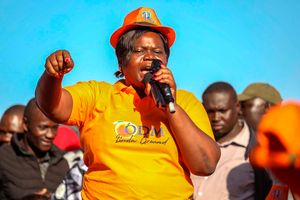
The problems did not end there with the ODM chairperson hard-pressed to explain how her administration spent some Sh43.46 million on fuel, oil and lubricants.
This is after a review of the fuel management controls and procedures revealed that the county government did not issue detailed orders for the purpose of authorising and managing the drawing of fuel at the petrol station.
Moreover, instructions to draw fuel were given verbally with no record being maintained for comparison between the supplier invoice and amount of fuel actually drawn.
In her response, Ms Wanga said the expenditure was incurred after obtaining all requisite approvals in accordance with the Public Finance Management Act, 2012 and the County Government Financial Management Regulations.
She pointed out that the approvals included authorisation by designated officers and approved detailed orders supported by work tickets and supplier receipts, all of which were duly recorded in the fuel registers.
“The verbal instructions issued in certain instances were supplementary operational communications and did not replace the approved authorisation process, but we have since strengthened controls to ensure that all fuel drawdowns are fully documented and traceable,” she said.
There was also the issue of the county government spending almost half a billion shilling to construct a two-door latrine during the period under review.
However, the governor clarified that such projects cost between Sh460,000 and Sh480,000 depending on the location.