Farmers in Kenya's North Rift food basket are facing the prospect of a second consecutive crop failure after the much-anticipated El Niño rains failed to deliver the sustained rainfall they had hoped would rescue their investments.
Having suffered losses during the previous planting season due to prolonged dry spells, many cereal farmers invested in a second crop, banking on forecasts of heavy rainfall and government subsidies on farm inputs to recover their losses.
But as maize and other crops wither in parts of Uasin Gishu and Trans Nzoia counties, farmers are once again staring at financial ruin, with their savings and household incomes at risk.
Some have already lost their second crop, while others who attempted a third planting are struggling with unpredictable rainfall and fall armyworm attacks.
Mr Duncan Sanchez Tum, a farmer in Chesegen, Kesses Constituency, Uasin Gishu County, is among those who have suffered repeated losses.
He planted four acres of maize after the government lowered the cost of fertiliser and seed to encourage farmers to take advantage of the anticipated El Niño rains. But the crop withered at the flowering stage, leaving him with little hope of recovering his investment.
“I took advantage of the reduced cost of farm inputs and planted four acres of the crop, but it withered at flowering and cannot even be converted into silage,” he said.
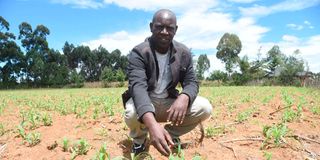
Duncan Sanchez Tum, a maize farmer at Chesegem Village in Kesses constituency, Uasin Gishu County, shows a third maize crop at his farm on November 11, 2026, which he planted in October this year following announcement by the Meteorological Department of expected El-Nino rains.
Photo credit: Jared Nyataya | Nation Media Group
Mr Tum subsequently made a third attempt, planting another crop last month. But its prospects are uncertain, with fall armyworms and erratic rainfall threatening its growth and development.
“The rains have become unpredictable and there are minimal chances that the crop will realise any yield. It seems the weather prediction was either misleading or the effects of climate change are now a reality,” he said.
A similar predicament has befallen Hellen Kosgei, a farmer in Cheptiret, Uasin Gishu County, who replanted 10 acres in the hope of recovering from the previous drought-related crop failure, only to suffer another loss.
“It's a double tragedy considering that maize production is my main source of income and food security. I will now be forced to purchase maize for consumption, something I have not done for many years,” she said.
Mr Tum and Ms Kosgei are among farmers who had hoped the forecast heavy rains would salvage a season already battered by drought.
Jackson Koech, a farmer in Ziwa, Uasin Gishu County, said he had planted a second crop after the government lowered the cost of farm inputs and forecasts pointed to favourable rainfall.
“I planted the second crop after the government motivated us with reduced-cost farm inputs and the hope that the El Niño rains would translate into a better harvest. But those hopes are diminishing because of unreliable rainfall,” he said.
Mr Koech is among farmers who had hoped the forecast rains would help them recover from the previous season's losses, which he estimated at 30 per cent.
The government had reduced the price of fertiliser from Sh2,500 to Sh2,000 and cut the cost of maize seed by half to encourage farmers to invest in a second planting and cushion them against the earlier losses.
However, the unpredictable weather has disrupted crop development, threatening the harvest farmers had hoped would help them recover their initial investments.
For Ms Miriam Maina, a farmer in Kiplombe, Uasin Gishu County, the prospect of another failed harvest means losing money she had struggled to raise after the first planting was affected by drought.
“It's a double tragedy. I lost my initial investment to drought, and now I risk losing the little I saved to invest in a second planting,” she said.
Amos Kipchirchir, also from Kiplombe, said his 10-acre maize crop had been damaged by unreliable rainfall, dashing his hopes of recovering from the previous losses.
“We had a lot of hopes that El Niño rains could salvage us from the drought-related crop failure, but the rains turned unpredictable and we have suffered yet another loss,” he said.
Mr Kipchirchir said he was unwilling to invest in another crop after losing money in the two planting seasons. He urged the government to put in place measures to protect Kenyans against the food insecurity that could follow another poor harvest.
The Ministry of Agriculture has projected a 40 per cent crop failure in the North Rift region due to the prolonged dry spell during the planting season, raising concerns about the country's food security.
In July, the government dispatched a team of experts to the region to assess the extent of the crop failure. The assessment led to the introduction of measures to encourage farmers to plant a second maize crop in the same season in an effort to boost production and household incomes.
Most farmers in the region took advantage of the reduced cost of inputs to replant in September and October, anticipating that the El Niño rains would provide sufficient moisture for the crops to mature.
Farmers whose crops had been damaged by drought were also encouraged to convert the maize into silage for livestock feed and diversify into alternative food crops.
However, some say their maize had withered before reaching the tasselling stage and could not be salvaged for silage.
“The crops withered before reaching the tasselling stage and cannot be converted into silage. We have no option but to feed them to livestock,” Mr Tum said.
He called on the government to introduce crop insurance schemes to protect farmers against losses caused by natural calamities such as drought.
The prospect of another poor harvest could undermine the government's efforts to increase domestic food production, reduce reliance on imports and stabilise the cost of staple foods.
The Ministry of Agriculture has warned that reduced maize production following drought-related losses could put additional pressure on food supplies and force the country to rely more heavily on imports to stabilise prices.
Agriculture Cabinet Secretary Mutahi Kagwe has said maize production increased from 34.3 million 90-kilogramme bags in 2022 to 73 million bags in 2025, while maize imports declined by more than 66.5 per cent over the same period.
However, the dry spell during the latest planting period, followed by unreliable rainfall, has exposed farmers to fresh uncertainty and threatens to reverse some of the gains made in domestic production.
In the major maize-growing areas of Uasin Gishu and Trans Nzoia, farmers who recorded reduced harvests in the previous season now face the possibility of another poor crop, raising concerns about their ability to sustain production without further financial support.
The unfolding situation also poses a challenge to the Kenya Kwanza administration's agricultural agenda, which prioritises increased food production and reduced dependence on imports.
President William Ruto identified agriculture as a key pillar of his pre-election manifesto, with a commitment to boost productivity through affordable farm inputs and other interventions aimed at strengthening food security.
For farmers who have already spent their savings on repeated planting attempts, however, the immediate concern is whether the remaining crops will survive long enough to deliver a harvest.