Elgeyo-Marakwet mudslide victims enduring hardship
For three days after last weekend’s deadly mudslides in Chesongoch, Elgeyo-Marakwet County, survivors endured severe hardship—going without food, water, or medical help as humanitarian workers struggled to reach them amid treacherous conditions.
Continuous landslides triggered by heavy rains cut off key access roads, leaving vehicles carrying relief supplies stranded. By Monday evening, bulk food aid had yet to reach the affected villages, with trucks stuck at Murkutwo after fresh slides blocked the only passable route.
Local residents stepped in to offer immediate help, sheltering displaced families as government and humanitarian agencies battled to reopen roads.
Among the worst-hit are 64-year-old John Khurah, who lost 11 relatives, and Ms Selina Krop, who lost five family members. They had not received any food or support by Monday evening.
“Since Saturday, I have not eaten anything. Red Cross vans with food are stranded at Murkutwo because the bridge to Chesongoch was submerged and blocked by rocks and mud,” said Ms Krop.
It was not until Tuesday—four days after the disaster—that trucks carrying relief food and medical supplies finally reached Chesongoch, after one road was partially cleared. Residents blamed the delays on poor road networks that worsened the impact of the disaster.
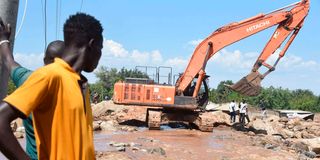
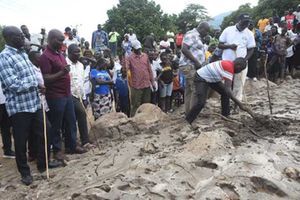
Officials work to open the damaged road at Murkutwo in Elgeyo Marakwet County on November 4, 2025, following mudslides.
Photo credit: Jared Nyataya | Nation
A Nation team on the ground found humanitarian vehicles that had left Eldoret on Saturday still stranded at Murkutwo by Monday afternoon. Officials said the initial focus had been on rescuing survivors and recovering bodies, with personnel from the Kenya Red Cross and National Youth Service (NYS) relying heavily on locals familiar with the terrain.
Mr Oscar Okumu, the Kenya Red Cross North Rift regional head, said access remained the biggest challenge. “The area was completely inaccessible after the landslides cut off all roads. Our teams are trekking long distances—sometimes up to three kilometres—across rivers and unstable ground to reach victims,” he said. He added that temporary shelters were being identified to facilitate rescue coordination and relief operations.
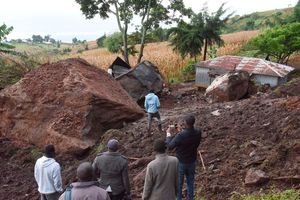
The weekend tragedy struck four villages—Kasegei, Kaptul, Kwemoi, and Kipkirown—where massive boulders now cover what were once homesteads. Government agencies resorted to using police helicopters to deliver food, medicine, and other essentials, though distribution was slowed by a lack of structured coordination.
One survivor, Mr Brian Kemboi, who lost five relatives, joined rescue efforts due to his knowledge of the terrain. “I am not a trained rescuer, but I managed to recover the body of my brother’s son from the debris,” he said at St Maurus Academy, where recovered bodies were being assembled before being airlifted to Eldoret’s Moi Teaching and Referral Hospital morgue.
The rugged landscape and ongoing ground movement continue to endanger both residents and rescuers. Over 100 NYS officers are on site using heavy machinery to clear blocked roads, but the Red Cross has warned that conditions remain unstable.
“The land is still moving; we could hear rumbling underground. Roads cleared on Sunday were swept away again,” Mr Okumu said.
Authorities have urged the public to avoid landslide-prone zones and to stay clear of fast-moving waters as heavy rains persist.
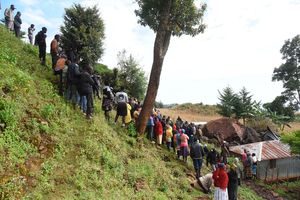
Officials work to open the damaged road at Murkutwo in Elgeyo Marakwet County on November 4, 2025, following mudslides.
Photo credit: Jared Nyataya | Nation
In a Monday statement, Government Spokesman Isaac Mwaura said the government’s emergency response had shifted to recovery and mitigation, including establishing temporary shelters, grouping displaced families by need, and deploying disaster specialists.
He said Kenya Power was working to restore electricity, while engineers from the North Rift Water Works Development Agency were repairing damaged pipelines.
By Monday evening, both the government and Red Cross confirmed that the Chesongoch landslides had killed 30 people. Two more deaths were later reported in the Kipkenda tragedy in Keiyo North, bringing the total toll in Elgeyo Marakwet to 32.
Thirty-one survivors are receiving treatment at Moi Teaching and Referral Hospital, Iten County Hospital, and Tambach Sub-County Hospital.
To strengthen rescue operations, the government deployed a special military police unit supported by trained sniffer dogs, while the Red Cross deployed drones and GIS mapping technology to locate victims in unsafe zones.
Mr Okumu warned of a looming public health crisis, citing poor sanitation and limited clean water.
The Red Cross has launched an expanded response that includes Water, Sanitation and Hygiene (WASH) services, psychosocial support, and assistance for residents with chronic illnesses who lost access to medication. Tracking desks have also been set up to coordinate ongoing relief efforts and identify vulnerable families.
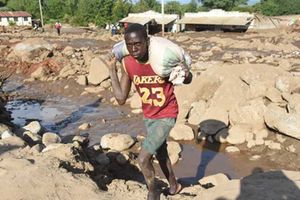
Officials work to open the damaged road at Murkutwo in Elgeyo Marakwet County on November 4, 2025, following mudslides.
Photo credit: Jared Nyataya | Nation
Psychosocial teams are offering counselling at St Benedict’s Adoration Chapel in Chesongoch, helping survivors to cope with the trauma of losing loved ones and homes.
Over the weekend, officials led by Interior Cabinet Secretary Kipchumba Murkomen coordinated a community fundraising drive to supplement government efforts.
However, one police helicopter ferrying patients and Red Cross personnel narrowly avoided a crash after a technical fault during take-off. All passengers were unharmed, and the patients were later airlifted to Eldoret by a military chopper.
Elgeyo Marakwet’s steep escarpments and the Kerio Valley lowlands remain among Kenya’s most landslide-prone areas. Experts attribute the recurring disasters to heavy rainfall, deforestation, and human settlement on unstable slopes, which have stripped away natural vegetation and exposed fragile soil layers.
Environmental specialists warn that unless proper mitigation measures are implemented, such tragedies will continue to recur with devastating consequences.