Governors have rejected a proposal by the National Treasury for a centralised system of own-source revenue collection, describing it as an attempt to undermine devolution and micromanage affairs of counties.
The system will operate like the e-Citizen – the one-stop payment platform for all national government services - to collect all county revenues, including land rates, parking fees, and hospital charges.
Essentially, this centralised system will replace the distinct electronic county revenue systems contracted by each of the 47 county governments.
With the Treasury planning to roll out the new system in December, it means counties will face legal consequences arising from the contracts they have signed with the vendors of the systems they are using to collect own-source revenue.
The proposal, which is currently under consideration in the Intergovernmental Budget and Economic Council (IBEC), has caused a storm with some county chiefs vowing to reject it.
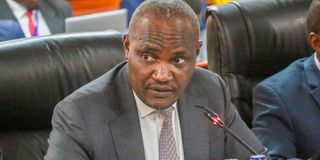
National Treasury Cabinet Secretary John Mbadi disclosed the proposed new revenue collection system for the counties during a meeting of the Senate Public Accounts Committee.
Mr Mbadi told Senators that plans are at an advanced stage to have only one entity collect revenue for all the devolved units.
He told the committee led by Homa Bay Senator Moses Kajwang’ that the matter had already been discussed at IBEC.
“We will have just one entity, the same way as the national government. There are still modalities being discussed at the IBEC level before the rollout in December,” Mr Mbadi said.
Mr Mbadi said the integrated county revenue management system will help in weeding out cases where some counties have become notorious for collecting revenue and spending it at source, while others under-declare what they have collected.
“We have discussed this at IBEC, and it has faced resistance from the Council of Governors, but we are getting somewhere. We cannot have 48 systems dealing with revenue collection,” Mr Mbadi told the committee.
He said the modalities on who will do the collection and how it will be released to counties are still being discussed in IBEC.
In preparation for the rollout of the new system, the national treasury has already written to counties to provide details of their current revenue system, information on records of who supplied the system and the expiry date of their current revenue system.
Nyeri governor Mutahi Kahiga, who also serves as the vice chairperson of the Council of Governors (CoG), rejected the system, saying it is just another way that the national government wants to use to frustrate spending by counties.
“The introduction of that system infringes on the rights of counties. This will be just another bottleneck by the national government to counties,” Mr Kahiga told the Nation.
“We have already seen what is happening to e-Citizen, so what are you telling us?” He posed.
Nyeri Governor Mutahi Kahiga.
Photo credit: Joseph Kanyi | Nation
Mr Kahiga said counties already have problems with the national government over delays in the release of funds from the shareable revenue and there should be no other move to stifle operations of the devolved units.
“Will we let counties run, or do we want to continue stifling them?" Mr Kahiga asked.
Makueni governor Mutula Kilonzo Jnr said the national government has no business in county revenue collection.
“What they ultimately want to do is collect and release the funds at their whims. They also want to justify the procurement of a system similar to e-citizen,” Mr Kilonzo said.
“The law creates a clear distinction between the two levels of government. We are not a unitary state,” added the governor.
Makueni Governor Mutula Kilonzo Junior.
Photo credit: File| Nation Media Group
Mombasa governor Abdulswamad Nassir told the Nation the move amounts to micromanaging of counties and the governors will not accept it.
Mr Nassir said the government can come up with policies like imposing maximum and minimum requirements but not to centralise the collection of revenue from the counties.
He dismissed assertions that some governors spend the cash at source, hence the system will cure that wastage, saying all collections are deposited into the Consolidated Fund.
“That is something that we will deal with; we are not going to accept it,” Mr Nassir vowed.
Mombasa Governor Abdulswamad Nassir addresses head teachers during the Kenya Primary Schools Head Teachers Association Conference in Mombasa on November 4, 2024.
Photo credit: Kevin Odit | Nation Media Group
Homa Bay governor Gladys Wanga said the discussions on the system are still ongoing, but warned that it must not be a claw-back on the gains made on devolution under the new constitution.
“Those discussions must be held within the confines of the constitution and the Public Finance Management Act, recognising the distinct constitutional mandate of both the national government and the county governments,” Ms Wanga said.
“The move should not be an overreach by the national government on the functions of the county government. Of course, all revenue collected by the Kenya Revenue Authority goes to the national government and then we get our share of 15 percent,” she added.
Homa Bay County Governor Gladys Wanga at a national event on March 7, 2025, at KICC in Nairobi. Her journey from political novice to Nyanza's first female governor began with a pilgrimage to Phoebe Asiyo's home in Wikondiek Village.
Photo credit: Francis Nderitu | Nation Media Group
“Currently, all counties have ongoing contracts with different revenue systems,” Ms Mbarire said.
Murang’a governor Irungu Kang’ata, however, said he has no problem with the proposal but insisted the system must be owned by the government and not a private entity.
“The system should be owned by the government and not private entities that collect monthly or annual service fees. Source code ownership is important. Whichever level owns is not an issue. Any can. But private owners should be discouraged,” Mr Kang’ata said.
Murang’a Governor Irungu Kang’ata.
Photo credit: Photo I File
CS Mbadi defended the decision, saying they are not interfering with the autonomy of counties in the management of their affairs.
“As much as we are saying counties are independent, the constitution gives the national treasury power to come up with financial systems in the country,” Mr Mbadi said.
He also clarified that before the rollout of the new system, all the 47 counties will be adequately engaged since they will be the end user and must be brought on board.
“We will not just come up with a system and give it to counties to use, we will be as consultative as possible because the end user can deliberately become resistant if not engaged,” Mr Mbadi said.
Treasury Cabinet Secretary John Mbadi.
Photo credit: Francis Nderitu | Nation Media Group
Mr Mbadi told the committee to brace itself for major reforms, especially in the sector revenue collections as they will be presented to parliament for consideration.
“There are a lot of gaps that we must close. Going forward, we will come up with a lot of reforms,” Mr Mbadi said.
Mr Mbadi said the taxes collected from Kenyans must begin to serve them. “Kenyans are complaining that they are subjected to taxes, but no services. This is because there are a lot taps where this money is going that we must close.”
Senators supported the move, saying many people are today eying gubernatorial seats not to serve the people but to enrich themselves.
“Let us not make counties places where people go to become rich rather than to serve the people. We will work together to actualise this,” said Mr Kajwang.
“We would like to assist you in having an efficient system with an automated system on revenue,” he added.
Isiolo Senator Fatuma Dulo said there is an urgent need to work on the system, decrying that what is happening in most counties is shocking.
“Do we even have a system at the moment? Some of this revenue is collected in cash and even spent there as you see,” Ms Dulo said.
If implemented as envisioned, the move will lock out governors who have opened multiple accounts which are not audited, wheretheir own source revenue collected ends up in
In her report for the first quarter of the 2024/2025 financial year, covering July to October, Controller of Budget Margaret Nyakang’o revealed that counties operate 2,421 bank accounts.
According to the report, some of the counties with the highest number of bank accounts include Bungoma with 321, Baringo with 292 accounts, Migori County with 208, and Kwale with 165 accounts.
Elgeyo Marakwet County (155 bank accounts), Kajiado (50), Embu (46), Kakamega (44), while Kwale and Migori are operating 64 and 76 bank accounts respectively.
Public finance laws and attendant regulations require that county government bank accounts must be opened and maintained at the Central Bank of Kenya.
Counties, however, were found to be operating the kitties in breach of Regulations 82(1) (b) of the PFM (County Governments) Regulations, 2015.