The Court of Appeal has held that perfection, or the lack of it, is not reason enough to strike down legislation, even if a section of the population is unhappy with it.
In refusing to do away with the Housing Act, five Appellate Court judges ruled that the decision to do away with a piece of legislation boils down to whether petitioners have proven outright violations of the Constitution.
In cases challenging passing of legislation, Parliament enjoys a presumption of Constitutionality. This means that the courts presume that lawmakers followed all legal processes, hence the “onus is on the party challenging that presumption to establish a contrary position.”
For the cases challenging the Housing Act, the Court of Appeal said there was not enough evidence that lawmakers violated the Constitution, either through the legislation’s wording or the process used to enact it.
For the 42 cases challenging the Housing Act, the Court of Appeal held that an imperfection in a specific piece of legislation is not enough to shoot it down.
The petitioners had argued that the Housing Act does not define the term “gross income” in relation to the Housing Levy, a 1.5 per cent deduction of income intended to finance construction of affordable housing units across the country.
But the judges maintained that the lack of definition is not so vague that it cannot be interpreted, whether by those affected by the deductions or to other members of the public.
“It is true that the Act does not define the term “gross income”. However, it is not alleged that the term is incapable of being understood by those to whom it applies… the law is vague only if it is so imprecise as to be incapable of any meaningful interpretation or guidance. We are not satisfied that sections 4 and 29 of the Act are worded in a manner that can be termed as so imprecise as to be incapable of any meaningful interpretation or guidance,” the court ruled.
The petitioners also argued that the Housing Act hijacked the National Land Commission’s (NLC) powers, in that the units are to be developed on public land then sold to private individuals.
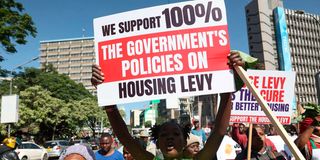
Members of Community Based Organizations (CBOs) and Jua Kali sector demonstrate in Nairobi on December 28, 2023 in support of the housing fund levy.
Photo credit: Evans Habil | Nation Media Group
Under Kenyan law, all public land is held and managed by the NLC and in some instances, county governments.
The petitioners argued that the Housing Act was passed without engaging the NLC or considering its views, despite the development programme having a huge impact on public land.
While the judges noted that the Housing Act has no express mention of the NLC, they held that its provisions refer to compliance with section 12 of the Land Act, where the NLC gets some of its powers to hold and manage public land.
“Any allocation of public land without the approval of the NLC will, accordingly, be unlawful. We cannot, however, make a determination that such eventuality is likely to occur in the scheme of the Act as to do so would be to arrive at a speculative decision,” the judges added.
The petitioners did not provide any evidence to counter the State’s stand that the NLC participated in panel beating the housing legislation at both the National Assembly and the Senate, which the Court of Appeal said was another reason for dismissing the 42 cases.
Whether another State institution, the Commission on Revenue Allocation (CRA), was involved in crafting the law also took centre stage in the cases before court.
The petitioners maintained that the CRA had no input in the Housing Bill during its crafting and assessment stages before Parliament.
The CRA, the petitioners argued, was crucial because the affordable housing programme’s structure foresaw counties being allocated money from the Affordable Housing Fund.
One of the petitioners argued that the CRA’s failure to participate in crafting and passing of sections 4 to 7 of the Housing Act meant that the entire legislation was null and void.
But, much like it was with the NLC, there was no evidence provided to show that the CRA was denied an opportunity to participate in formulation of the Housing Act.
The fatal wound for the petitioners was failure to make the CRA a party to the case, as the institution would have then been afforded an opportunity to clarify whether it was denied an opportunity to help formulate the law.
“Our difficulty in arriving at the determination of this matter is that the CRA was never made a party to the proceedings and hence its position as to whether or not this opportunity was afforded was not clearly brought out by the petitioners whose duty it was to prove this assertion,” the judges ruled.
The petitioners have not indicated whether they will attempt to challenge the decision at the Supreme Court.