The National Transport and Safety Authority (NTSA) is under sharp public scrutiny over what many motorists and transport stakeholders view as recurring regulatory and administrative blunders.
From controversial policy rollouts to enforcement strategies that critics describe as impractical, the agency has in recent years faced repeated public backlash.
The latest controversy surrounding NTSA's plan to subject millions of private vehicles to mandatory annual inspections has once again exposed a series of missteps by the transport sector regulator.
Although the authority and courts have since suspended the new directives, the agency continues to face intense criticism over the proposed policies.
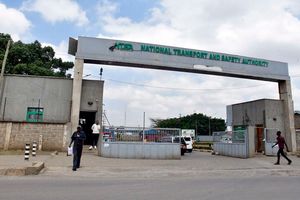
The National Transport and Safety Authority (NTSA) inspection yard along Likoni Road in Nairobi.
Photo credit: File | Nation Media Group
The new regulations provide for mandatory annual inspections of private vehicles, stricter requirements for school transport vehicles and new operating rules for commercial vehicles.
Under the proposed road safety framework, all private vehicles older than four years are subject to annual inspections.
NTSA Director-General Nashon Kondiwa has argued that private vehicles account for more road accidents than public service vehicles (PSVs), underscoring the need for stricter roadworthiness checks.
"Currently, private vehicles are the leading cause of accidents on our roads. Private vehicles and motorcycles account for 62 per cent of accidents in the country," he said.
Defending the new regulations, Mr Kondiwa dismissed claims that the annual inspections were a moneymaking scheme, terming the exercise a matter of national security.
"Apart from boosting road safety, this whole motor vehicle inspection exercise is a matter of national security. It seeks to improve the integrity of the records that we keep and the completeness of a registry that we are trying to build for purposes of strengthening national security," he said.
Explainer: New NTSA vehicle inspection regulations
"We have suspended the planned enforcement of annual inspections of private vehicles until early next year. Enforcement will begin once we have established and automated inspection centres," Mr Kondiwa said during an interview on NTV's Fixing the Nation earlier this week.
"During routine checks, traffic officers shall not enforce the mandatory inspection requirement on private motor vehicle owners."
NTSA had earlier announced that the regulations would take effect on July 1, 2026.
However, an admission by the agency that it does not currently have the capacity to implement the regulations has raised questions about its preparedness before unveiling the new measures.
Mr Kondiwa revealed that the agency currently has only 17 government-owned motor vehicle inspection centres across the country, a number it hopes to increase to more than 100 by next year.
The admission has cast doubt on the authority's capacity and preparedness to conduct annual inspections of millions of private vehicles.
"NTSA moved to implement the regulations despite lacking adequate inspection centres and personnel. The lack of preparedness to implement and enforce the regulations is a major blunder," lawyer Steve Kabita said.
"Revelations that the regulations were approved by the National Assembly but not the Senate further complicate the matter."
According to the Motorists Association of Kenya (MAK), the NTSA lacks both the capacity and legal backing to inspect millions of private vehicles.
"Apart from failing to conduct proper public participation before enacting the rules, NTSA has admitted that it lacks the capacity and is not prepared at the moment to implement the measures," MAK Chairman Peter Murima told the Nation .
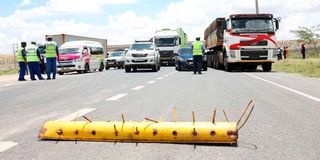
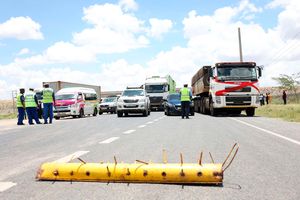
Police officers and officials from the National Transport and Safety Authority inspect vehicles at a roadblock in Lukenya, Machakos county on March 27, 2024.
Photo credit: Evans Habil | Nation Media Group
Revelations that NTSA bypassed the Senate and moved to enforce the regulations before the parliamentary approval process was completed have further exposed failures by the transport sector regulator.
It has emerged that the agency proceeded with implementation after securing approval from the National Assembly but before obtaining Senate approval.
The dispute has set the stage for a constitutional showdown, with senators threatening court action to stop the implementation of the regulations until the Senate is properly involved.
Senators insist that the legal notices allowing the authority to implement the regulations remain contested because the Senate has not voted to approve them.
"The Senate has not passed the regulations. Any action the authority is taking is nugatory, null and void," said Senate Minority Leader Stewart Madzayo.
The Senate had been expected to vote on the report by its Committee on Delegated Legislation before proceeding on recess two weeks ago.
However, debate on the report was deferred, leaving the fate of the regulations unresolved even as NTSA moved ahead with implementation.
The committee recommended the annulment of the Traffic (School Transport) Rules, 2026, the Traffic (Motor Vehicle Inspection) Rules, 2026, and the National Transport and Safety Authority (Operation of Commercial Vehicles) Regulations, 2026, arguing that they failed to meet legal and constitutional requirements.
"Senate still has powers under the Statutory Instruments Act to recall the regulations despite NTSA's decision to implement them. We will recall the regulations. We cannot allow Kenyans to suffer and be forced to dig deeper into their pockets," Makueni Senator Dan Maanzo said.
According to Kakamega Senator Boni Khalwale, NTSA had overlooked the constitutional role of the House in scrutinising regulations affecting counties.
"The Senate has the power to consider regulations that concern counties. National transport concerns counties, and there is no way NTSA can escape the Senate," he said.
Senators have also cited the circumstances that led the High Court in 2020 to nullify 24 pieces of legislation enacted without Senate participation despite affecting county governments.
"The regulations are punitive, impractical and incapable of being implemented within the timelines set by NTSA. We do not have enough inspection centres in this country. Kenyans will be forced to queue, pay inspection fees and risk arrest if they do not have inspection stickers," Tana River Senator Danson Mungatana said.
The senators have also faulted NTSA for seeking powers to appoint private inspectors without sufficient legal safeguards and accused the authority of ignoring requests to withdraw and republish the regulations.
The Senate further found that NTSA had failed to conduct meaningful public participation, claiming consultations held in 2024 excluded key stakeholders such as private school operators and vehicle owners.
"They have not followed the law and failed to conduct proper public participation," Mr Mungatana added.
Narok Senator Ledama Olekina criticised NTSA for copying transport systems from other countries without adapting them to Kenya's realities.
He cited the requirement for mechanical stop arms on school buses, saying it had been borrowed from the United States without considering local road conditions, public awareness or implementation capacity.
"We have a business of copy and paste. We benchmark elsewhere and expect Kenyans to implement foreign systems overnight," Mr Olekina said.
Leaders have also warned that mandatory annual inspections of private vehicles could create opportunities for corruption while increasing the cost of owning motor vehicles.
While NTSA argues that the regulations are necessary to improve road safety, boost national security and update its registry, senators and other stakeholders contend that the rules impose significant financial burdens without adequate public participation or sufficient implementation capacity.
In July 2025, Auditor-General Nancy Gathungu revealed that NTSA had no control over the recently rolled out Transport Integrated Management System (TIMS), which manages services such as vehicle registration and transfer of ownership, exposing the agency to revenue leakages and data breaches.
Ms Gathungu said NTSA staff had limited access to the system's functionalities despite the agency spending Sh186 million on the installation of the online portal.
In yet another indication of systemic challenges, the agency last month acknowledged delays in issuing vehicle number plates amid growing public complaints.
The delays came amid frustrations from vehicle owners over prolonged waiting periods for newly registered vehicles and replacement number plates.
On June 6, 2026, a court suspended the implementation of a 21-year Public-Private Partnership agreement between NTSA and Pesa Print Limited aimed at rolling out second-generation smart driving licences and an automated traffic enforcement system.
Under the proposed arrangement, motorists were to pay Sh3,050 for the new smart driving licences, with Pesa Print responsible for card design and printing while KCB Bank would manage enrolment and registration services.
A key component of the project involved the deployment of 1,000 traffic surveillance cameras across the country, including 700 fixed cameras and 300 mobile units, to detect traffic violations and facilitate automated enforcement.
In the case, the Road Safety Association of Kenya raised concerns over the legality and constitutionality of the partnership between NTSA and the private firm.
Both the rollout of the automated traffic fines system and the smart driving licences project have faced legal challenges over alleged lack of public participation and irregular procurement.