The plan was simple: climb Asego Hill, take pictures and videos of the sweeping view and post them on social media. One Friday in October, Brenda (not her real name) and six fellow students set out to do exactly that.
Then, on the way up, a masked man holding a machete confronted them.
Her account exposes the threat of sexual violence shadowing one of Homa Bay Town’s popular new pastimes.
Leon Otieno, Secretary-General of the Homa Bay Civil Society Organisation Network, says he knows of five rape cases, one defilement case and one physical assault case at Got Asego over the past three months.
Brenda’s group of five girls and two boys had been taking pictures and videos on what was meant to be a once-in-a-lifetime trip to the summit. Like other students, they planned to share the memories online. Then the man appeared.
“He had a machete in his hands. We did not know his intentions,” she says.
Adrenaline surged as instinct urged them to fight or flee. But what could first-year students do against a grown man wielding a brand-new machete? Running seemed the best option.
Escape was itself perilous. The hill is as difficult to descend as it is to climb, and one wrong move can cause a fall resulting in head trauma or fatal injury.
Her companions fled, but fright rooted Brenda to the spot.
“The others left me because I was too slow to react. I was left standing, facing him,” she says.
The man grabbed her, told her to call her parents to demand a ransom and set the price at Sh50,000.
“My parents were able to get Sh14,000, which was sent to the attacker,” Brenda recalls.
He later set her free, but only after raping her and taking her mobile phone and some cash, according to her account.
Meanwhile, her friends, almost at the foot of the hill, were frantically making calls. Their phone books, however, held contacts only for other friends, who could not help them at that moment.
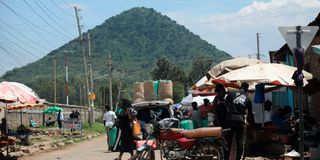
‘Got’ Asego, or Asego Hill, dominates the Homa Bay Town skyline. The region’s most commanding physical feature, it is visible to travellers driving in from Kendu Bay or Mbita, crossing from Rongo or cutting across the blue expanse of Lake Victoria.
Asego Hills as seen from Sofia Market in Homa Bay Town on November 27, 2026.
Photo credit: George Odiwuor | Nation Media Group
Once a rich wildlife habitat, the hill lost its animals as expanding human settlement and the demand for land pushed them away. In recent years, religious groups have sought sanctuary there to fast and pray, while local farmers have grazed goats and sheep on its natural vegetation. Lower down, the clack-clack of hammers rings out as bare-chested stonemasons toil under the scorching sun, breaking boulders into construction ballast heaped along the dirt trails.
Then, about a year ago, a hiking craze swept through the town. Since then, locals and students have scaled its rugged paths daily for leisure, capturing Homa Bay Town, Lake Victoria and the distant silhouette of Sikri Peninsula for TikTok, Instagram and Facebook.
The trails are well-defined but rough, with narrow paths winding up slopes covered in loose stones, gravel and huge boulders. In places, climbers must squeeze between massive rocks, clamber over boulders or haul themselves up steep rock faces by hand. No trail markings warn hikers of the dangers ahead. Higher up, green bushes, tall trees and cacti crowd the path.
But the effort has its rewards. The views are beautiful along the way and grow even better with height. From the summit, the whole of Homa Bay Town spreads out below, Lake Victoria stretches to the horizon and Rusinga Island sits in the distance.
It is this panorama that draws many. Some carry drinks in backpacks to enjoy at the top, while others pose for photographs on the way up or shoot videos for TikTok, Instagram and other platforms to preserve the memories.
Yet the features that give the hill its allure also offer attackers cover: narrow passages between huge rocks, thick bushes, hidden bends and isolated stretches where hikers walk alone.
Witnesses say men lie in wait for lone hikers or vulnerable groups of girls, then pounce and rape or defile them. Accounts of past attacks indicate that perpetrators hide in the bushes and grab victims as they walk past. Beyond the danger of slipping and falling, such violence is emerging as a major risk for adolescent girls and women.
Local non-governmental organisations helping survivors seek justice say most victims are students of Tom Mboya University. The institution has up to 15,000 students, including newcomers who joined two months ago, in September, some having just turned 18.
Outside the lecture halls, some students take up income-generating activities, while others spend their leisure time hiking or visiting the lake. Younger learners are easily manipulated, and some people exploit that vulnerability.
Paralegals and youth advocates Mercy Kwamboka and Cynthia Akoth, who help girls who have been raped or defiled, say survivors initially suffered in silence, leaving many cases unreported. As attacks became more frequent, several organisations stepped in.
When the two advocates learn of a case, they trace the survivor, listen to her account and begin supporting her journey towards recovery and justice. Ms Akoth says that in some cases, they have also tracked down suspects and alerted the police.
“We have had parades where suspects were lined up, and survivors were told to identify who they believe sexually violated them. No one has been positively identified and arrested,” she says.
“We referred the cases to Tiko for help,” Mr Otieno says.
Tiko connects adolescent girls and young women, typically aged 15 to 24, to free, stigma-free sexual and reproductive health services and education. The survivors received dignity packs and psychosocial support.
At Hope Centre, the counselling unit of Homa Bay County Teaching and Referral Hospital, psychologists have counselled several women and girls on how to overcome trauma. Georgina Otieno, a psychiatrist there, says she has held counselling sessions with girls from Tom Mboya University following incidents of sexual violence.
“I have engaged a few survivors after an ordeal at Asego Hill,” she says.
The centre’s records show four cases reported in October and three in November. Two, Ms Otieno notes, were handled at the outpatient department.
Survivors of sexual offences admitted to the hospital are immediately started on treatment. This includes post-exposure prophylaxis (PEP), an emergency 28-day course of antiretroviral drugs used to prevent HIV infection after a potential exposure. They also receive counselling for psychological trauma.
Yet pursuing justice remains difficult. Most survivors who report to police are reluctant to follow through, fearing reprisals from suspects. Some withdraw their complaints or fail to appear when required.
Marvin Njuguna, regional programme coordinator at the Gender Violence Recovery Centre (GVRC), says most survivors of sexual violence know those who harm them. In most cases, he says, attackers have trailed their targets.
“After the attack, the survivors fear that they will be harmed and would rather keep quiet than speak up,” he says.
Lack of information, he adds, is another major barrier, as many survivors do not know where to seek help or what steps to take. Survivors, he advises, should first seek medical care, where evidence can be preserved, before reporting the matter to the police.
Tom Mboya University Vice-Chancellor Prof Charles Ocholla, however, says no student has reported such an incident to his office.
“The university has not received any case of its students being attacked at the hill. We have heard the stories like everyone else, but no one has come to us to report that they were sexually assaulted,” he says.
It would be proper, he adds, for any student whose rights have been violated to inform the university management.
“Structures for building cases need to be strengthened. GVRC knows of some of the cases from Asego Hill and will start a conversation with Tom Mboya University to see how this matter can be addressed,” Mr Njuguna notes.
For some, merely seeing the hill can reopen wounds. Ms Kwamboka says survivors may struggle to continue living in the same environment and be retraumatised by the sight of where they were assaulted.
“The response to these cases is weak,” she says, adding that survivors’ failure to cooperate also complicates matters.
She also wants the hill marked as unsafe and young people sensitised on preserving evidence after a sexual attack. For now, climbers drawn by the promise of a breathtaking view must reckon with more than loose stones and steep rock. On Asego Hill, danger may be waiting around the next bend.