When the story of Shakahola is told, the spotlight naturally falls on cult leader Paul Mackenzie, whose teachings persuaded hundreds of followers to shun food and embrace death in the name of salvation.
But behind the man who preached the deadly doctrine was a woman who helped keep it alive.
His wife, Rhoda Mumbua Maweu, initially seemed little more than a spouse caught in the storm surrounding the preacher.
When the soil of Shakahola began coughing up bodies, she cut the image of a woman whose only connection to the unfolding horror was her marriage to Mackenzie.
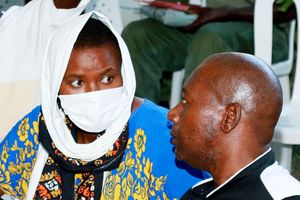
Pastor Paul Mackenzie with his wife Rhoda Maweu, who were both convicted of 238 counts of manslaughter charges relating to deaths in Shakahola Forest that happened between January 2021 and September 2023, after the Judgement delivered by Chief Magistrate Alex Ithuku before the Mombasa Law Court.
Photo credit: Kevin Odit | Nation
Indeed, during the early stages of investigations and exhumations, she secured temporary freedom after the court granted her a Sh300,000 bond, observing that there was little evidence against her beyond her association with the preacher.
“It would appear that her undoing was being Mackenzie’s wife. It is only mentioned that she is believed to have resided with her husband at Shakahola. If her only sin is being Mackenzie’s wife, then her continued detention would be unwarranted and unfair. There is no basis for holding her in custody any further,” the court ruled at the time.
But as investigations progressed and witnesses began recounting life inside Good News International Church (GNI), that early impression gradually gave way to a more complicated picture.
Evidence presented in court portrayed Maweu as an influential figure within the organisation, with responsibilities that went beyond those of a preacher’s wife and extended to the indoctrination and control of followers.
She was entrusted with religious literature used to reinforce the church’s teachings, which shaped the beliefs of members and encouraged their rejection of conventional institutions and services.
Her influence also extended to the women’s and children’s sections, where she helped guide female followers and pass on instructions in keeping with Mackenzie’s teachings.
It was a role that placed her close to the machinery through which the church’s extreme beliefs were translated into everyday practice.
At the centre of those teachings was the deadly fasting doctrine, which persuaded followers to forgo food in the belief that death would bring them closer to salvation.
The Shanzu court would later find her guilty of engaging in organised criminal activity and radicalisation, concluding that she had helped promote an extreme belief system that facilitated ideologically motivated violence through fasting to death.
In its assessment, the court found that Maweu participated in the group’s activities by keeping religious literature, encouraging women and children, and guiding them on spiritual matters in accordance with her husband’s teachings.
“It is the court’s view that Maweu actively participated in the organised criminal activity headed by your husband, Mackenzie, who ordered fasting to death. She is hereby found guilty of the offence of engaging in organised criminal activity and radicalisation,” the court ruled.
However, the magistrate drew a distinction between her participation in the organisation and Mackenzie’s role in disseminating extremist publications.
Although she was found to have kept religious literature and guided women and children followers, the prosecution did not provide sufficient evidence linking her directly to the production or distribution of the CDs, DVDs and pamphlets recovered from Mackenzie’s house.
The court consequently found that her marriage to the preacher, or her participation in the church, could not by itself establish that she possessed or distributed publications intended to instigate terrorism.
Yet perhaps the most disturbing account of her influence emerged from outside Shakahola, in police custody in Watamu.
Even after the forest had been exposed as the site of mass deaths, the doctrine appeared to have followed its adherents beyond its boundaries.
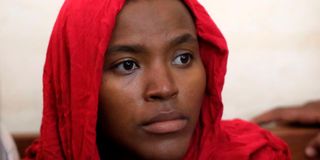
Pastor Paul Mackenzie wife Rhoda Mumbua Maweu.
Photo credit: Kevin Odit I Nation Media Group
While in custody, Maweu encouraged a fellow follower, Joseph Juma Buyuka, to persist with extreme fasting despite his deteriorating physical condition.
Mr Buyuka eventually died, turning what might have appeared to be another act of religious persuasion into a matter of criminal responsibility.
On Friday, the Mombasa court found Maweu guilty on one count of manslaughter arising from Mr Buyuka’s death in custody.
“Maweu is convicted on one count, relating to the death of Buyuka in police custody in Watamu,” Justice Alex Ithuku ruled. He had begun handling the matter as a magistrate before his elevation to the High Court.
The verdicts marked a striking departure from the early perception of Maweu as a woman whose misfortune was simply being married to Mackenzie.
The court’s findings instead established her participation in the organisation’s activities while also holding her criminally responsible for Buyuka’s death.
Born in 1998 in Kibwezi, Makueni County, Maweu came from a humble family of peasant farmers and was the second of four children. Her parents later moved to Malindi in 2017 in search of better economic opportunities, where they took up small-scale businesses.
Unlike the life she would eventually become associated with, her early years offered a glimpse of a young woman with academic promise.
She attended St Joseph’s High School in Kibwezi, where she scored a B plain in her Kenya Certificate of Secondary Education examinations in 2016.
She subsequently secured admission to Jomo Kenyatta University of Agriculture and Technology (JKUAT), but financial difficulties at home prevented her from pursuing a university education.
Her next stop was Nairobi, where she took up casual employment as a waitress in a hotel. It was there that she met the charismatic preacher Mackenzie, who would dramatically alter the course of her life.
Their relationship developed into marriage in 2019 through customary rites. By then, Mackenzie was already a preacher, and Maweu became part of a family that included four children from his previous relationships.
The couple later had a daughter, who is currently living under the care of a paternal aunt in Malindi. Meanwhile, her parents and siblings remain in close contact with her.
From a young woman who had excelled in secondary school but missed university due to a lack of fees, Maweu’s journey took an unexpected turn when she married Mackenzie.
She would eventually find herself at the centre of one of Kenya’s most devastating religious extremism cases.
Now, Maweu is a convict awaiting sentencing for serious offences, including manslaughter, which carries a maximum penalty of life imprisonment, as well as terror-related charges that attract equally severe punishment.