The Council of Governors (CoG) is seeking Sh4.2 billion to finance the transition from one governor to another following the 2027 General Election, in what is raising fears that county chiefs are pursuing a soft landing at the taxpayers’ expense.
At the same time, the council is pushing to raise the statutory wage-bill ceiling (the percentage of total allocation that a county can spend on salaries) from 35 percent to between 40 and 45 percent to accommodate additional recruitment and rising personnel costs.
CoG Chairman Muthomi Njuki made the proposals while presenting the governors’ comments on the 2027 Budget Policy Statement before the Senate Committee on Finance and Budget, arguing that counties require additional resources to prepare for leadership changes and meet growing staffing obligations.
The Sh4.2 billion transition funding is intended to facilitate the handover of county administrations, with the council warning that the 2027 elections will trigger changes in leadership at both levels of government, requiring arrangements to safeguard stability, continuity of services and good governance.
According to the governors, the transition will involve induction and training of incoming office holders, establishment and operationalisation of Assumption of Office of Governors Committees, publication of reports and publicising the transition process, among other activities.
Council of Governors chairperson Muthomi Njuki when they appeared before the Senate Finance Committee on Thursday, November 26, 2026.
The proposed funding also covers transition-related activities including the preparation of institutional structures, training and induction of incoming leaders, coordination of the handover process and ensuring county administrations remain operational during the change of leadership.
The governors say the process requires funding to put in place the structures necessary to ensure incoming administrations assume office smoothly while maintaining government operations and avoiding disruptions to service delivery during the transfer of power.
“We are in an electioneering year where we definitely need to have in place what we normally call the Assumption of Office Committees. And counties need funding for this to manage the transition,” Mr Njuki told the committee chaired by Mombasa Senator Mohammed Faki.
He said preparations for the transfer of power would begin months before election day, requiring counties to have the money in place early to facilitate the process.
“It is important to note that the transition does not take place the day after elections. It’s a process that starts much earlier, as early as January next year. And therefore, the funding needs to be in place,” he said.
The council estimates the transition will cost Sh4.2 billion across the 47 counties and wants the allocation applied uniformly, arguing that the structures, activities and processes required to facilitate the change of administration are similar across the devolved units.
Kakamega Governor Fernandes Barasa, the chairman of CoG’s Finance, Planning and Economic Affairs Committee, said the Sh4.2 billion was arrived at after costing transition activities across the 47 counties, with each county expected to receive an average of Sh90 million.
He said the expenditure had been itemised to cover costs associated with the assumption of office committees and other transition activities, which will begin before the August 2027 General Election and extend beyond the polls to facilitate the handover of power and ensure continuity of county operations.
The funding request comes as counties begin preparing for the 2027 elections, which are expected to usher in new administrations in some counties while others retain their incumbent governors.
The transition process is expected to involve the preparation and transfer of government records, institutional briefings, induction of incoming leaders and coordination of administrative structures to ensure continuity.
The transition request is part of a wider push by the governors for additional resources, with the CoG proposing that counties receive Sh557.24 billion in equitable share for the 2027/28 financial year against the Sh449.47 billion proposed in the budget policy statement.
The council argues that the proposed allocation should reflect revenue growth, the cost of additional responsibilities assigned to counties and emerging expenditure obligations, including personnel costs and funding for devolved functions.
Its proposed adjustments include funding for Universal Health Coverage workers, salary increments, remuneration reviews, transition-related costs and enhanced recurrent expenditure ceilings for county assemblies, among other obligations.
The governors are also seeking additional resources to finance functions transferred or unbundled from national government ministries, departments and agencies, arguing that counties should not be left to shoulder responsibilities without corresponding funding.
The council has identified about Sh6.65 billion in resources relating to transferred and unbundled functions, which it wants factored into county allocations to ensure devolved governments can effectively perform the responsibilities assigned to them.
It is also seeking Sh11.18 billion to accommodate enhanced recurrent expenditure ceilings for county assemblies, arguing that assemblies face growing operational and personnel costs that cannot be adequately addressed within existing allocations.
The governors have further proposed Sh3.25 billion for the remaining 13 counties under the County Kitchens programme, seeking to extend the initiative to counties yet to benefit.
Separately, county chiefs want Parliament to review the law limiting personnel spending to 35 per cent of county revenue, arguing the threshold is increasingly incompatible with the demands of devolved service delivery and expansion of public facilities.
The governors say counties cannot expand hospitals and other public services without recruiting additional personnel to operate the facilities, arguing the wage-bill ceiling has constrained their ability to hire workers despite growing service delivery demands.
“This may require a change of law. No institution has been able to align and achieve 35 per cent. There are always staff involved in service delivery. When you build more hospitals, you need staff. You cannot have an increase in service delivery without increasing staff,” Mr Njuki said.
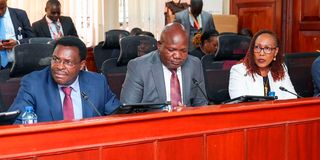
The Chairperson of the Council of Governors (CoG), Muthomi Njuki (left), Kakamega County Governor Dr Fernandes Barasa,and the CoG Chief Executive Officer (CEO), Mary Mwiti (right), appear before the Senate Standing Committee on Finance and Budget at County Hall, Nairobi, on Thursday, November 26, 2026.
Photo credit: Dennis Onsongo | Nation
The CoG is proposing that the threshold be raised to between 40 and 45 per cent of county revenue, giving devolved governments greater room to recruit health workers, teachers and other essential personnel as they expand services and infrastructure.
CoG Chief Executive Mary Mwiti questioned the basis of the current ceiling, saying the 35 per cent threshold was introduced under the Public Finance Management framework before devolution and was not informed by the realities of county governance.
“This percentage was not scientifically driven. It was in the PFM before devolution. For any growth and increase of structures in county governments, there must be attendant human resources,” she said.
Ms Mwiti said the ceiling had become increasingly untenable as counties took on wider responsibilities and expanded their service delivery structures, calling for a review of the formula used to determine personnel expenditure.
“We need to go back to the drawing board and get a new formula. Thirty-five per cent, to be very honest, is not realistic. It is not tenable with the current scenario and context of governance that we are in,” she said.
The CoG says county governments’ wage bills averaged 39.5 per cent of total revenue in the 2025/26 financial year, compared with 41.4 per cent in 2024/25, with only five counties having managed to comply with the 35 per cent ceiling.
The Council argues that the wage-bill pressure is compounded by salary reviews, collective bargaining agreements, personnel obligations arising from transferred functions and the cost of expanding county services, which it says have not always been accompanied by adequate funding.
The governors are also seeking the settlement of outstanding Equalisation Fund entitlements, whose cumulative allocation between FY2012/13 and FY2026/27 stood at about Sh90 billion, with approximately Sh22.42 billion paid by June 2026. They want Treasury to provide a time-bound plan for settling the outstanding balance and ensure the remaining resources are directed towards priority gaps in basic services.
The proposed increase in the wage-bill ceiling is likely to reopen debate over the balance between recurrent and development expenditure, with a higher limit potentially allowing counties to expand their workforce but leaving a smaller share of revenue available for infrastructure, development projects and other capital investments.