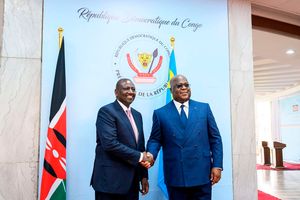
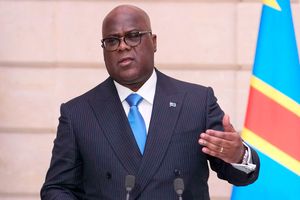
For most of the past four years, Congolese President Félix Tshisekedi has avoided appearing in the same photograph as Kenya’s President William Ruto.
That changed twice in the past month. In October, at the Russia-Africa Summit in Moscow, the two leaders appeared in the same family photograph organised by their host, Vladimir Putin, and attended other summit events under the same roof.
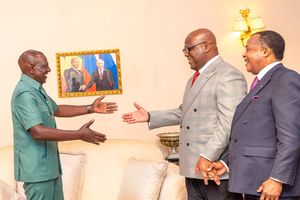
Then, last Sunday in Oyo, Congo-Brazzaville, they sat opposite each other at a lobby table. Brazzaville secured not just a handshake but also a joint photo opportunity.
The story did not begin in Brazzaville, however. According to diplomatic sources who spoke to Sunday Nation on condition of anonymity, it began with a conversation between the two countries’ intelligence chiefs: Noordin Haji, the Director-General of Kenya’s National Intelligence Service (NIS), and Gaston Mikobi, head of the Congolese External Intelligence Agency. Days before the trip, Mr Mikobi was in Nairobi to discuss renewed security cooperation, which had been missing for four years.
Officials said cooperation was becoming harder because political leaders were not talking. Regional bodies the two countries are members to, such as East African Community (EAC) and the International Conference on the Great Lakes Region (ICGLR), have also struggled to bring harmony among their members.
The two countries’ embassies had largely stopped functioning after the term of the Congolese ambassador to Kenya, Joseph Nyakeru, ended in July 2024 and Kenya’s George Masafu retired the same year. Kinshasa had refused to accredit two Kenyan ambassadors in quick succession and had not nominated an envoy to Kenya in two years. Kenya’s embassy premises were also torched by a mob last year.
The two agencies agreed that reopening the embassies would ease cooperation, but this needed a formal decision by the leaders. Congolese President Denis Sassou-Nguesso became the most likely host because he is on good terms with both Nairobi and Kinshasa, according to sources.
President William Ruto, Democratic Republic of the Congo President Félix Tshisekedi (centre) and Republic of the Congo President Denis Sassou N’Guesso during the High-Level Quadripartite Political Summit in Oyo, Republic of the Congo on November 22, 2026.
Photo credit: PCS
A communiqué from Oyo, following the meeting that was also attended by Togolese President of the Council Faure Gnassingbé, said the two sides had agreed, as an initial step, to redeploy their ambassadors soon and to keep diplomatic channels open.
The communiqué does not explicitly mention security in the Great Lakes region, but Mr Gnassingbé, said it is a threat to everyone.
“Faced with the security and humanitarian challenges confronting our populations, our conviction remains firm: dialogue, consultation and diplomacy must prevail in order to foster lasting political solutions and achieve genuine peace,” Mr Gnassingbé said after presidents Ruto and Tshisekedi attended the meeting hosted by Mr Sassou-Nguesso. Mr Gnassingbé also attended as the African Union’s mediator.
The thaw was first driven by growing concern that the Ebola outbreak and the humanitarian and security crisis in eastern Congo were damaging both countries’ economies.
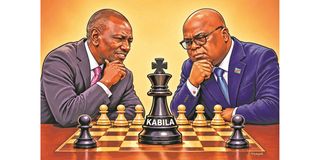
But politics also played a part. Kinshasa is wary of former President Joseph Kabila’s recent return to rebel activity and was concerned that he could gain ground in Nairobi from where he has held political events recently.
After the summit, Dr Ruto and Mr Tshisekedi agreed to “strengthen cooperation within regional mechanisms responsible for peace, security and integration issues”, particularly the ICGLR and the EAC, “with a view to jointly contributing to the consolidation of peace and stability in the region.”
In October, Kabila, who ran Congo for 18 years until 2018, founded the Front for the Refoundation of the Nation (FRN), formalising his alliance with the leaders of AFC/M23, the biggest rebel group in eastern Congo. He has been sentenced to death in absentia and has long been a source of tension between Kenya and the DRC. Last year, he formed an alliance in Nairobi, vowing to topple Kinshasa, and endorsed the Congo River Alliance (AFC), the precursor of the FRN. Kinshasa protested when the AFC was launched in Nairobi.
Most AFC leaders also face death sentences in absentia. But Kinshasa, which has not carried out an execution in three decades, has been unable to stop the conflict in eastern DRC.
“For the DRC, many of the options have not succeeded,” the official explained, speaking on condition of anonymity.
“When you have gone full circle making everyone an enemy, you have got to weigh your decisions. Nairobi is not Kinshasa’s enemy. It is the last thing they want,” the official told Sunday Nation .
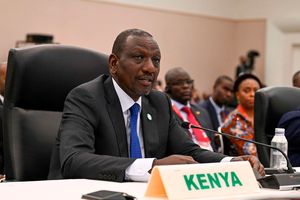
President William Ruto and his Republic of the Congo counterpart, Denis Sassou N’Guesso during the High-Level Quadripartite Political Summit in Oyo, Republic of the Congo on November 22, 2026.
Photo credit: PCS
Kenya’s proposal, the diplomatic sources said, was to show that it would not support any rebel movement. Kenya also told Kinshasa that it gains little by making public allegations.
Reaching out to Nairobi, the official said, was one way to cut off Kabila’s foreign networks especially as he is heavily sanctioned. Kinshasa is also concerned that the peace accord it signed with Rwanda last year, mediated by the US, continues to fail, with the neighbours meant to guarantee it routinely seen as enemies.
Kabila, now under US sanctions, has embraced confrontation with Tshisekedi, perhaps to remain relevant. He dissolved the AFC while Kinshasa was negotiating with the group in Doha, Qatar. Some commentators say this might mean Kabila himself wanting to negotiate with Kinshasa, where his head is wanted.
Some key AFC figures, including Corneille Nangaa, Bertrand Bisimwa and Sultani Makenga, are now with Kabila, who spent years fighting the M23 during his presidency.
“The country is in peril; to do nothing is to be complicit,” Kabila said then. He claimed he wants to save Congo from the brink of collapse, while denouncing what he considers an authoritarian drift by the current government.
His movement aims to “bring together and coordinate all forces of resistance to put an end to tyranny by all means, including force.”
This comes as Tshisekedi pushes to amend the constitution and remove term limits. Lawmakers have approved the proposals, which must go to a referendum. But a referendum requires peace and security for voters, which are not assured in eastern DRC, where Kabila’s group is in control. Both sides now agree that their tensions were hurting trade. Last month, Kenyan truck drivers petitioned the government for security assurances after threatening to stop shipping goods to eastern Congo, where rebel activity is rampant.
From right: President William Ruto, Republic of the Congo President Denis Sassou N’Guesso, President of the Council of Ministers of the Togolese Republic, Faure Essozimna Gnassingbé and Democratic Republic of the Congo President Félix Tshisekedi during the High-Level Quadripartite Political Summit in Oyo, Republic of the Congo on November 22, 2026.
Kenya argues that Nairobi and Kinshasa must inevitably work together, describing the recent tensions as bumps on the road.
“Kenya and DRC are not abstractions on a map. We share deep connections, trade, security, and brotherhood,” said Korir Sing’oei, Kenya’s Principal Secretary for Foreign Affairs.
“Our people cross, trade, marry, and build together daily — from Goma to Bunia to Kinshasa to Nairobi. Those who manufacture tension from a distance, for clicks, for funding, for foreign agendas, do not know the market woman in Goma, the truck driver on the Northern Corridor, the mother in Ituri,” Mr Sing’oei said.
Earlier, Mr Sing’oei had said that bringing the vital Kenya-DRC relationship back on track reflected the leaders’ “commitment to the ideals of Pan-Africanism, the values of solidarity and fraternity among African peoples, and the promotion of African solutions” to the challenges confronting the continent, including peace, security and stability in the region.
Both sides had tried before. Last year, Kenya sent a special envoy, Prime Cabinet Secretary Musalia Mudavadi, to dispel suspicions that Kenya was siding with rebels. Mr Mudavadi was received in Kinshasa, but months later Tshisekedi had not softened his stance.
When Kenya nominated a new ambassador, Peter Tum, Tshisekedi still did not accept his credentials. At the France-Africa Summit in Nairobi, Tshisekedi travelled to Kenya but avoided a public photograph with Ruto.
Both sides agree that the situation in eastern DRC is tricky, but Kinshasa said the causes of the conflict 20 years ago differ from today’s.
Mr Sing’oei said all political and diplomatic efforts should be encouraged to find a solution “given the conflict exposes the region to other risks including public health crises.”
The communiqué avoided mentioning the war in the DRC, over which Tshisekedi and Ruto have held divergent, even contradictory, views and which was at the root of their rift. They did, however, commit to non-interference in the internal affairs of states and reaffirmed their “commitment to the principles of sovereignty, territorial integrity."