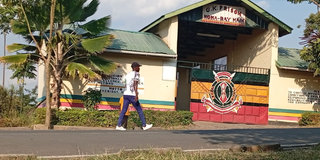
Homa Bay GK Prison on July 27, 2026. Plans are underway for the correctional facility to be relocated to Lambwe Valley to create room for expansion of Tom Mboya University.

George Otieno has lived in Nyadenda Village in Suba South, Homa Bay County for the past 60 years.
He grew up there after his parents relocated from Nyakach in Kisumu County. Among the Luo, it is customary to introduce oneself not only by name but also by ancestral home. In keeping with that tradition, Mr Otieno identifies himself as a man from Nyakach.
Yet he cannot trace his roots to the exact place his family once called home. He knows Suba South far better than he knows Nyakach.
“My parents moved to Suba when I was still young. This is the place I know as my home,” he said.
Mr Otieno’s family is among hundreds that migrated from different parts of Nyanza to settle in Lambwe Valley in Homa Bay.
Today, many of those families can only name their ancestral homes but cannot identify their precise locations. Having spent decades in Lambwe, the valley has become the only home they truly know.
Long before people settled there, the valley was largely untouched by human habitation. Wildlife roamed freely across vast expanses of thorny woodland and scrub, while fertile tracts of uncultivated land lay waiting for cultivation.
Recognising its agricultural potential, the government embarked on an ambitious resettlement programme. Beginning in the mid-20th century, families were moved into the valley to ease severe overpopulation and overstocking in neighbouring regions, reclaim productive but unused land for farming, and occupy areas made safer after State-led efforts to control tsetse flies and sleeping sickness.
By the 1970s, Lambwe Valley had become home to a significant population. But for many settlers, the promise of a fresh start soon gave way to hardship.
Although the government reduced the tsetse fly menace, it never fully eliminated it. To this day, the insects continue to threaten farmers by attacking livestock and spreading disease.
Many families also found themselves displaced repeatedly as the government established State facilities, including Ruma National Park and a National Youth Service (NYS) camp.
Joseph Gadi, a resident of Nyakiya Village, recalls when the government expanded the park by fencing off additional land to protect wildlife and reduce human-wildlife conflict.
According to him, families that had originally been allocated land by the government were forced to vacate to make way for the park’s expansion.
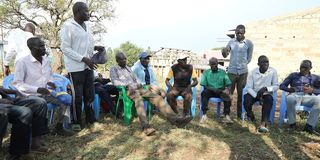
Community members in Nyadenda Village in Lambwe Valley in Suba South, Homa Bay county on July 27, 2026.
“My family was among those evicted. Some families had already buried their loved ones on the land where they had settled before they were told to move,” Mr Gadi said.
Another wave of displacement followed in the early 1970s when the government identified Lambwe as the site for a National Youth Service camp.
The facility, then known as the Lambwe Valley Development Unit or Lambwe Field Station, focused on community development, agricultural production and vector control.
Mr Gadi said several families were uprooted to create space for the project.
“Some people died during the evictions. Families lost their property when the government announced it wanted land for the camp,” he said.
Filegona Atieno said she had settled in the area before the camp was established.
During her time there, she lost two sons and a grandchild, all of whom were buried on the land where the family had first settled.
“I had to move out when the camp was established, leaving behind the graves of my children and grandchild,” Ms Atieno said.
The elderly resident said her family unsuccessfully challenged the eviction in court.
For more than four decades afterwards, families rebuilt their lives, living peacefully and relying on farming for their livelihoods. Slowly, many healed from the pain of repeated displacement.
Now those old wounds are being reopened.
Read:
The government has identified Lambwe as the preferred site for a new prison, reviving fears of yet another forced relocation.
“We were moved because of the park. We were moved because of NYS. Now a prison?” Mr Gadi asked.
The valley that was once empty is now home to generations who know nowhere else. Yet with every new government project, the ground beneath their feet seems to shift once again.
In May 2025, President William Ruto directed the Interior and Education ministries to develop a plan for relocating inmates from Homa Bay GK Prison to create space for the expansion of Tom Mboya University.
The President said the land currently occupied by the correctional facility should be released to facilitate the university’s growth and strengthen higher education in the region.
Several alternative locations were considered, including Kanyamwa Kosewe in Ndhiwa.
However, elders and political leaders there strongly opposed the proposal, forcing the government to abandon the plan.
That has left Lambwe as the remaining option, heightening anxiety among residents who fear another round of displacement.
Tom Mboya University stands adjacent to the existing prison. It was established in 2016 as a constituent college of Maseno University. Before then, it operated as a Farmers Training College.
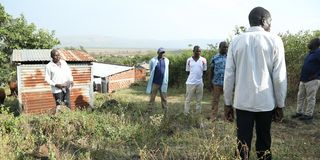
Community members in Nyadenda Village in Lambwe Valley in Suba South, Homa Bay county on July 27, 2026.
The institution received its own charter as a fully fledged university in 2022 and currently offers programmes in business, arts, education and ICT. It is also preparing to introduce engineering courses.
The government further plans to establish a Centre of Excellence for Blue Economy and Maritime Affairs at the university.
These expansion plans require additional land for research facilities and new buildings.
President Ruto directed Interior Cabinet Secretary Kipchumba Murkomen to work alongside Education Cabinet Secretary Julius Ogamba to ensure the university acquires more land.
“I have instructed the Ministry of Education and Internal Security to work on making sure that extra land is given to Tom Mboya University, especially from the prison. I think we can take the prisoners to Lambwe Valley,” the President said.
Lambwe was identified as the preferred relocation site because of its expansive land.
The Head of State said the move was intended not to punish inmates but to support the growth of higher education.
“I think we can take the prisoners to Lambwe Valley. Not because it is infested with tsetse flies, but because we have space there,” he said.
Tom Mboya University currently has more than 6,500 students.
Residents of Nyadenda say recent developments suggest that the proposed prison will be built close to their homes.
Officials from the Ministry of Lands have visited the village to conduct surveys, take measurements and install boundary beacons.
Some of the new markings indicate that several families will have to vacate the land they currently occupy.
Tobias Onyango is among those whose homes are reportedly earmarked for demolition after being informed that they occupy government land.
His home stands next to the NYS camp fence.
However, newly installed beacons now suggest that part of his land falls within the camp.
“I settled here in 1972 before the land was subdivided in 1975. I have always known where my boundary is because it was marked by NYS officials who placed a beacon,” Mr Onyango said.
He questioned how boundaries that had existed for decades could suddenly change overnight.
Affected families believe some NYS officials colluded with their counterparts in the prison service to acquire additional land for the proposed correctional facility.
They argue that both the prison and the NYS camp require vast acreage for agricultural activities and suspect that some rogue officials are attempting to secure more land at the community’s expense.
Enos Odaga, who settled in Nyadenda in 1971, remembers previous evictions vividly.
According to him, families were never consulted or given notice before being forced to leave.
“We were simply confronted and ordered to move. No reasons were given. Police even fired into the air to disperse those who resisted the government’s plans,” he said.
Human rights activists are now calling for the proposed relocation of the prison to be suspended until all land disputes are resolved.
Interface Community Help Desk Chairperson Evance Oloo and member Micheal Kojo said they are not opposed to relocating the prison, but are deeply concerned about the manner in which land is being acquired.
Mr Oloo argued that the prison service and the NYS camp could share the existing land without displacing residents.
He urged Lands Cabinet Secretary Alice Wahome to ensure meaningful public participation before any further action is taken.
“We will file a case in court to stop the process. We also want past cases of displacement reviewed so that affected families can be returned to their original land,” he said.
Mr Kojo criticised the government for failing to involve residents while officials from the Ministry of Lands were identifying new boundaries.
Follow our WhatsApp channel for breaking news updates and more stories like this.