Court annuls Isiolo Sh7bn budget on rushed process

Isiolo County Assembly. The High Court has declared the Isiolo County Appropriation Act, 2025 unconstitutional.

The High Court has declared the Isiolo County Appropriation Act, 2025 unconstitutional and nullified the county's Sh7.3 billion budget, citing multiple violations of constitutional provisions on public participation and legislative process.
The judgment followed a petition by Speaker Mohamed Roba Qoto and nine Members of the County Assembly, who challenged the legality of the budget's passage in July this year.
However, recognising the potential disruption to the county government’s financial operations, the court suspended the nullification order for three months to allow for corrective action. During this period, the county government must restart the budgetary process from scratch, this time ensuring full compliance with constitutional requirements.


This includes conducting meaningful public participation across all wards, maintaining proper records of legislative proceedings, and submitting verifiable documentation at each stage.

Isiolo County Assembly Speaker Mohamed Roba Qoto
“The Isiolo County Assembly and the County Executive Committee Member for Finance are directed to regularise the legislative process and re-enact the Isiolo County Appropriation Act, 2025 within the three-month suspension period, in strict conformity with the Constitution,” said the judgment.
This temporary reprieve allows the county government to continue functioning while working to rectify the constitutional violations.
The suspension recognises the potential chaos that could ensue if all county financial operations were halted abruptly, particularly regarding staff salaries and ongoing development projects.
County Revenue Fund
The contested Act, published on July 25, 2025, sought to authorise the spending of Sh7.3 billion out of the County Revenue Fund.
The petition argued that the county government had rushed through the budgetary process without following proper procedures or consulting residents adequately.
The court’s ruling exposed systemic failures in how the budget was prepared and enacted, highlighting the absence of crucial documentation that should have accompanied such a significant financial decision.
Central to the court's decision was the finding that public participation - a constitutional requirement for all county budgets - had been reduced to a mere formality.
The county executive had allocated just three days for consultations across Isiolo's 10 wards, an impossibly short timeframe given the county's vast geography and low literacy rates.
“This court is not convinced that the CEC Finance was, within those two days, and in the manner that it was done, in a position to collect, analyse and effectively incorporate the views of the public,” said the judge.
The court noted that public notices appeared only in newspapers, ignoring radio broadcasts —critical in a county where literacy levels stand at 49 percent, far below the national average of 82.9 percent.
“As per county government’s current integrated development plan, the county’s literacy level is at 49 percent against the National Average of 82.9 percent. Thus, the advertisement through the Newspaper was inadequate in view of the prevailing literacy level,” stated the court.
The judgment found the county officials had failed to produce authentic Hansard records proving the budget had been properly debated in the assembly, submitting instead an uncertified document of questionable authenticity.
Critical minutes from committee meetings and attendance registers were conspicuously absent, leaving the court unable to verify whether proper legislative procedures had been followed.
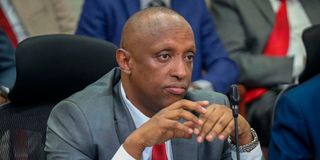
Isiolo Governor Abdi Guyo when he appeared before the Senate Committee on Public Investments and Special Funds in Nairobi on May 15, 2025.
The judge described these omissions as fatal to the budget's legitimacy, emphasising that constitutional processes cannot be treated as optional formalities.
The case exposed deep divisions in Isiolo’s leadership. The respondents —led by Deputy Speaker David Lemnantile— claimed the petition was politically motivated, stemming from a feud between Speaker Roba and Governor Abdi Guyo.
However, the court rejected this argument outright. The judgment made clear that, regardless of political tensions, constitutional compliance remains non-negotiable.
"This is not about political rivalry but blatant disregard for the law," the court said in the verdict that reinforces Kenya's constitutional safeguards on fiscal responsibility and citizen participation in governance.
It added: “The rule of law is not an option for both those who govern and the governed. The moment any of the parties step outside it, injustice, anarchy, and oppression are some of the inevitable results”.
Follow our WhatsApp channel for breaking news updates and more stories like this.