Days after it was officially declared complete, sections of the Sh4 billion Ngong–Suswa road are already showing visible cracks, raising fresh questions about construction quality, supervision and the integrity of the multi-billion-shilling infrastructure spending.
The roughly 70 kilometre road, billed as a major alternative to the congested Nairobi–Mai Mahiu route, has in recent days come under intense scrutiny following a wave of public criticism online.
The backlash was triggered after Interior Principal Secretary Raymond Omollo announced that the road was complete and fully operational, describing it as a transformative project that would unlock economic opportunities and ease travel for thousands of motorists.
But a spot check by the Nation reveals a more complicated reality on the ground, one that sharply contrasts with the official narrative.
From Ngong Town, the road begins with promise. The tarmac is smooth and the ride steady despite huge traffic, especially heading to the town. Several motorists are already embracing it as an alternative route, keen to avoid the often treacherous and congested Nairobi–Mai Mahiu escarpment.
Public service vehicles, private cars and tour vehicles snake their way out of Ngong town in a steady flow, an early sign that the road is already reshaping travel patterns across the region.
Motorists using the new Ngong-Suswa road on January 6 2025.
Photo credit: Stanley Ngotho| Nation Media Group
For the first few kilometres, it is easy to see why the road has been celebrated. It cuts through scenic landscapes, opening up vast stretches of land that had long remained difficult to access. There is a sense of movement, of economic potential, of a corridor beginning to come alive.
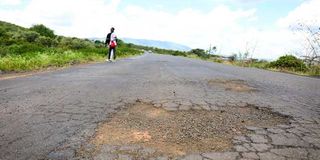
But about 20 kilometres into the journey, cracks begin to appear. What should be a newly laid, pristine surface begins to show signs of early distress. Thin fractures stretch across sections of the tarmac.
In some areas, the cracks widen into visible breaks, cutting across entire lanes. The ride becomes uneven. Vehicles slow down, and drivers instinctively manoeuvre to avoid damaged patches that seem out of place on a road barely months old.
The road alternates between smooth and rough rides. Further along, the surface also deteriorates with a few potholes that disrupt the flow of traffic. Some sections appear patched, suggesting recent repair attempts. Others look neglected, as if the damage has been allowed to persist without intervention.
For a project of this scale and cost, the early signs of wear are difficult to ignore.
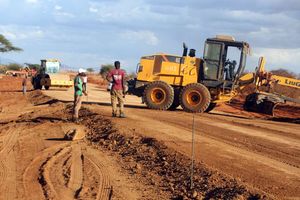
In several areas, construction crews are still at work. Workers can be seen along the roadside, digging trenches, adjusting drainage channels and attending to sections that appear unfinished.
There are also piles of construction materials that lie by the roadside. Drainage systems, a critical component of road durability, are also incomplete in many sections. Open trenches run alongside the road, some partially constructed, others abandoned mid-work.
Without proper drainage, water can seep into the road base, weakening its structure and accelerating the kind of cracking now visible on the surface.
A section of the Ngong–Suswa Highway, pictured on April 8, 2026.
Photo credit: Bonface Bogita | Nation Media Group
The absence of basic safety features is equally concerning. Large sections of the road lack clear markings. Lane dividers are entirely missing. Reflective signs, which are essential for night driving, are also scarce.
Guardrails, particularly along sharp bends and elevated sections, are either incomplete or not installed at all. Driving through these stretches requires constant alertness. The road twists and turns through hilly terrain, with sharp corners that appear suddenly.
In the absence of signage, drivers unfamiliar with the route are forced to rely on instinct, slowing down abruptly or risk misjudgement. Along some stretches, herds of cattle graze by the roadside. At times, they spill onto the road, crossing slowly as vehicles approach. There are no designated animal crossing zones, no warning signs to alert motorists to the presence of livestock. It is a hazard that locals say has already contributed to a rise in accidents.
At Kimuka, along the corridor, livestock farmer John Oleluan has witnessed the changes firsthand. The road, he says, has brought opportunity, but also risk.
“Most drivers using this road have not used it before. We are seeing accidents almost daily. It is risky, and some people have lost their lives,” he said.
His concerns are echoed by other residents who say the combination of poor signage, damaged sections and unfamiliar drivers has created a dangerous mix. The road may be new, but its risks are already evident.
A PSV vehicle plying the new Ngong-Suswa road on January 6, 2025. The new highway offers an alternative route to motorists heading to South Rift and Western Kenya.
Photo credit: Stanley Ngotho| Nation Media Group
Mr John Kameru, who moved to the area a few years ago, says the situation is worrying.
“We are worried. The road has improved access, and that is a good thing. But when you start seeing sections already damaged, it becomes dangerous. If the government does not fix this in time, it will become a death trap,” he said.
Nation contacted Kenya Rural Roads Authority board chairman Anthony Mwaura for an explanation regarding the state of the road and whether the construction standards were breached.
He referred us to the Director General Jackson Magondu, who was yet to respond by the time of going to press.
A KeRRA official, who is familiar with the road but not authorised to speak to the media, attributed the damage to a huge number of trucks that are avoiding the Suswa weigh bridge along the Mai Mahiu escarpment, especially at night.
“We experienced a lot of heavy trucks that were avoiding the Suswa weigh bridge, especially during the night. They would sneak in under the cover of darkness to avoid being detected. We acted fast and set up another weighbridge along the same route to ensure compliance. We now weigh, and the trucks using the roads are very heavy,” he explained.
He also explained that, contrary to recent news that the road is new, it has been in construction since 2018, and some sections of the road have been in use. “It is important for us to understand that the road is not actually new. It has been in construction since 2018, and it has been in use.”
But even as concerns mount, there is no denying the road’s impact on local livelihoods. In a statement posted on X, PS Omollo described the road as “a major milestone” that would transform regional connectivity, reduce travel time and unlock economic opportunities across Kajiado and beyond.
He said the highway would ease pressure on the Nairobi–Mai Mahiu corridor while boosting trade, tourism and investment along the route.
There are already signs of that promise. Motorists and local businesses say the road has opened up the area, making travel to Narok and surrounding counties such as Bomet, Nyamira, Kericho and Kisii faster and more efficient. New shops and trading centres are emerging along the corridor, signalling early economic activity. A tour operator along the route described the road as a game changer despite its flaws, citing easier access to clients and the scenic value of the drive.
“It is now easier to access Narok. Picking up tourists from Nairobi is faster, and the drive is more direct. The views along this road are also very attractive,” Mr Derrick Babu said.