For more than half a century, the community in Kajiado County has lived with what many regard as one of Kenya’s longest-running historical injustices – the loss of Amboseli National Park.
Today, some 52 years after Amboseli was gazetted as a national park and placed under the Kenya Wildlife Service (KWS), the dream of reclaiming its stewardship hangs in the balance again, this time stalled by court battles despite a presidential directive to transfer its management to the devolved government of Kajiado.
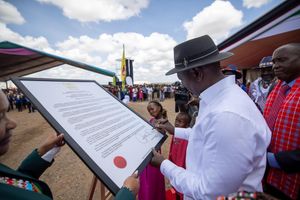
Three days before President William Ruto handed the Amboseli National Park transfer deed to the county government of Kajiado on November 14, 2025, conservationists and activists lodged a petition at the High Court in Nairobi challenging the decision and setting the stage for a fresh legal battle over one of Kenya’s most iconic parks.
Amboseli National Park, which is 392 square kilometres, got its name from the Maasai word “Empusel”, which means “a salty and dusty place”.
It has remained one of the country’s premier tourist destinations and a major economic artery for locals.
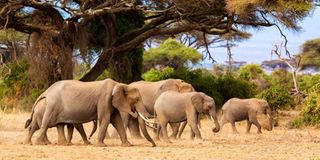
The park, globally known for its large herds of elephants and spectacular views of Mt Kilimanjaro, falls within the Amboseli ecosystem, which boasts dozens of private wildlife sanctuaries and animal migration corridors linking Tsavo West National Park, Chyulu Hills and Serengeti National Park in Tanzania.
The community has coexisted with the animals while bearing the brunt of human-wildlife conflict over the decades.
KWS says up to 23 people have been killed by wild animals in Kajiado County, while 134 others have suffered serious injuries, in the last 10 years.
A pride of lions at Amboseli National Park.
According to Dr David Western’s research memoirs from the late 1960s and early 1970s – corroborated by records of the defunct Olkejuado County Council – a 1,269-square-mile Amboseli National Reserve was established in 1948 and administered by the Kenya National Parks Trustees on behalf of Kajiado County Council.
The reserve was handed to Kajiado County Council to manage as the Amboseli Game Reserve in 1961.The council then set aside a 30-square mile livestock-free area around Ol Tukai swamps to protect wildlife and promote tourism.
The swamps provide visitors with one of the best elephant-viewing sites in the world, especially in the morning.
Pressure was mounting to create a national park around Amboseli swamps in 1967, Dr Western notes in his memoirs, a move that would alienate the community, deprive it of late-season grazing land and sever wildlife migration routes.
Then-Home Affairs Minister Stanley Oloitiptip, who dominated local politics, supported the takeover of the park by the government, sparking a row with Olkejuado County Council Chairman Francis Lemeeki ole Legis.
An Amboseli Maasai Park, which would ensure local participation in wildlife benefits while protecting the integrity of the ecosystem, had been proposed.
Despite initially being accepted by Kajiado County Council, the Maasai Park proposal was ultimately rejected, prompting the Game Department to pull out.
The county council failed to invest in the conservation and management of Amboseli, leading to a run-down reserve and conservation concerns.
In July 1974, President Jomo Kenyatta declared Amboseli a national park. The 1974 gazettement of Amboseli as a national park was a bitter pill for the community.
The dispute centred on the unilateral takeover by the government of the Maasai Amboseli Game Reserve and the curtailment of ancestral grazing rights.
The unresolved history of the 1974 takeover continues to echo loudly. In 2005, locals petitioned President Mwai Kibaki’s administration to have the park back.
The pressure continued through President Uhuru Kenyatta’s administration and into Dr William Ruto’s government.
Kajiado Governor Joseph ole Lenku told the Saturday Nation on Thursday that the government committed a historical injustice against the community despite knowing Amboseli was a game reserve in an ecosystem shared by locals and wildlife.
“It was an orchestrated scheme by individuals who wanted to stamp political authority at the expense of vulnerable locals. Most animals are in group ranches or community land,” said Governor Lenku, who broached the idea to President Ruto in Narok during the Maa Cultural Week in August 2023.
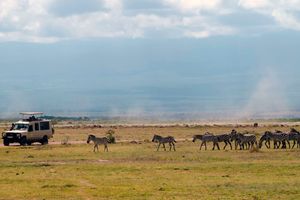
Tourists enjoy a game drive at the Amboseli National Park.
Photo credit: Shutterstock
“Amboseli is a small wetland where wildlife come for water. With the transition in the homestretch, my administration wants to go a notch higher and create what is now called a third-generation park that will focus on the ecosystem, the wildlife and community livelihoods.”
Mr Lenku said Amboseli is and should be the goose that lays eggs for locals through employment, beadwork and other revenue streams stemming from tourism.
“The county government of Kajiado also eyes a new revenue stream,” he said.
According to the KWS data, Amboseli generates roughly Sh3 billion annually through core revenue streams, including park conservation fees (gate entry), concession and lease fees from lodges such as Amboseli Serena, and income from campsites and bandas.
Under the three-year Transition Implementation Framework, KWS was expected to remit 50 per cent of its revenue on July 1, 2026, increase the share to 70 per cent in the 2026/27 financial year and finally transfer 100 per cent of revenue in the 2027/28 fiscal year.
The devolved government was to retain 40 per cent of the remitted revenue, while another 40 per cent was earmarked for community projects in education, water, health and environment conservation.
Governor Lenku expressed confidence that the transition would reduce human-wildlife conflict, arguing that locals would develop a greater sense of ownership of the park.
Olgulului-Olarashi Group Ranch Chairman, Daniel Leturesh, and his Imbirikani colleague, Daniel Metui, said the neighbouring group ranches had set aside a million acres to complement the park.
“In the spirit of wildlife conservation, we have set aside at least one million acres of community land to extend the park as a positive gesture towards conservation,” Mr Leturesh told the Saturday Nation.
Mr Leturesh, who also serves as the chairman of the Amboseli Ecosystem Trust, said the community is excited with the pending transition of the park.
“Locals are waiting for their resources. It’s a key moment for a community that has waited for the government to correct a historical injustice,” Mr Metui said.
Ms Janet Nanapo, a bead ornament trader at Kimana Gate, said she hopes the county government will establish strategic curio shops in the park or at points traders can sell their wares with ease.
“Our preserved culture remains the epitome of tourism in the Amboseli ecosystem and nationally. We want to reap the benefits of our culture. We have always operated at the gates of the park,” Ms Nanapo said.
“We only target visitors when they are entering or leaving. Traders want the devolved government to set up a 24-hour cultural centre.”
Amboseli Land Owners Conservancy Association (Aloca) Chairman, Samuel Kaanki, said locals would gain more from revenue collected from the park.
Mr Kaanki said the county government has been advised to adopt the Aloca model of operations, where 336 landowners in the Amboseli ecosystem are compensated for their conservation efforts.
“Our members get Sh5,000 per acre as a lease fee twice annually. The money is collected from investors who pay conservation fees and from donors. With such a model, landowners will be at ease not to fence their land, allowing animals to roam freely and reducing human-wildlife conflict,” Mr Kaanki said.
Conservation organisations, including Big Life, take an all-round approach to protecting the Amboseli ecosystem, enabling people to earn more from keeping wild animals on their land while reducing the costs they bear as a result.
The rewards are increasing. Conservation, tourism and research in the Greater Amboseli Ecosystem generated at least Sh2.4 billion in 2023, a 74 per cent rise since 2018, supporting more than 1,500 full-time jobs, most of them held by locals, according to the Amboseli Ecosystem Trust and Amboseli Trust for Elephants.
For the community, it is about correcting what it considers a 52-year injustice, reclaiming a shared heritage and securing a future in which conservation and community prosperity coexist – with the final whistle now in the hands of the court.