For months, Charles Seth Okinyi’s family clung to the hope that he had slipped away to Russia in search of greener pastures rather than having joined a group of believers fasting in Kwa Bi Nzaro village, Kilifi, in the hope of meeting Jesus.
The possibility seemed plausible because the 47-year-old prison warder disappeared around March last year, when reports emerged that Kenyans were being recruited to fight for Russia in the war against Ukraine.
Okinyi was stationed at Homa Bay GK Prison and had previously served in Nairobi. His family believed he might have left the country without telling them.
“We thought he sneaked from prison to go and seek greener pastures in Russia, where we were hearing they were employing people,” his brother, Titus Omondi, said.
Graves discovered at Kwa Bi Nzaro area, within Shakahola Forest, Kilifi County on August 15, 2025.
Photo credit: File | Nation Media Group
They held on to that hope, never imagining that Okinyi could have died in the religious fasting linked to controversial preacher Paul Mackenzie and priestess Ann Temba Anindo.
“So, all along, we have been holding that idea that perhaps this gentleman is out of the country but not dead,” Mr Omondi said.
That uncertainty ended last Thursday when DNA tests identified Okinyi’s body at Malindi Mortuary. His brother was among relatives who collected the remains of their loved ones for burial, bringing an agonising wait to an end.
“Now that they have positively identified Okinyi’s body through DNA sampling, I am convinced that that is him. I am going to give him a befitting send-off,” Mr Omondi said outside the mortuary as he prepared to take his brother home to Migori County.
Okinyi was among eight people whose bodies the government released to their families last week after DNA analysis matched them to living biological relatives. The remains had spent more than a year in the mortuary as investigators worked to establish their identities.
The eight bodies were released to families from Migori, Homa Bay and Busia counties. Four went to two families in Migori, two to one family in Homa Bay and another two to a family in Busia.
Government pathologist Richard Njoroge said a multi-agency team had identified 14 bodies through DNA analysis, enabling the authorities to release eight that had been claimed by relatives.
“After DNA analysis, we have identified or matched 14 bodies to their living biological relatives. We have released eight bodies that have been claimed to their relatives for dignified burial in their own home counties,” Dr Njoroge said.
He added that the government would assist the families with transportation to ensure they could bury their loved ones at home.
The pathologist urged families with missing relatives to visit Malindi Hospital Mortuary or nearby Kenya Red Cross offices to provide DNA samples for comparison with profiles generated from the recovered remains.
Although Okinyi's identification brought some relief to his family, it also confirmed the scale of their loss. Okinyi and his immediate family - his wife, Emily Adoyo, and their four children - all perished in the Kwa Bi Nzaro tragedy.
“It is satisfying because this has been giving us sleepless nights. We were wondering if he is discovered not to be dead, then where is he?” he said.
The loss has left the family struggling to come to terms with an ordeal that Mr Omondi said was unprecedented in their community.
“It is painful to lose six people at once. It has never happened in our area. We are the first family to encounter such an experience in our community. It is painful,” he said.
He called on the government to crack down on religious leaders who radicalise followers and encourage practices that tear families apart.
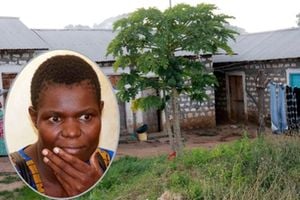
Residential houses at Kaoyeni Village in Malindi, Kilifi County, where the Kwa Bi Nzaro prime suspect Sharlyne Anindo Temba (inset) lived.
Photo credit: Kevin Odit | Nation Media Group
“I am not against Mackenzie, but I am against anyone who is radicalising people, turning them against their community and society and making them wild animals because it’s a burden to us, the family,” he said.
Mr Omondi said the authorities should ensure that anyone found responsible through the judicial process faces the appropriate punishment.
“If it is found through the judicial process that Mackenzie was the cause of all this, then he should meet the maximum sentence,” he said, fighting back tears outside the mortuary.
The Kwa Bi Nzaro deaths are part of a wider investigation into religious extremism associated with Mackenzie’s outlawed Good News International Church, whose followers were allegedly encouraged to fast to death.
During an exhumation exercise at Kwa Bi Nzaro last year, the government recovered 53 bodies and 44 body parts. Identification has proved difficult in some cases because of advanced decomposition and a lack of relatives’ DNA samples for comparison.
The government has so far released 10 bodies from the Kwa Bi Nzaro deaths, while the identification and release of remains from the original Shakahola tragedy have proceeded more slowly. Fewer than 40 bodies from that case had been released since 2023, according to the figures provided.
The authorities have appealed to families who suspect their missing relatives died in Shakahola to come forward for DNA sampling. The process is urgent because many remains are still unidentified and unclaimed.
In a notice dated September 17, the Kilifi County Government gave families 21 days to identify and collect the remains of relatives believed to have died in Shakahola. It warned that unclaimed remains would be disposed of in accordance with the law after the deadline.
“The identification and collection of the bodies should be done within 21 days from the date of this notice. Anybody that remains unclaimed after the expiry of the stated period shall be disposed of in accordance with the applicable law and regulations,” the notice stated.
For families still waiting for answers, the DNA exercise offers a chance to establish what happened to their missing relatives. For the Omondi family, it has ended one uncertainty, leaving them to mourn six loved ones at once.
In March 2025, Okinyi began selling off the family’s possessions one after another, cattle, goats, pigs, ducks, household items and other valuables, without giving clear explanations. He also leased his land to a neighbour for Sh7,000.
Then, without warning, on the morning of March 27, 2025, Okinyi disappeared from his rural village of Othoro, North Kanyamkago, Migori County.
He left home with his wife, Adoyo, and their children, Pendo Karren, Garson Fadhili, and Wema Rhoda. Okinyi’s eldest daughter, Rehema Amina, and her husband, Steve Juma, also joined him.
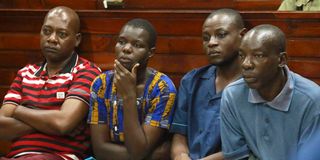
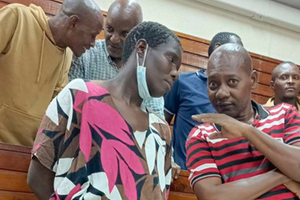
Mackenzie and Anindo face 23 counts of murder as crimes against humanity over the Kwa Bi Nzaro deaths. They are jointly charged with Kahindi Kazungu Garama, alias Mlewa; Tom Ochieng Mkonwe, alias Thomas or Tomaso; Julius Tuva Luwali; Johnson Gona Richard; Charles Mutua Musee, alias Mzee Mutua; and James Kazungu Kahindi, alias Ponda or Baba Bura.
On Monday, the High Court in Mombasa is scheduled to deliver judgment in a separate Shakahola-related case in which Mackenzie and a group of 30 followers face charges over the deaths of 191 children.
Mackenzie also faces 238 counts of manslaughter and other charges relating to child torture and radicalisation. Those cases have concluded and are awaiting judgment.
For Omondi, the court proceedings offer a chance for accountability, but they cannot undo the family’s loss.