On a cold morning in June 2014, Titus Njari Ndei, 47, stood alone in the dock at the Kajiado Law Courts, Kajiado County, separated from fellow accused persons by more than just physical space.
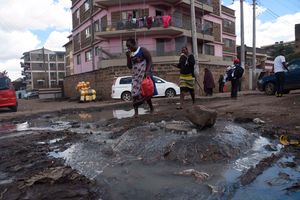
Raw sewage flowing from residential plots into a feeder road was now the subject of a criminal charge.
Mr Ndei, then 36, and 22 other plot owners in Kitengela Township had been hauled to court by the County Government of Kajiado for violating the Public Health Act by discharging untreated sewage into public spaces.
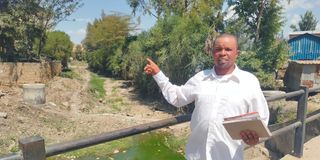
Titus Ndei, pioneer of the Kitengela community sewer line, inspects the project at Tropicana Estate on January 26, 2025.
Photo credit: Stanley Ngotho | Nation
The accused were released on bonds ranging between Sh180, 000 and Sh200, 000, but the case would take an unexpected turn.
Before the matter could proceed, Mr Ndei, a locomotive engineer by profession, made an unusual plea to the magistrate: give them two months to come up with a permanent solution.
“I was anxious and desperate,” Mr Ndei recalls. “But standing there, I knew court appearances and fines were not the solution. We needed a system.”
That idea, conceived in the dock, would later transform sanitation in one of Kenya’s fastest-growing towns.
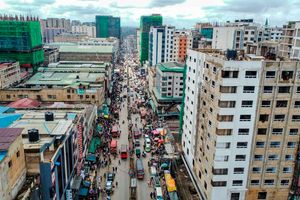
Kitengela, in Kajiado East Sub-county, has for decades struggled under the weight of rapid, unplanned urbanisation. In the 1980s, it was little more than a single-shop trading centre serving herders en route to the Kenya Meat Commission in neighbouring Machakos County. By the 1990s, it had exploded into a bustling satellite town; without sewer lines, proper drainage or waste management systems.
The result was predictable: raw effluent flowing into rivers, open roads doubling as sewer channels, perennial water shortages and frequent outbreaks of waterborne diseases.
Liquid waste pollution remains one of Kajiado County’s most persistent environmental and public health challenges, affecting urban centres such as Kitengela, Ngong, Kiserian and Ong’ata Rongai. Illegal discharge of sewage from abattoirs and residential plots is common, worsened by inadequate infrastructure.
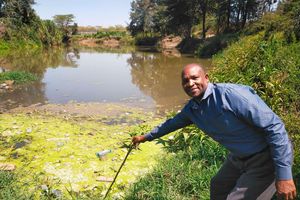
Titus Ndei, pioneer of the Kitengela community sewer line, oversees the project's progress along the New Valley River in the Tropicana area on January 26, 2025.
Photo credit: Stanley Ngotho | Nation
Back in 2014, Mr Ndei and his co-accused moved swiftly. Within two months, they had registered the Kitengela EPZ Neighbouring Community Association, secured approvals from the Export Processing Zones Authority (EPZA), Nema and other regulators, and returned to court with a proposal: a community-funded sewer line.
“The court allowed us to pursue the solution,” says Mr Ndei, now the project’s pioneer. “That decision changed everything.”
Twelve years later, the results are visible and tangible. Kitengela town now boasts more than 64 kilometres of community sewer lines valued at Sh172 million, all connected to the EPZA Kinanie effluent treatment plant in neighbouring Machakos County.
However, the biggest hurdle was money. Convincing hundreds of plot owners to dig deep into their pockets for a shared good was no small task. Doubt, suspicion and resistance threatened to derail the project. But the association’s seven-member board held firm.
Each plot owner was required to pay a flat Sh250, 000 connection fee, plus a Sh1, 000 registration fee. On top of that, EPZA levies were introduced in three categories: Sh26, 730 for single-floor flats, Sh7, 500 for residential homes, and Sh74, 000 for multi-storey rental buildings. Most owners paid in instalments.
“We went door to door pleading,” Mr Ndei says. “We told the story of pollution, disease and dignity. Slowly, people bought in.”
Construction was rolled out in phases. The first phase, launched on September 8, 2018, covered 45 kilometres serving 818 plots at a cost of Sh85 million. An additional 11 kilometres followed, reaching another 200 plots. The ongoing Tropicana phase, under the Tropicana Association, an eight-kilometre main trunk line extending towards Milimani and Yukos areas, has been slowed by rocky terrain and rising costs.
Today, about 65 per cent of Kitengela ward is connected to the community sewer, including EPZ, Kyang’ombe, Deliverance area, Balozi Road and parts of New Valley Estate.
Concrete manholes line feeder roads, a quiet marker of progress over the years.
For landlords like James Matian of Kyang’ombe, the difference is enormous. He once paid Sh13,000 per exhauster trip, twice a week, to empty sewage from his five-storey flat — Sh104,000 a month. Now, he pays Sh7, 025 monthly through the e-Citizen platform.
“This sewer line is a huge reprieve,” he says. “It was long overdue. It proves communities can solve their own problems.”
Monthly charges vary by category: Sh350 for residential homes, Sh2, 000 for non-storey rentals and Sh7, 025 for storey buildings — a fraction of exhauster costs.
Some defiant plot owners have refused to connect, leading to sporadic sewage seepages. Churches, schools and the Kitengela Modern Retail Market remain unconnected.
In 2021, Governor Joseph Ole Lenku pledged Sh20 million to link the market to the trunk sewer, but the funds never materialised.
“This is a non-profit project,” Mr Ndei says. “We have no provision for free connections. Despite follow-ups, the money never came.”
With Kitengela elevated to municipal status in 2022, hopes are high for further infrastructure investment. Municipality Manager Josephine Nashipae acknowledges that liquid waste pollution remains a major challenge but says the town is banking on the stalled Sh22 billion Oloitikoshi water and sewerage project.
“The project was to boast of mega dams and a sewer treatment plant. We are still optimistic the project will be undertaken when funds become available. The community sewer line will be connected to the mega effluent plant,” said Nashipae.
Nema data underscores the urgency. Water pollution remains one of Kenya’s top environmental concerns, with 840 incidents recorded nationwide in 2020 alone, largely from raw sewage and industrial effluent.
As a new EPZ mega effluent treatment plant nears completion, Kitengela’s community sewer is expected to plug into a more robust system.
For Mr Ndei, it is already a personal victory.
“We midwifed an idea in court,” he says quietly. “It’s slow, it’s tough, but it’s changing lives. For me that dock gave birth to a dream.”