Documents tabled before the Malindi Court indicate that suspects currently under investigation channelled money to facilitate their operations, including renting houses in Malindi where followers were offered temporary shelter and radicalised before being ferried to the remote Chakama area of Kilifi County.
Once there, they were confined, starved, and eventually perished under the extremist teachings linked to controversial preacher Paul Mackenzie.
"So far, several shallow graves have been identified at the Binzaro area where Kahindi Kazungu Garama, Thomas Mukonwe, James Kahindi Kazungu and Sharleen Temba Anido had step up a homestead and enforced the fasting by locking the victims in the houses and preventing them from escaping," the police stated.
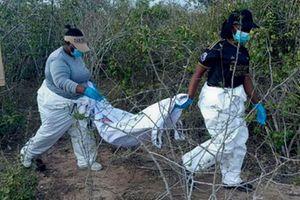
Morticians carry an exhumed body at Kwa Binzaro village within the vast Chakama Ranch in Kilifi County on August 21, 2025.
Photo credit: Brian Ocharo | Nation Media Group
According to court documents, investigators sought court orders to access bank and M-Pesa records of the suspects to establish the flow of funds.
"Our investigation has established that the respondents used money to advance their heinous plans. We obtained court orders to access their accounts and this process requires time," the police say in the document while seeking a 30-day extension of detention orders.
The officers are also pursuing critical electronic evidence, which they believe can offer crucial clues into the communication patterns of the coordinators of the cult.
Mobile phones, SIM cards and storage devices recovered from the suspects have been forwarded to the Anti-Terrorism Police Unit (ATPU) forensic laboratory for analysis.
Investigators are still waiting for reports expected to shed light on communication patterns, coordination, and financial instructions that tied the network together.
Additionally, the investigators have obtained orders requiring mobile service providers to assist them with information that would enable them to review SIM card registration details and call data records believed to contain evidence of the suspects’ communications.
"Investigations team relies heavily on the mobile phone data and other evidence that may be available in the said exhibits and that when the said mobile phones are extracted, they will give a breakthrough in this case. The subject phones were forwarded to the ATPU CYBER LAB and are currently being analyzed and the same will require time," the police said in the court document.
Preliminary findings allege that Garama, Mukonwe, Kazungu and Anido traversed the country spreading Mackenzie’s apocalyptic doctrines. They persuaded followers of Good News International Ministries to abandon their homes and embrace fasting to death as a guaranteed path to meeting Jesus.
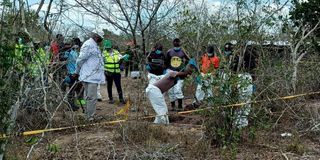
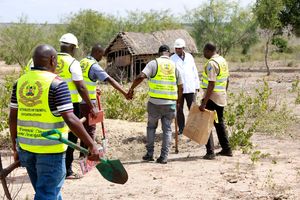
Officers from the Directorate of Criminal Investigations at the site where more graves were discovered at Kwa Binzaro area, within Shakahola Forest, Kilifi County on August 15, 2025.
Photo credit: Kevin Odit | Nation Media Group
Investigators believe several of these recruits were housed in rented premises in Malindi before being escorted to Kwa Binzaro. Evidence gathered so far suggests that victims were locked in huts, denied food and water, and prevented from escaping until they succumbed.
"The investigation have also established that Garama and Anido had rented several other houses within Malindi where they would host the victims before being transported to Binzaro for fasting until death. These houses need to be traced, documented and statement of the proprietors recorded an exercise that requires more tim," said the police.
Police say the suspects “set up a homestead and enforced the fasting by confining followers indoors."
According to the ongoing investigations, several families across Kenya have since reported cases of missing relatives, many of whom vanished after following Mackenzie’s adherents.
"Some of the missing persons have now been traced to Binzaro, where exhumations continue to uncover shallow graves," the police said in court documents.
The Malindi court had earlier issued an exhumation order under miscellaneous application No. E103/2025, paving the way for the recovery of victims’ remains. The process has been painstakingly slow due to the nature of the terrain and the complexity of the crime scene, which was hidden under shrubs and reinforced with vegetation to conceal the bodies.
Homicide Unit boss Martin Nyuguto is leading the exhumation exercise, working alongside homicide detectives, the Government Chemist, crime scene investigators and ATPU officers.
Morticians carry an exhumed body at Kwa Binzaro village within the vast Chakama Ranch in Kilifi County on August 21, 2025.
Photo credit: Brian Ocharo | Nation Media Group
Each exhumation requires documentation, post-mortem analysis and eventual DNA sequencing to match remains with reported missing persons. Detectives emphasise that DNA profiling is a continuous process since more graves continue to be discovered.
"Without positive identification of the victims, investigators cannot make fair recommendations to the Office of the Director of Public Prosecutions (ODPP)," said the police in court documents.
Families of missing persons have been urged to come forward and provide DNA samples to assist in the identification exercise.
Detectives have expanded investigations beyond the immediate crime scene. They are mapping the wider Kwa Binzaro area with the assistance of the Survey of Kenya to establish the full extent of the massacre.
They are also tracing additional houses rented by suspects in Malindi that operated as radicalisation cells, interviewing those who might have unknowingly rented their houses to the cult facilitators, and recording statements of possible witnesses. Equally, investigators are pursuing social inquiries to confirm the true identities of the respondents, amid suspicions that some provided false names.
Just like in Shakahola, where suspects provided false identities, detectives are grappling with the same possibility that some suspects might have given incorrect details to hide their real identities. Detectives told the court that elimination prints have been sent to the National Registration Bureau for verification.
"Identification parades are also planned, though some witnesses remain traumatised and are not ready to participate," the police told the court.
According to the detectives, some of the victims left their homes with children whom they cannot account for. Officers plan to visit the rural homes of these suspects to trace missing minors, some of whom are feared to have died in the same fasting rituals.
Psychosocial support has also been recommended for suspects before comprehensive interrogation can be conducted, as detectives say some of them are still traumatised.
Officers from the Directorate of Criminal Investigations at the site where more graves were discovered at Kwa Binzaro area, within Shakahola Forest, Kilifi County on August 15, 2025.
Photo credit: Kevin Odit | Nation Media Group
The Directorate of Criminal Investigations (DCI) has acknowledged the magnitude and evolving nature of the case, forming specialised sub-teams focusing on homicide, crime scene imaging, acoustics, forensic services and counter-terrorism.
“The complexity, gravity and evolving nature of this investigation require adequate time,” Mr Alfred Mwatika, who is investigating the case, told the court on Friday.
Detectives have further cautioned that releasing the suspects before investigations are concluded could pose serious risks. Police believe that some, being ardent followers of Mackenzie and previously linked to the Shakahola deaths, might revert to fasting until death or regroup with accomplices still at large.
"Several witnesses have provided descriptions resembling some of the suspects, reinforcing the need for identification parades once conditions permit," said the officer.
According to the detectives, preliminary investigation paints a picture of the suspects' connections to the previous Shakahola massacre and other related outcomes that led to mass deaths.
"The investigation team, therefore, believes that the respondents had regrouped themselves in order to further the radical believes, in this regard, the investigations team has uncovered about seven key suspects who are currently at large and efforts to arrest them are underway, the same will require to trace and arrest," said the police.
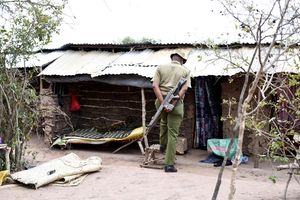
A police officer mans a homestead in Binzaro area in Chakama Ranch where a body of a middle-age man was found.
Photo credit: Wachira Mwangi | Nation Media Group
Investigators fear that if the accused are freed prematurely, they could interfere with witnesses or re-establish contact with escapees who remain on the run.
The revelations of a coordinated financial network, cross-country recruitment, and systematic concealment of bodies under shrubs highlight the chilling sophistication of the operation in the expansive forest. For now, the families of the missing wait anxiously for answers, while forensic experts work to return names to the faceless and skeletal victims buried in shallow graves, naked and facing upwards.
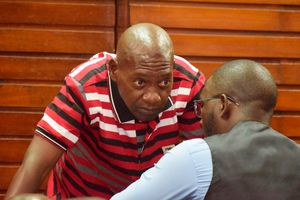
Suspects under investigation for the Kwa Binzaro atrocities are Jairus Otieno Odek, Lilian Akinyi, Kahonzi Katana Karisa, Loise Zawadi, Safari Kenga Nazi, Karisa Gona Fondo, Gona Charo Kalama, Kahindi Kazungu Garama, Thomas Mukonwe, James Kahindi Kazungu and Sharleen Temba Anido.
Detectives were on Friday given 21 more days to hold these suspects in different police stations as they piece together evidence that would help in their prosecution. Some of the suspects are reportedly not cooperating with the police as they are highly radicalised and believe in the apocalyptic message of end times and fasting to death as the only way to see Jesus.