Less than a kilometre off the Malindi–Salagate road lies Kaoyeni village, a place that tells two contrasting stories at once.
By day, it is a picture of rural transformation in Bamba Ward, Malindi sub-County, where new homes rise steadily as wealthy Kenyans discover its quiet charm. By night, and away from prying eyes, it became the unlikely staging ground of a chilling cult.
Just three kilometres from Malindi town, Kaoyeni offers a serene escape for those seeking privacy, whether for a peaceful retreat or for darker, clandestine purposes. In recent months, it was here, in simple rental rooms, that suspected cult priestess Sharleen Temba Anido quietly ran temporary holding cells for victims destined for death in the deep Kwa Bi Nzaro forest, 60 kilometres away.
For Herbert Ngala, a resident who turned his compound into rental units to cash in on the village’s growth, what began as an ordinary tenancy deal quickly morphed into something sinister. On April 12, this year, a woman, later identified as Ms Anido, arrived at his gate. She was pregnant and persuasive.
Kwa Bi Nzaro Suspects James Kahindi Kazungu, Thomas Mukonwe, Kahindi Kazungu Garama and Sharleen Anido Temba at the Malindi Law Courts in Kilifi County on September 12, 2025.
Photo credit: Kevin Odit | Nation
“She told me she needed a house for her brother, who was back in the village. She wanted him to try life in town,” Mr Ngala recalled.
The two agreed. Ms Anido paid him Sh1,500 in cash, promising to settle future rent the same way. Mr Ngala thought little of it.
Within two days, she returned with a man and a woman, whom she introduced as her brother and sister-in-law. They carried no belongings.
To the landlord, they looked like an ordinary couple starting afresh. What he did not know was that they were survivors of the 2023 Shakahola tragedy, Jairus Otieno Odek and his wife, Lilian Akinyi.
Investigations show both had once been members of Paul Mackenzie’s Good News International Church. The church is linked to the Shakahola cult which led more than 450 people to their deaths through starvation.
Mr Ngala did what any helpful landlord would. He lent the new tenants a mattress, a basin and a jerrican. When he visited them later, he often found them praying, Bibles in hand.
“One day, Anido brought another person, so they were four. I even thanked God for giving me God-fearing tenants. I was thinking of quitting alcohol because of their example,” he said.
But he began to notice odd behaviour. The woman looked weak and frail, wasting away as though life was draining out of her. She never cooked. Her husband appeared healthy, often buying chapati and beans soup, popularly known as “surwa” from nearby eateries.
“She was too emaciated. I never smelled food from their house. But you cannot ask people why they are not cooking, so I did not intervene,” Mr Ngala said.
Each week, Ms Anido returned thrice, usually in the evenings, ferried by a boda boda rider. They would pray, talk softly behind closed doors, and she would leave an hour later.
Kwa Bi Nzaro cult prime suspect Sharlyne Anindo Temba at the Malindi Law Courts in Kilifi County on September 12, 2025.
Photo credit: Kevin Odit | Nation Media Group
On May 15, the couple vanished. Word reached Mr Ngala that they had moved to another rental unit nearby, where rent was Sh1,000 per month.
Days later, Ms Anido reappeared, handed over the keys, and settled the rent balance. But she was not done. She brought in another man, promising he would stay for a month or less.
Three weeks later, the man too disappeared without notice. Ms Anido again collected the keys, this time assuring Mr Ngala she had another client lined up.
In early July, she arrived with yet another man, calling him her worker. But she was no longer pregnant.
“I even asked her about the baby so I could buy a gift. She said the child was at home with a house help,” Mr Ngala said.
Her payments always came in cash. Never via mobile money. Although she carried a smartphone which locals say looked expensive, she could never be reached on it.
“She could call you, but if you tried her number, it was unreachable,” Mr Ngala explained.
By the end of July, her chain of tenants ended abruptly. Investigators had moved in, searching Mr Ngala’s property and seizing his rental records.
Next door, neighbour Salim Abdallah had been watching quietly. He confirmed seeing Ms Anido make her visits.
“They lived like fugitives, no furniture, no cooking. For the whole month, I never smelled onions or food from their house. They only once made porridge,” he said.
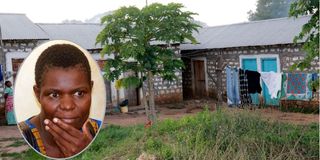
Residential houses at Kaoyeni Village in Malindi, Kilifi County, where the Kwa Bi Nzaro prime suspect Sharlyne Anindo Temba (inset) lived.
Photo credit: Kevin Odit | Nation Media Group
To him, the tenants were polite but odd.
“They were peaceful, minded their business. The pregnant woman visited often with a boda boda rider, stayed an hour, and left. I thought she was the man’s mother-in-law visiting,” he said.
It was only later, when police officers swarmed the village, that Mr Abdallah realised these were cult victims.
Another villager, Moses Mulea, who was a neighbour at the second residential house where victims relocated to from Ms Ngala’s house, recalled how Ms Anido avoided conversation.
“She only responded to greetings. One day she told me she had a gut operation, which is why she was not talking much,” he said.
Julius Baya, another neighbour, said his memory was of seeing Jairus and Lilian walking together each evening, buying chapati with bean soup before they suddenly disappeared.
Dominic Karanja owns one of the second rental properties where victims of the Kwa Bi Nzaro cult were briefly held before disappearing into the forest. He recalls receiving a call in May from an unknown number asking about available rentals.
“The caller said she had viewed my vacant house and was satisfied. We agreed on the rent, which she paid via Mpesa,” he says. The name on the M-Pesa transaction was 'Grace'.
“I gave the details to the police, but I only remember the first name. So, I knew her as Grace,” he adds.
Since he was away in Kilifi, Mr Karanja planned to visit the property in early June to collect rent from other tenants.
“When I arrived, Grace was gone. The door was broken, and the other tenants said she had stayed only three weeks before leaving without anyone noticing. I didn’t follow up as she hadn’t stayed for a full month,” he explains.
Mr Karanja never met the tenant, so he could not confirm if the woman using the name Grace was Ms Anido. However, when shown photographs of Ms Anido, the neighbours confirmed she was the woman they had seen at the rental.
“Yes, that’s the woman. I saw her go to the washroom. She didn’t speak much, just greeted people,” said Mr Mulea, a neighbour.
Kwa Bi Nzaro prime suspect Sharlyne Anindo Temba (right) with her co-accused at the Malindi Law Courts in Kilifi County on September 12, 2025.
Photo credit: Kevin Odit | Nation Media Group
According to neighbours, Ms Anido briefly stayed before bringing in two other guests, a woman and a man, and then disappeared. Ms Nelly Kashuru, the Kayoeni village elder, who has served for seven years, confirmed receiving reports of suspicious people in the area. Soon after, the DCI arrived.
“These people spent most of their time indoors,” she said.
Ms Kashuru noted that the emaciated woman raised suspicions, but it was hard to link her to a cult, as weight loss can be due to illness.
“I only realised they were cult members when the landlord contacted me, saying the police had been searching for cult members in his house. His wife then asked if she could leave the rental book with me to help vet new tenants,” she said.
Interviews with villagers reveal a chilling pattern. Victims stayed at Mr Ngala’s house for weeks before shifting to another rental just 20 metres away. Then they would disappear completely.
According to detectives, boda boda operators would then ferry them to the dense Kwa Bi Nzaro forest. There, in makeshift “fasting bays” set up by Ms Anido in her five-acre farm, she had purchased, the victims were left to starve to death in what was presented as a final act of meeting Jesus.
A police officer manning the home in Bi Nzaro Area, Kilifi County.
Photo credit: File | Nation
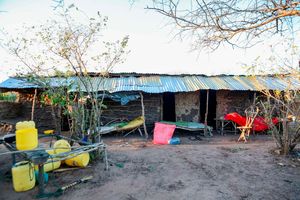
Investigations show that at least two residential blocks, consisting of six single rooms and another block of eight nearby, were used as secret holding cells for radicalisation. These were houses of innocent Kenyans cashing in on the rental demand of the growing area, which has attracted people from different parts of the country.
“They lived secretive lives, never mixing with villagers. They were always behind closed doors,” a local elder said.
Today, Kaoyeni’s serenity and the story of its transformation have been overshadowed with its unintended role in a macabre chain of events.
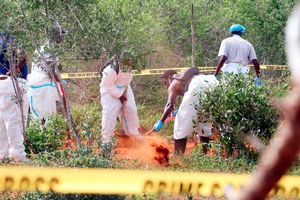
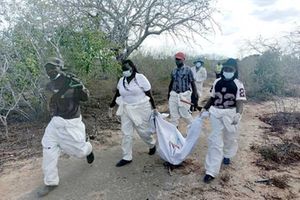
Last Friday, detectives asked for an additional 60 days to detain Ms Anido, Kahindi Kazungu Garama, Thomas Mukonwe and James Kazungu as they seek to finalise their probe into the Kwa Bi Nzaro cult where 34 bodies have been exhumed and 102 body parts recovered scattered inside the thickets.
Investigators say the four played key roles in reviving radical teachings after fleeing Shakahola, where at least 454 followers of Mackenzie died through forced starvation. According to the state, the four not only radicalised followers but also orchestrated mass deaths, which they described as a “holy safari to see Jesus”.
Affidavits filed in court reveal that all the four suspects lived in Shakahola with their families before escaping. Garama’s five children are now in a children’s home within Kilifi County. Mukonwe’s wife and three children are missing and believed to be dead.
Kazungu’s wife, Dhahabu Kabwere Chea, is facing 238 manslaughter charges alongside Mackenzie in Mombasa, while their five children are also missing. Ms Anido’s husband is similarly suspected to have died from extreme fasting rituals.
Recent searches at their residences uncovered 15 SIM cards, flash disks, a national identity card belonging to one of the victims, and a soiled jembe believed to have been used for burials.
Investigators also recovered agreements linking the suspects to land where mass graves were found, as well as a sale agreement for a motorcycle believed to have been used to ferry victims to the fasting site.
The investigators say that the cells at Kaoyeni village served as transit points. Victims were first isolated, indoctrinated, and weakened through controlled fasting before being ferried deeper into the forest. The secrecy around these movements allowed the cult to evade detection for months, until arrests in July exposed the network.