A Senate probe has unearthed a simmering row between Kilifi residents and the National Environment Management Authority (Nema) over the issuance of licences for mining and sand-harvesting activities in the region.
Residents have accused the environmental authority of issuing licences to private individuals instead of organised groups such as Savings and credit cooperative societies (Saccos), a practice they say has disadvantaged them.
They expressed their frustrations during an inspection tour by the Senate Committee on Land, Environment and Natural Resources in the Magarini area on Monday, as senators convened for this year’s Senate Mashinani forum.
The residents say that despite Magarini having the best sand in the region, locals do not benefit from it. They attributed their woes to the collapse of the once-flourishing Magarini Sacco in 2000, which they said left them vulnerable to exploitation and manipulation by sand-harvesting cartels.
Led by Ali Mbithi, who joined sand harvesting in 1996, the residents recounted how the Sacco’s liquidation had affected their lives, leaving them barely able to meet their basic needs while cartels “laughed all the way to the bank”.
“We used to be able to pay school fees for our children. Now children are sent home and parents are unable to provide,” Mr Mbithi said.
The residents appealed to the committee, chaired by Mombasa Senator Mohamed Faki, to intervene urgently and have the Magarini Sacco revived to rescue them from what they described as marauding cartels.
“The cartels are denying us our rights,” said another resident, Kevin Kazungu.
Speaking to the Nation , Mr Kazungu said a lorry can carry sand worth up to Sh60,000, while the owner of the land where it is harvested is paid between Sh1,500 and Sh2,000.
“Each lorry that you can see passing here is carrying sand worth not less than Sh50,000. The owner of the land will be paid Sh2,000,” he said.
Apart from financial exploitation, the residents raised the alarm over the public health and environmental risks posed by sand transporters who rarely cover their loads during transportation.
“The sand is not covered. It is blown by the wind, causing accidents. Recently, there was a grisly accident involving a boda boda that resulted from this,” a resident said.
Committee chairman Senator Faki assured the residents of the Senate’s commitment to addressing issues relating to sand harvesting and mining in the region through the Senate Mashinani forum.
“We will not allow children to dig sand,” Mr Faki said tasking the local authorities with ensuring that sand-harvesting firms adhere to the relevant regulations.
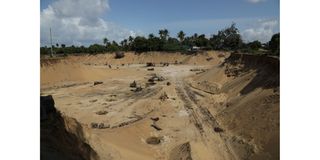
On Mjana Heri Sand Quarry, an inspection report dated January 2026 indicated that the quarry, owned and operated by Mjatingo Sand Loaders Association, had active sand extraction and truck loading beneath high, steep and unsupported sand faces.
“Workers are positioned at the toe of the faces and are also climbing or working directly on loose slopes.”
With no effective exclusion zone, benching, edge protection or personal protective equipment evident in the photographs, the report warned that the conditions present an immediate risk of face collapse, burial, falls, vehicle interaction and injury.
Despite the active operations, the operator did not produce a county sand-harvesting permit or Nema environmental licence during the inspection, according to the report.
The county government said the inspection was part of a continuing programme rather than a single exercise.
Kilifi County geologist George Shoka was at pains to explain why the county government had presented what Senator Faki described as a “shallow report” on the environmental challenges facing the region.
For instance, of the five salt-producing companies, the county only addressed one Krystalline Salt Limited, which operates in Marereni and Gongoni in Kilifi County, Changamwe in Mombasa and Westlands in Nairobi.
“You only responded on two issues. It is like you are behind environmental degradation in this county. This is not a serious report,” Senator Faki said.
Krystalline Zone Manager Eunice Mugo, who represented the company’s management, appealed to the Senate for intervention over what the company considers unfair treatment, particularly being the only salt-producing facility charged millions of shillings for using seawater.
She argued that the methodology used to calculate the payment owed by Krystalline Salt Limited for seawater usage was based on assumptions and urged legislators to develop a comprehensive formula to protect the company from what she described as exploitation and unfair treatment.
Established in 1984, Krystalline Salt Limited employs approximately 700 permanent staff and 150 contracted or seasonal workers, about 85 per cent of whom are drawn from Magarini sub-County and neighbouring wards in Kilifi County.
The company’s products are packaged under three brands of Kaysalt Premium for the Kenyan market, Habarai Salt for Uganda, Rwanda, South Sudan and the Democratic Republic of Congo; and Kaysalt for Tanzania, Burundi, Malawi and Zambia.
The legislators also took issue with the number of mining companies that are not adhering to the set regulations, seeking to know what measures were being taken to fast-track full compliance.
An assessment report presented by Mr Shoka indicated that there are 37 mining companies across the Coast region, of which 19 are compliant and 18 do not meet the requirements.
In Kilifi, which has 17 facilities, 13 are compliant while four are non-compliant. Of the 19 facilities in Taita-Taveta, 15 are compliant while four are not.
Kwale has 46 facilities, of which 36 are compliant while four are yet to comply. In Lamu, the county has one murram-mining company, which is compliant.
Mombasa has two facilities, both of which are compliant.
“Nema, how are you dealing with non-compliant companies? How frequently do you measure air quality? What about water salinity in Lamu?” nominated Senator Beatrice Ogolla asked.
In response, the county executive said it was in the process of amending the Kilifi County Solid Waste Management Act, 2019, to align it with the Sustainable Waste Management Act, 2022.
The amendments will incorporate emerging issues such as the circular economy and extended producer responsibility organisations for more efficient waste management.
The county has also prepared a draft Sand Harvesting Policy to streamline and organise sand-harvesting activities throughout Kilifi County. The policy is intended to establish a consistent framework for site identification, county permitting, environmental compliance, occupational and public safety, transportation and cess administration, community participation, monitoring, progressive rehabilitation and enforcement.
“The County is progressing the draft through the required consultation, approval and legislative processes,” the county said.
To improve sanitation for workers and the surrounding community at Mjana Heri, the county said it had supported the construction of an ablution block at the site in conjunction with the World Bank and Malindi Water, as part of wider efforts to improve public health conditions in the sand-harvesting area.
The county said it had also been enforcing the rehabilitation of exhausted and inactive sand quarries. The required measures include stabilising unsafe faces and restoring disturbed areas through tree planting and other forms of revegetation.
The objective, it said, was to reduce erosion, collapses and public-safety risks while returning exhausted sites to safe and beneficial use.
Some exhausted quarry sites have also developed, or been established, as freshwater wells that support water-trucking services in Magarini and Malindi sub-counties, helping to alleviate water shortages.
The county said it recognised the public benefit while requiring water-quality assessments, safe access, controlled abstraction and protection from contamination.
The county noted that the licensing concerns “remain subject to corrective action”, but should be considered alongside the wider measures already being undertaken.
“The County requests the Committee to support continued inter-agency coordination, completion of the draft policy process, rehabilitation of exhausted sites and safe use of suitable quarry-derived freshwater wells to alleviate water stress in Magarini and Malindi sub-counties.”