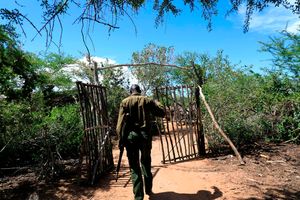
For the past week, a fresh nightmare has been unfolding at Kwa Bi Nzaro in Kilifi County, eerily similar to the Shakahola massacre that led to the discovery of hundreds of bodies in a forest.
Homicide detectives have exhumed at least 32 bodies from shallow graves in a thicket, but authorities fear many more may have died in Kwa Bi Nzaro, especially because the few identified victims are not from the area.
The bodies, buried naked and facing upwards, paint a grim picture of an underworld procession to a tragic ending of life, reviving the horrors of Shakahola that shocked the world and battered Kenya’s image.
At one point, the government was forced to pull the plug on “damaging” live coverage of the exhumations, but what had been declared a “never again” tragedy after Shakahola now feels like a chilling replay, unfolding at Kwa Bi Nzaro, barely 30 kilometres away from the first scene of horror.
"Each exhumation here evokes grief and disbelief, reviving haunting memories of Shakahola where, only two years ago, more than 450 people associated with the Good News International Church under Paul Mackenzie died while fasting to “meet Jesus.”
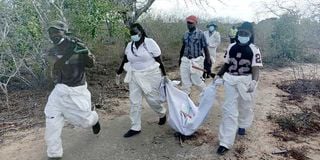
Morticians carry the remains of a person exhumed at Kwa Binzaro village within the vast Chakama Ranch in Kilifi County on August 28, 2025 as part of investigations into a suspected cult.
Photo credit: Brian Charo| Nation Media Group
Once again, shallow graves are giving up their secrets. Skulls, bones and decomposed remains are being unearthed. In some instances, animals appear to have disturbed the graves, as though nature itself were unwilling to let such cruelty remain hidden.
With every excavation, more bodies emerge, reinforcing the foreboding feeling that this could just be the tip of a deadly iceberg — and that many more bodies could be buried in the forest.
The Malindi-Salagate road leads first to Kwa Bi Nzaro village, before stretching further into the dense forest that hides Shakahola.
Investigations suggest that many of those now buried in Kwa Bi Nzaro are the same survivors of Shakahola. They either fled the police dragnet or returned here after facing stigma and rejection from their families and communities. Having found no acceptance, they slipped back into the same destructive cycle of faith, fasting and death.
Investigators link the indoctrination to Mackenzie’s apocalyptic sermons, which continue to resonate despite his arrest.
One suspect in custody, a senior cult member, has given detectives chilling details.
He claims to account for at least 49 dead people. According to him, 33 casualties are from Migori, Siaya, Kakamega and Homa Bay, and 16 from the Coast and other regions.
He admitted that deaths were already happening before he arrived in the forest, raising fears that the toll could be higher.
Police have also established that most of the 11 suspects currently in custody have direct links to the Shakahola tragedy. Investigators believe the group quietly regrouped after Shakahola was disrupted and resumed spreading Mackenzie’s radical teachings.
Documents filed before the Malindi court identify four individuals who travelled across the country, recruiting Mackenzie’s followers and urging them to fast until death.
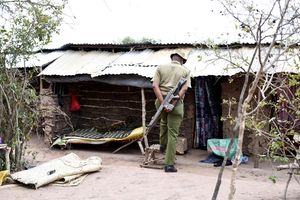
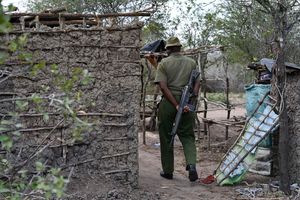
Police officers secure the Binzaro homestead in Chakama Ranch where the body of a middle-aged man was found. Authorities say at least 11 people are being investigated in what appears like the Shakahola cult.
Photo credit: Wachira Mwangi | Nation Media Group
Locals say the dead are unlikely to be from Kwa Bi Nzaro itself. With a population of 591, the village has not reported any missing persons, nor have the neighbouring sub-locations of Makongeni, Mkondoni, Sosobora, Ndigiria Mriqchagwe, Matolini or Kisiki.
“We do not have any reports of missing people here. All our families are intact,” said our source, who requested anonymity due to the sensitivity of the matter.
He has lived in the area for many years and says the discovery of bodies being exhumed from the thicket shocked the community.
“For now, these exhumations have interfered with our daily activities. We depend on this forest for many things, including firewood and charcoal, which we use and also sell to earn a living,” he explains.
He says that all the locals are safe, but he is worried that the cult activities being uncovered may negatively influence the youth in the area.
Gladys Kadzo, a long-time resident of Kwa Bi Nzaro village since 1992, also knows the forest intimately. For decades, she and her husband made their living by burning charcoal here.
“I know this forest from one end to the other. I have spent most of my life here. I used to burn charcoal with my husband, but he is now too old and frail to move around as we once did,” she says.
Ms Kadzo explains that she has never heard of any reports of missing persons or burials in the forest. However, she recalls having once seen a grass-thatched hut deep inside.
Officers from the Directorate of Criminal Investigations at the site where more graves were discovered at Kwa Binzaro area, within Shakahola Forest, Kilifi County on August 15, 2025.
Photo credit: Kevin Odit | Nation Media Group
“The man who stayed there left before this incident came to light,” she says, adding that she was stunned by the news of exhumations. “This forest is vast. You cannot know what is happening everywhere at the same time.”
Still, residents admit to having noticed unusual activity in the forest.
Ms Kadzo says she has often seen vehicles entering and leaving the thicket, sometimes under the guise of visiting Somali herders.
“We cannot assume everyone driving in is after livestock. Some may have other intentions,” she says.
The vastness of the forest, coupled with the absence of missing persons reports, made it difficult for local administrators to detect what was happening.
“Investigations usually start with a missing person’s report. Without that, the authorities have little to act on,” a source explained.
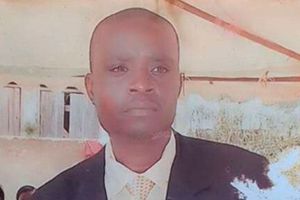
This aligns with the reality that some of the identified victims, such as Samuel Owino Owiti from Homa Bay, came from far away.
But just how could a tragedy similar to Shakahola occur again two years later, even after a government investigation and a parliamentary inquiry exposed the weaknesses that abetted the massacre and recommended measures to ensure the tragedy did not recur?
A Senate investigation blamed failures by the Kilifi County Security team and said the hasty transfers of officials after the massacre were intended to sabotage the probe because they were never available to testify.
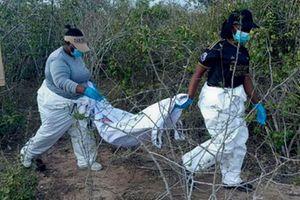
Morticians carry an exhumed body at Kwa Binzaro village within the vast Chakama Ranch in Kilifi County on August 21, 2025.
Photo credit: Brian Ocharo | Nation Media Group
Senators also noted that when the whistle was blown on the crime following the rescue of an eight-year-old boy from Shakahola forest, and the identification of two possible graves of his two siblings, police officers did not go to the forest until after five days.
And when they did, on March 22, 2023, they accompanied an employee of the Malindi Human Rights Centre, Victor Kaudo, and the boy’s grandfather, Francis Wanje, who had obtained exhumation orders — but their actions later were suspicious.
“Upon reaching the forest the police officers allegedly received a phone call and retreated from the exercise, leaving Mr Kaudo and Mr Wanje in the forest. It was not established who called the police officers and instructed them to retreat,” the Senate report stated.
Senators resolved that the National Police Service Commission should severely sanction all security officers whose acts of commission or omission aided or abetted the Shakahola tragedy within 30 days of adoption of the report by the Senate. The report named 11 officers who were to be investigated by the Directorate of Criminal Investigations with a view to prosecutions, but no action has ever been taken.
Morticians carry an exhumed body at Kwa Binzaro village within the vast Chakama Ranch in Kilifi County on August 21, 2025.
Photo credit: Brian Ocharo | Nation Media Group
“The Committee further observed that despite a comprehensive policy on the framework proposed by the former National Steering Committee for Nyumba Kumi, there was a failure in community policing that would have assisted in gathering information from the local community and prevented the tragedy in Shakahola, Kilifi County,” the report stated.
The Shakahola Task Force appointed by President Ruto in May 2023 identified several gaps in laws governing religious organisations and recommended stringent registration requirements, mandatory financial reporting, among others.
Locals argue that while authorities were blamed for failing in Shakahola, the situation in this new wave is more complicated. The ideology, they say, has outlived Mackenzie himself. Arresting him did not uproot the radical seeds he planted.
Investigators from the Anti-Terror Police Unit have confirmed that Mackenzie’s adherents continue to move from door to door, spreading end-time messages and recruiting followers.
Police affidavits presented in court show that some victims were radicalised elsewhere, then lured to Kwa Bi Nzaro, locked in houses and starved to death in preparation to “meet Jesus.”
Kwa Bi Nzaro falls within the 50,000-acre Chakama Ranch, once community land but now private property.
Grave diggers exhume bodies of suspected cult members at Kwa Binzaro village in Kilifi County on August 21, 2025.
Photo credit: Brian Ocharo | Nation Media Group
The government and the locals claim the cult took advantage of limited access and secrecy around land transactions to conceal its activities.
When she toured the forest on Wednesday, Coast Regional Coordinator Rhoda Onyancha said investigations are also focusing on how suspects in this case acquired land within Chakama Ranch, despite owners insisting they never sold any part of the over 50,000-acre property.
“We want to know who sold this land to the prime suspect, because this is Chakama Ranch and we are aware the owners have not sold it to anybody. Once we finalise investigations, we are going to take legal action,” she stated.
“This ranch is very huge, over 50,000 acres. It is not easy to detect everything,” Ms Onyancha said.
The distance to the nearest police station, over 40 kilometres, further compounds the challenge. The forest is also home to elephants and other wildlife, discouraging regular human activity.
Owing to the lack of reports on missing persons, the vastness of the forest, the fact that most of the dead were non-locals, its strategic location, and the nearest police station being more than 40 kilometres away, locals feel that the government was inevitably caught unawares.
Sources privy to the activities in the forest disclosed that, were it not for a power struggle among senior cult members, the Kwa Bi Nzaro deaths might have continued unnoticed for some time.
The source revealed that the dispute led to a split, with one faction briefly relocating to Malindi before returning to the forest. The problem arose when one of the senior members rejoined the group in the forest but was unable to communicate directly with their leader, who is currently in detention — something he had been able to do freely while still upcountry.
For now, the forest, once a source of life for locals who fetched firewood and charcoal, has become a graveyard. Its silence is broken only by the sound of shovels digging up one body after another.
And with every body lifted from the soil, one haunting question lingers: how did both government and community allow another tragedy of this scale to unfold so soon after Shakahola?