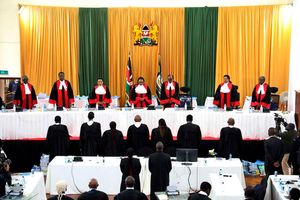
A legal battle is brewing at the High Court in Nairobi as five Court of Appeal judges fight off allegations that they received a $2.5 million (Sh325 million) bribe to influence a 2024 ruling in a property dispute between a borrower and a bank.
The judges have sued Captain Kung’u Muigai, describing the social media claims as false and defamatory, and are seeking damages, an apology and an order barring further publication.
But Mr Muigai denies defamation, maintains that his statements were justified and argues that the allegations against the judges should be investigated by the Judicial Service Commission (JSC).
The plaintiffs are Justices Milton Asike-Makhandia, Kathurima M’Inoti, Sankale Ole Kantai, Francis Tuiyott and John Mativo. The civil case filed on August 6, 2026 says Mr Muigai made the contested statements in media briefings on September 8 and 10, 2025.
Mr Muigai is a nephew of Kenya’s first president Jomo Kenyatta and a cousin of fourth president Uhuru Kenyatta.
The legal dispute stems from a Sh18.6 million loan advanced by Kenya Commercial Bank (KCB) to Benjoh Amalgamated Ltd, where Mr Muigai says he was a director and shareholder. The 1989 loan was secured against three properties and has generated litigation for more than three decades.
The ruling at the centre of the current case concerned Benjoh’s attempt to reopen an earlier decision upholding a consent order dated May 4, 1992. The order allowed KCB to sell charged properties after the borrower defaulted.
The heart of the dispute is whether the consent order existed, with Mr Muigai maintaining that no such consent was ever recorded.
The five judges say after delivering their ruling dismissing Benjoh's attempt to reopen the case on May 24, 2024, online publications emerged on social media linking their decision to an alleged US$2.5 million (Sh325 million) payment.
They deny receiving a bribe or inducement to rule against Benjoh and say the publications damaged their reputations.
The plaint says the contested material appeared on Facebook, X, LinkedIn and Instagram, as well as TikTok and YouTube platforms. It alleges other digital media outlets republished the statements, widening their reach further.
"From the litigation history, the context of the dispute and the 'review ruling', the allegations that the plaintiffs took a bribe to rule against Benjoh Amalgamated limited are entirely unfounded and completely preposterous," says the judges' advocate, Peter Wanyama.
They seek a declaration of defamation, an unqualified public apology and deletion of the material. They also seek a permanent injunction against further publication, general, exemplary and aggravated damages, interest and costs.
However, in his defence filed on September 10, 2026, Mr Muigai denies the comments were false, malicious or defamatory. He maintains the the 2024 ruling was procured through a bribe. He pleads justification and privilege, saying he was reporting concerns raised with the JSC.
Mr Muigai says he was a director and shareholder of Benjoh and Muiri Coffee Estate Ltd. He argues that the JSC, rather than a defamation court, should examine his complaint about the judges’ conduct.
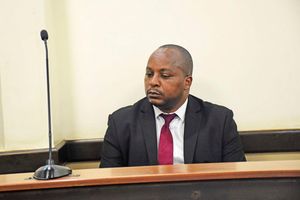
Captain Kung'u Muigai.
Photo credit: File | Nation Media Group
"An action in defamation is not the forum for the plaintiffs to defend themselves on a complaint of bribery lodged with the JSC, which complaint has not been responded to by them, and which complaint has further, not been investigated and determined by the JSC," his advocate Nelson Havi says, asking for dismissal of the judges' case.
Mr Muigai's witness statement says he had lodged a complaint of gross misconduct and misbehaviour against the judges at the JSC, which notified him on August 7, 2025, that his complaint had been dismissed.
He says no reasons were supplied explaining the said dismissal and later sought a hearing. The complaint followed the May 24, 2024 ruling, in which the five judges rejected Benjoh’s application to review an earlier decision upholding a consent order in the bank dispute.
"The JSC has not rendered any decision on the complaint by defendant as against the Plaintiffs," his lawyer Nelson Havi says arguing that the case is an abuse of court process.
He adds that Mr Muigai spoke to the media, detailing how the JSC "had failed and/or refused" to ask the five judges to answer to the complaint of making the ruling on May 24, 2024, "on the basis of the non-existent consent made on May 4, 1992" and receipt of a bribe.
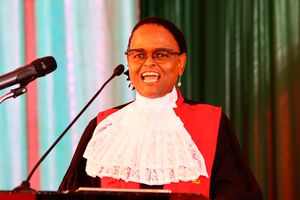
Former Law Society of Kenya president Nelson Havi.
Photo credit: File | Nation Media Group
"Instead of tabling the alleged consent made on May 4, 1992, in Hccc No.1219 of 1992 or investigating the complaint of bribery made against the plaintiffs by the defendant, the Judiciary and the Judicial Service Commission embarked on an elaborate cover-up exercise, and defence of the plaintiffs," adds Mr Havi.
The dispute dates back to 1989, when KCB advanced Benjoh Amalgamated Ltd a loan of Sh18.6 million to finance a flower export business under the Rural Projects Enterprise Programme, supported by the United States Agency for International Development (USAID).
The facility was secured by charges over two properties, LR No. 12411/1 and LR No. 12411/2, while Muiri Coffee Estate Ltd provided additional security through a charge over LR No. 10075 in Kiambu County.
After Benjoh defaulted on repayment, KCB moved to sell the properties, triggering litigation that has passed through the High Court, Court of Appeal and Supreme Court, with the companies challenging the consent order said to have allowed the bank to realise the securities.
A day before a May 1992 auction, the companies sued to stop the sale and claimed Sh13 million in losses.
The parties recorded a consent before Justice Erastus Githinji on May 4, 1992, according to the 2024 Court of Appeal ruling. That consent allowed KCB to realise the securities, but the companies later challenged its validity.
In 2018, Benjoh applied to reopen the Court of Appeal’s 2017 decision upholding the consent. The five judges dismissed that application in May 2024.
In their ruling, they stated: “It is common ground that the consent in question was recorded in Court on May 4, 1992.”
“We, in the premises, find absolutely no merit in all the grounds cited in support of the review sought," they concluded dismissing the application.
Mr Muigai contests the consent’s existence and validity. His witness statement cites a 1997 High Court ruling and a 2018 letter from a deputy registrar in support of his position that no consent was recorded. The appellate court treated the consent as recorded in 2024.
The dispute has also produced a separate constitutional case filed by Mr Muigai, Benjoh and Muiri in 2025 against several judges and the JSC, challenging aspects of the 2024 ruling and the commission’s handling of his complaint. That petition is pending determination.
The judges defamation case is scheduled for hearing on January 21, 2027.