A court in Kisumu has found two former governors and a senior official from the Ministry of Environment guilty of encroaching on riparian land around Lake Victoria.
The Environment and Land Court established that former governors Jack Ranguma (Kisumu) and Evans Kidero (Nairobi), as well as former environment secretary Dr Alice Kaudia, illegally extended the fences around their properties beyond their demarcated boundaries, thereby encroaching upon the Lake Victoria riparian reserve.
The court has ordered them to demolish any walls or buildings within the encroached areas within 90 days.
A court has found former governors Jack Ranguma and Evans Kidero, along with former Environment Secretary Alice Kaudia, guilty of encroaching on riparian land around Lake Victoria.
Photo credit: File | Nation
Mr Nyaguti also filed lawsuits against the National Environment Management Authority (Nema) and the Ministry of Environment and Natural Resources in connection with this case.
In his suit, Mr Nyaguti—the chairman of the Magnam Environmental Network—sought a court order to bar the three from building houses on land stretching into Lake Victoria. He argued that such construction would endanger the lake's wetlands.
The activist claimed that Mr Ranguma owned two plots of land in the Korando region of Kisumu, while Dr Kidero owned seven plots in the same region, and Dr Kaudia owned two plots in Kogony.
Mr Nyaguti asked the court to permanently prevent the three public officials from building on the plots in question, as this would be detrimental to the area.
He said that if they were allowed to build houses on the disputed plots, community members, as well as domestic and wild animals, would be denied access to the wetland resources.
Human waste would also likely end up in the lake, which could expose the local community to polluted water.
In October 2023, Justice Samson Okong'o of the Environment and Lands Court directed the three to adjust their perimeter fences and adhere to the boundaries of the plots of land along the shores of Lake Victoria.
Justice Okong'o directed their advocates to instruct them to comply with the court's directive, limiting their boundaries and preventing them from encroaching further beyond their designated portions. This was also intended to give the parties an opportunity to settle the matter amicably.
The parties also agreed to carry out a survey of the current boundary to determine the extent of the encroachment before subsequent court proceedings.
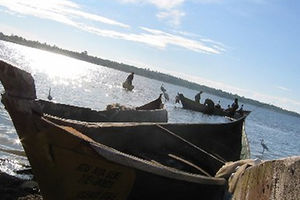
Fishermen in Lake Victoria.
Photo credit: File | Nation
The hearing involved a site visit on January 21, 2025, during which Justice Okong’o, Nema officials and other court officers visited Mr Ranguma’s home at Ngege Beach, Dr Kidero’s land in the Otonglo area next to the lake, and Dr Kaudia’s property at Usoma Beach, in order to establish the extent of encroachment prior to delivering the judgment.
In a ruling delivered on September 29, 2025, Justice Okong’o found in favour of the environmentalist.
“The plaintiff and the community living along Lake Victoria are entitled to a clean and healthy environment, as guaranteed under Article 42 of the Constitution. This includes the right to access various public elements of the environment for recreation, education, health, spiritual and cultural purposes. The three defendants had no right to encroach on the 100-metre riparian reserve or to interfere with the plaintiff and the local community’s access to the lake,” he said.
The court ordered Mr Ranguma to remove the illegal perimeter walls built beyond the boundaries of his two plots of land extending to the riparian reserve within 90 days.
“I also order the first defendant (Ranguma) to demolish any structures constructed on the lake riparian reserve within the same period, and to limit developments on his two plots of land to their demarcated boundaries,” said Justice Okong’o.
Dr Kidero had fenced off a public access road. He was ordered to re-survey the land registered in his name at his own cost within 90 days, as well as reopen the public access road through his property, which had been closed following the amalgamation process that created the property.
Justice Okong’o also issued a permanent injunction to prevent the three, either individually or through their employees or agents, from carrying out any activities or construction work that would interfere with the Lake Victoria riparian reserve.
Riparian land, defined as the area within 30 metres of the highest water level, is protected under the Environmental Management and Coordination Act of 2006.
Other legislation protecting riparian lands includes the Water Act (2002), the Agriculture Act, the Water Resource Management Act (2007) and the Environmental Management and Coordination Regulations (2006).
Meanwhile, nature has also played its part, with the current backflow in Lake Victoria reclaiming its usual territory and encroaching on some of the plots.