For more than two decades, Francisca Odhiambo has drawn her livelihood from the waters of Lake Victoria.
Her fish business on Dunga Beach in Kisumu—she affectionately calls “my husband”—has faithfully provided for her family, paying school fees, rent, and daily expenses. But that once-reliable source of income has been shaken to the core.
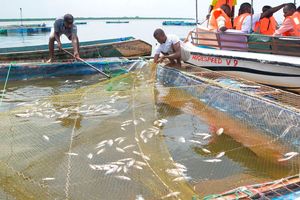
Fish farmers retrieve dead tilapia from cages at Dunga Beach, Kisumu County on September 29, 2025.
Photo credit: Alex Odhiambo | Nation Media Group
In September, thousands of tilapia died in cage farms along the Kisumu shoreline, crippling local fish trade and plunging traders like Francisca into uncertainty.
“I’ve been selling fish here in Dunga for more than 20 years, and business has never been this bad. Since the fish in cages died, customers no longer trust what we sell,” she says.
Fish trader Francisca Odhiambo at Dunga Beach in Kisumu on October 10, 2025.
Photo credit: Domnic Ombok | Nation Media Group
The once-vibrant market, once filled with the voices of sellers and buyers haggling over prices, now echoes with doubt.
“The dead fish came from cages, not the open lake. But customers don’t believe us. Every transaction feels like a test—you must defend your honesty just to make a sale,” she explains.
The die-off wiped out stocks of tilapia in 12 of the 150 aquaculture cages near the Kisumu shoreline. Experts and local authorities attributed the tragedy to a sudden drop in oxygen levels, a phenomenon triggered by abrupt temperature changes that suffocate fish in enclosed cage systems.
Yet despite scientific explanations and official assurances, fear and suspicion persist.
Many residents remain unconvinced, shunning fish from Dunga in fear of contamination. The ripple effects have been devastating, particularly for female traders selling fresh fish. “I could make over Sh4,000 a day. Now, earning even Sh500 is a struggle,” Ms Odhiambo laments.
She once bought around 100 kilogrammes of fish every morning and sold out by evening. “Now, I can only afford six kilogrammes, and sometimes, even that remains unsold. It breaks my heart to sit here all day and go home empty-handed.”
Fish farmers retrieve dead tilapia from cages at Dunga Beach, Kisumu County on September 29, 2025.
Photo credit: Alex Odhiambo | Nation Media Group
Ms Odhiambo is not alone. “The dead fish were taken away immediately and buried. We are pleading with customers not to be afraid. Those were farmed fish, confined in cages. What we’re selling now is fresh, wild-caught fish from the lake,” says Rose Onyango, another trader in Dunga.
“If we had other sources of income, most of us would have left. People no longer come. They just assume everything from Dunga is contaminated,” she adds.
Fish trader Rose Onyango at Dunga Beach in Kisumu on October 10, 2025.
Photo credit: Domnic Ombok | Nation Media Group
The crisis has been worsened by dwindling fish supplies and soaring prices. “Fish numbers in the lake have gone down, and prices have gone up. A kilo that used to cost Sh300 now sells for Sh400. We’ve had to raise prices and customers get angry. Some even say, ‘Why sell dead fish at such a high price? These should be free,’” Ms Onyango says.
To survive, some traders have resorted to loans. “It’s not easy. We need the government’s support to restore public trust. The fish we sell are safe and fresh,” she insists.
The shockwaves have reached beyond the market, hitting local eateries and restaurants that depend on tilapia as a staple dish.
On Dunga Beach, tilapia is more than food—it’s a symbol of pride. Whether fried, grilled, or boiled and served with ugali and kachumbari, it has long drawn tourists and locals alike. But now, even this beloved delicacy struggles to find buyers.
“Business has dropped drastically. Before the incident, tourists and families came every weekend for fresh tilapia. These days, they only order soft drinks and chips,” says Joan Ochieng, who runs a lakeside restaurant.
Fish farmers retrieve dead tilapia from cages at Dunga Beach, Kisumu County on September 29, 2025.
Photo credit: Alex Odhiambo | Nation Media Group
“I had to let go of three employees. I simply could not afford to pay them anymore. Now we only serve a handful of regulars, but they, too, are cautious,” Ms Ochieng says, blaming the panic on misinformation.
“People hear that fish died in the lake and assume everything is unsafe. But the deaths happened in specific cages, not in open waters,” she explains.
Nicholas Oyete, the chairman of the Dunga Beach Management Unit, confirmed that only 12 out of 150 cages were affected. He reassured the public that local authorities acted quickly to dispose of the dead fish before any reached the market. “The affected fish never made it to the stalls or tables,” he says.
But for fishmongers and restaurateurs, the damage has already been done.