The recent attack at Kwa Kamari village in Tseikuru, Kitui County, that claimed seven lives was a chillingly well-coordinated operation, witness accounts have revealed.
By piecing together the events of April 25, 2026, it has become clear that the attackers knew exactly where to strike to immobilise the village. The assault began at the market centre, which serves as the primary entry and exit point for the area.
“These people got to the Kwa Kamari centre around 11am and immediately they torched my son’s petrol station,” Mr Kavilu Muli recounted the ordeal.
By destroying the fuel pump and several motorcycles parked nearby, the attackers effectively cut off the only motorised escape route.
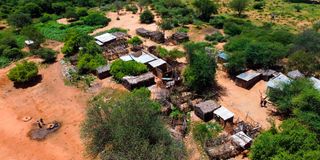
The geography of the village further aided the assailants; a dry seasonal river separates the shops from the main market stands and the settlement area where Kwa Kamari Police Station is also located.
This layout left the petrol station as the only viable escape route for the residents. By striking this specific area, the gunmen created a tactical choke point; although it was the primary way out of the village, the fire and the presence of gunmen made it impossible for anyone to use it without running directly into the assault.
“I heard explosions from town and immediately I started running away from my home,” said Ms Regina David, who was among those forced to seek refuge in the scrubland.
While many fled, those who remained in their homes and fields became targets of the gunmen. At one homestead, Damaris Matei and Titus Munywoki were shot dead.
Christina Matei, mother of the late Damaris Kisio Matei, during an interview at their home in Tseikuru, Kitui County on May 2, 2026.
Photo credit: Bonface Bogita | Nation Media Group
In a chilling moment of the assault, Damaris’s young daughter was stabbed in the knee but was spared her life.
The violence extended to the surrounding farmland. Three individuals, Mulandi Kauni, Kilonzi Kauni, and Gregory Syengo Mwangangi, were gunned down while tilling the shamba of Kilyungi Musila. Mr Musila himself was shot in the upper left thigh but survived the encounter.
To ensure a total communication blackout, the attackers cut off access to the only high ground with cellular reception, preventing residents from alerting authorities in Tseikuru.
Residents stand next to a tree to cellular reception in Kwa Kamari, Kitui County on May 3, 2026.
Photo credit: Bonface Bogita | Nation Media Group
The most critical evidence regarding the level of planning behind the attack came from the Tseikuru Deputy County Commissioner, Anita Mwangi.
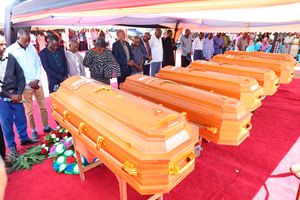
During the mass funeral for the seven victims at Tseikuru Primary School, she revealed that authorities had intelligence suggesting the gunmen would strike, although the exact timing remained unknown.
During the mass funeral service, the residents demanded to know why a village as targeted as Kwa Kamari was manned by only three police officers.
Surrounded the police station
They challenged leaders to explain the lack of security, given the size of the new station.
In response, the DCC promised that personnel numbers would be increased. They noted that GSU officers have been temporarily posted to the area as an immediate measure to bolster security.
“It is time that we do not let any intel go unutilised. We knew that they would come but we did not know when. We are recruiting extra National Police Reservists for Tseikuru and the biggest number of them will go to Kwa Kamari,” said Ms Mwangi.
Tseikuru Sub-County Deputy County Commissioner Anita Mwangi during an interview outside her office in Tseikuru, Kitui County, on May 4, 2026.
Photo credit: Bonface Bogita | Nation Media Group
Kwa Kamari Police Station, funded by the County Government of Kitui, was manned by only two officers during the attack, despite three who are stationed there. The assailants knew that this small team could not match their firepower.
Around noon, the armed men surrounded the police station and sprayed it with gunfire, forcing the officers to flee for their lives. Evidence of the assault remains visible, with several bullet holes marking the walls and shattered glass at the station gate. Reports indicate that the two officers who fled have not yet returned since the attack.
One officer, who had stepped out before the raid and encountered the group on his way back, described his narrow escape.
“These people had decided to finish us completely. You can see the bullet holes. I was not inside when they attacked, but I met them and pleaded for my life and they let me go. I am very lucky to be alive,” he said.
Mr Musili Kauni, who lost two brothers (Kilonzi and Mulandi) during the attack, recounted his experience with the assailants.
He explained that he was supposed to accompany his brothers to work on his nephew’s land, but had excused himself to search for a goat that had gone missing the previous day. When he heard the gunshots, he hid in the bush, from where he could see the attackers; he noted that the majority of them had covered their faces.
“The ones I saw while hiding were about 24 attackers; I saw 16 guns and two spears. Those people terrorised us because there was no network. Even the police you see at the station are restricted in their work. If one of them gets into trouble, he cannot even communicate to call for help,” said Mr Kauni.
According to Mr Kauni, the gunmen left the area at about 2 pm, having timed their withdrawal to avoid police reinforcements.
Musili Kauni during an interview at his home in Tseikuru, Kitui County, on May 4, 2026. His two brothers, Kilonzi Kauni and Mulandi Kauni, who were among the seven victims of the Kwa Kamari bandit attack.
Photo credit: Bonface Bogita | Nation Media Group
The DCC explained that the report of the attack at Kwa Kamari had to be delivered physically. This delay bought the attackers time, as the main police station and administrative offices are in Tseikuru—roughly 40 km away—with poor road conditions further slowing the journey.
The County Commissioner for Garissa, Mohamed Mwabudzo, explained that there is a possibility of outside infiltration in the recent attack.
“We can put an end to these killings because this habit of retaliatory attacks is somewhat foreign; there could be infiltration by people we are not certain about. We are neighboring people in conflict and we may not know,” said Mr Mwabudzo.
The government says it is investigating the incident and collecting information that will help arrest the perpetrators of the attack and the killings at Kwa Kamari.
The well-coordinated attack, which forced residents to flee for their lives and left families and residents mourning people they knew well, has cast a long shadow of fear over the village. While the government speaks of infiltration and reinforcements, the people of Kwa Kamari remain shaken, uncertain whether this was an isolated tragedy or a precursor to further violence.