Security officers from the Anti-Terror Police Unit (ATPU) and the Kenya Defence Forces (KDF) have defended their decision to conceal their identities during operations in parts of the country prone to terrorist attacks.
Their defence follows a public confrontation between human rights activists and ATPU officers manning a roadblock on the Mombasa–Lamu highway on Tuesday. The incident, which went viral on social media, sparked debate among Kenyans, with some supporting the officers’ decision to remain anonymous in sensitive and high-risk operations, while others criticised it as a breach of transparency and accountability.
According to a High Court ruling delivered last year, all security officers are required to remain identifiable when performing public duties such as arrests or crowd control. The order, issued following a petition by the Law Society of Kenya (LSK), directed the Inspector-General of Police to ensure that officers deployed during public assemblies or demonstrations wear full uniform, display name tags and service numbers, and refrain from covering their faces.
However, ATPU and military sources, who spoke to the Nation anonymously for their safety, argued that concealing their identities is a matter of survival. They said they operate in hostile environments where terrorists and criminal networks use asymmetrical warfare tactics—unconventional methods meant to exploit vulnerabilities in formal security systems.
“Remember, places like Lamu and parts of the Coast have witnessed ambushes, killings, and terrorist attacks. We must protect our identities when dealing with such threats. We are also human beings with families and personal lives that could easily be endangered,” said one officer.
Another officer questioned why officers confronting enemies who operate in secrecy should be compelled to reveal their own identities. He said operational realities sometimes necessitate discretion.
“Before each deployment, we assess the local security situation. If intelligence suggests active threats, we are forced to adapt, and that includes covering our faces,” he explained.
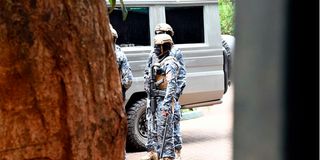
Anti-Terrorism Police Unit (ATPU) tactical team member guards the entrance of a Kiambu Law Court on February 2, 2021.
Photo credit: File|Nation Media Group
The officers cited routine checks along the Mombasa–Malindi–Garsen–Witu–Lamu highway, where ATPU and Special Operations Group (SOG) personnel often conduct surprise inspections.
“These are not ordinary traffic checks,” said an officer. “We’re looking for high-value targets—drug traffickers, terrorists, or their couriers. We can’t afford to expose ourselves when the people we are screening could be part of the networks we’re fighting.”
On Tuesday, tension flared when human rights activists, including Muslims for Human Rights (MUHURI) board member Khelef Khalifa, Haki Africa’s Rapid Response Officer Mathias Shipeta, and SheRises Executive Director Salma Hemed, confronted ATPU officers at a checkpoint between Gongoni and Marereni in Kilifi County. Journalists accompanying them were also detained briefly at Malindi Central Police Station.
Mr Khalifa said the activists were challenging indefinite curfews imposed from Minjila to Lamu and the requirement for passengers to present ID cards to hooded officers—actions he claimed violate Article 39 of the Constitution, which guarantees freedom of movement.
“The commotion started after we demanded that officers identify themselves as required by court orders,” said Mr Khalifa. “Our operation was independent and based on complaints from passengers about persistent harassment at security checks.”
He accused the officers of linking their lawful activities to commercial interests. “In their minds, our presence was ‘sponsored’ by one of the bus companies plying the Mombasa–Lamu route, but that’s false. We were simply demanding accountability and respect for the rule of law.”
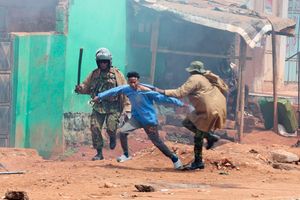
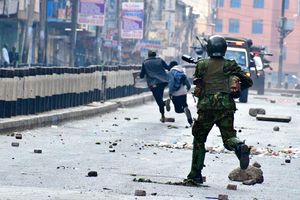
Civil society groups have long argued that anonymity among security forces fuels impunity, particularly in the wake of the 2024 Gen Z protests, where victims of police brutality struggled to identify their assailants.
But officers insist that the dynamics of counter-terrorism cannot be equated with regular policing. “The Constitution guarantees rights, yes, but we also have a duty to preserve life—ours and that of civilians,” one said. “When we hide our faces, it is not to evade responsibility but to stay alive in a fight where the enemy doesn’t wear a uniform.”