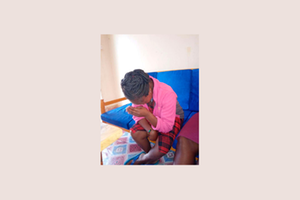


A baby has been at the centre of a painful case that has cast a spotlight on gender-based violence against people living with disabilities in the country.
For months, 47-year-old Stepkem Kinyua Nyambari insisted the child was not his, even when scientific evidence suggested otherwise.
It was only after the trial had ended and sentencing loomed that he told the court he was ready to take responsibility and care for the baby. The court, however, was not persuaded by the sudden change of heart.
Nyambari was charged with the offence of defilement of idiots and imbeciles (persons with mental disability) under Section 146 of the Penal Code. On Monday, a court in Lamu dismissed his pledge as insincere, noting that throughout the trial he had denied paternity despite a DNA report confirming he was the biological father.
To the court, the statement appeared less like an expression of responsibility and more like a last-minute attempt to seek leniency. In a strongly worded ruling, the court said it could not accept that the accused had suddenly undergone a change of heart.
“Since it cannot be in the mouth of the accused that he is all of a sudden the Biblical Paul and now wants to appear converted and more concerned about the baby, when all along he had denied paternity of the said child, I find that the aggravating circumstances outweigh the main mitigating factor,” the court said.
The court also examined the circumstances under which the offence was committed, concluding that they outweighed any plea for mercy.
According to the ruling, the victim endured threats which she heeded until her condition deteriorated to the point where she could not pass urine and developed infections that required hospital admission. The court noted that the situation could easily have endangered both her life and that of the unborn child.
With this in mind, the court found the circumstances of the offence grave and aggravated. Nyambari was consequently sentenced for offences committed between October 1 and 30, 2024.
“I do hereby sentence the accused person to 10 years’ imprisonment. In addition, the accused is declared a dangerous sexual offender and his name shall be entered in the Sexual Offenders Register forthwith,” the court ruled.
The court further observed that Nyambari had abused a position of trust and failed to exercise restraint despite being aware that the victim had a mental disability.
In its judgment, the court emphasised the vulnerability of persons living with disabilities and the need for courts to impose firm sentences in order to deter similar offences and protect those at risk.
“No one should take advantage of their situation for whatever reason or season,” the court added.
Court proceedings showed that Nyambari had initially been charged under Section 7 of the Sexual Offences Act, which relates to performing a sexual act in the presence of a person with a mental disability. However, during the hearing, evidence presented before the court indicated that the accused had engaged in a sexual act with a person with a mental disability.
Because that conduct is not specifically provided for under the Sexual Offences Act, the court substituted the charge with the offence of defilement of a person with a mental disability under Section 146 of the Penal Code, as permitted by law.
According to the prosecution, the accused committed the offence against a 25-year-old woman. He had also faced an alternative charge of committing an indecent act with an adult under Section 11(a) of the Sexual Offences Act.
During the trial, the prosecution presented four witnesses to support its case. After hearing their testimonies, the court found that the accused had a case to answer and placed him on his defence.
Nyambari gave sworn testimony in his defence but did not call any witnesses before closing his case.
At one stage during the proceedings, and based on the victim’s testimony, the accused applied for a DNA test. The court granted the request and the test was subsequently conducted.
While delivering the sentencing ruling, the Lamu court noted it had also considered the victim impact assessment report that had been filed on March 14, 2026.
The magistrate noted that sentencing is an integral part of the judicial process and must be exercised judiciously. “In doing so, courts consider several factors including the nature and gravity of the offence, the circumstances in which it was committed, the accused person’s previous record, the mitigation presented, and the broader objectives of sentencing,” it said.
According to the court, these objectives include punishment of the offender in a just manner, deterring the offender and others from committing similar offences, and promoting rehabilitation so that an offender may reform and become a law-abiding citizen.
The court also emphasised that any sentence imposed must be proportionate to both the offence and the offender in order to uphold the integrity of the justice system and maintain public confidence in the administration of justice.
In its ruling, the magistrate also expressed concern about the heightened vulnerability of persons living with mental disabilities, particularly women and girls, to sexual violence.
He observed that studies have shown that girls and young women with disabilities face significantly higher levels of gender-based violence compared to those without disabilities, and that perpetrators are often individuals known to the victim rather than strangers.
The court noted that girls and young women with disabilities face up to 10 times more gender-based violence than their non-disabled counterparts.
The court cited a study in Australia that found that as many as 62 percent of women with disabilities under the age of 50 had experienced violence since the age of 15.
In this case, the court found that the convict had taken advantage of the victim’s vulnerability and abused a position of trust.
Guided by the law, sentencing principles, and the Judiciary Sentencing Policy Guidelines, the court concluded that a custodial sentence was appropriate.