At least 20,000 residents of Lamu East have been plunged into a month-long blackout after two ageing diesel generators broke down, crippling fishing businesses, disrupting essential services and leaving students struggling to study.
The power crisis has renewed scrutiny of a decision by Kenya Power to transfer old generators from Lamu Island to Faza after the island was connected to the national electricity grid in 2016, with residents demanding a lasting solution to years of unreliable electricity supply.
Initially, relocating the generators was viewed as a quick fix to improve electricity access in the area. However, the stopgap measure has, over time, exposed residents to recurrent power disruptions.
The latest blackout has left residents of Faza, Kizingitini, Mbwajumwali, Myabogi, Siyu, Shanga-Rubu, Mtangawanda and other parts of Pate Island without electricity for weeks, with fishermen and traders counting heavy losses.
Mr Mohamed Ali, the former chairman of Faza Fishermen Cooperative Society, has called on the national government and its concerned agencies to urgently address the crisis and implement a lasting solution to the island’s unreliable electricity supply.
According to Mr Ali, relocating the old generators from Lamu Island to villages in Lamu East did not solve the problem but merely transferred it from one island to another.
“Since early September 2026 to date, we've had no electricity. We’re plunged into a prolonged blackout that has completely disrupted livelihoods, paralysed our economic activities and even undermined the delivery of essential services to us, the residents. Something needs to be done urgently to restore the power,” said Mr Ali.
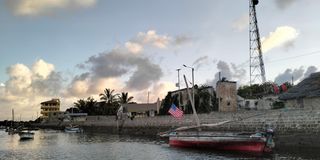
A section of a beach resort in Mtangawanda village on Pate Island, Lamu County, on October 16, 2026. The village has been plunged into a month-long blackout, disrupting livelihoods and businesses.
Photo credit: Kalume Kazungu | Nation Media Group
The frustration boiled over the weekend when residents, accompanied by Lamu East MP Ruweida Obbo, protested against the outages in Faza Town before storming the off-grid diesel station to demand the immediate restoration of electricity.
Ms Obbo said the recurrent outages were not isolated technical failures but part of a longstanding infrastructure challenge, particularly the reliance on ageing diesel generators prone to frequent breakdowns.
She warned that continued dependence on outdated generators threatened economic productivity, public service delivery and the general well-being of Lamu East residents.
“Businesses are closed, and this needs to stop,” said Ms Obbo.
The latest blackout has revived concerns about Pate Island’s vulnerability to prolonged power disruptions. The island experienced a similar crisis in June 2020 after its diesel-powered generators broke down.
The situation prompted Ms Obbo, who was then serving as Lamu Woman Representative, to lead more than 100 residents in camping at the Kenya Power diesel generation station in Faza for three days and nights as they demanded the restoration of electricity.
The problem persisted in subsequent years. Following another outage in 2023, the legislator sought a ministerial explanation in Parliament from the Cabinet Secretary for Energy and Petroleum on measures the ministry had put in place to ensure a reliable electricity supply to residents of Faza Ward.
In July 2024, Kiunga, a settlement on the Kenya-Somalia border in Lamu East Sub-county, experienced a power outage that lasted nearly 100 days after a diesel-powered generator broke down.
“The place is served by three generators. Unfortunately, two of them broke down after their alternators burnt out, triggering the blackout and power disruption in the area. We’re in the process of clearing for new generator parts at Mombasa Port before ferrying them to Pate Island. Power will be restored. People should be patient,” said Mr Irungu.
A section of Kiwayu Island in Lamu East, photographed on October 16, 2026. Kiwayu is among the villages in Lamu East without electricity.
Photo credit: Kalume Kazungu | Nation Media Group
On whether Lamu East could be connected to the national electricity grid, Mr Irungu said the project would be too expensive for the region.
“It’s nearly an impossible venture to undertake, bearing in mind that most islands in Lamu East are very remote, far-flung and geographically isolated deep in the vast Indian Ocean. Extending physical national grid poles and underwater cables is not always viable,” said Mr Irungu.
Similar sentiments were expressed by Mr Feiswal Miji, a resident and former KenGen employee.
Mr Miji said connecting the islands to the national electricity grid was the most effective long-term solution to the persistent power outages. He, however, added that it would be too costly.
“It's an expensive affair as it involves laying subsea or marine transmission cables. But integrating the island directly into the country’s primary utility network is the best option to eliminate the localised generation,” said Mr Miji.
Mr Simon Kiura, a power generation technician and systems engineer, proposed relocating the Kenya Power diesel generation station from Faza to Mtangawanda to simplify maintenance and reduce costs.
“Having the off-grid diesel station placed at Faza was a mistake. It increases maintenance costs. We need it relocated to Mtangawanda because if we have a generator breakdown, it will be easy to ferry it from Mtangawanda to Mombasa for maintenance and bring it back,” said Mr Kiura.
He also proposed establishing a modern, high-capacity hybrid solar-diesel mini-grid to improve electricity reliability in the affected areas.
“If the islands are too remote and physically unreachable by the national grid lines, the government should consider transitioning away from diesel by rolling out independent solar mini-grids,” said Mr Kiura.