About a decade ago, travelling to Lamu felt like heading into a war zone.
During the period, particularly between 2014 and 2022, Lamu’s mainland areas of Mpeketoni, Kibaoni, Witu, Hindi, Boni Forest and the Kenya-Somalia border towns of Kiunga and Ishakani, experienced a devastating wave of terror attacks orchestrated by Al-Shabaab insurgents.
It all started on the night of June 15, 2014, when a group of heavily armed Al-Shabaab militants from neighbouring Somalia raided Mpeketoni town. The attack left more than 90 people dead, while more than 40 buildings and over 30 vehicles were burnt in just one night.
What followed were coordinated nighttime raids and bus attacks in the surrounding areas along roads and in the villages. These attacks tragically left hundreds of security officers and civilians dead.
Security officers comb Boni Forest in Lamu County for Al-Shabaab terrorists during “Operation Linda Boni”.
To date, Western nations are yet to lift strict travel advisories for the affected areas, as the Kenyan government maintains a night curfew.
In September 2015, the government also launched operation Linda Boni, currently known as Operation Amani Boni (OAB), a multi-agency security mission to stabilise Lamu and parts of Tana River, Garissa and Kilifi counties that border the expansive Boni Forest towards the Kenya-Somalia border.
Together with vigorous community sensitisation against radicalisation and incitement, the coordinated security efforts conducted by the Kenya Defense Forces (KDF) in conjunction with the National Police Service and the National Government Administration Officers have transformed Lamu from a once insecure terror hotbed into a peace haven, receiving international accolades.
Last week, the county made history by becoming the first African local authority to win the United Cities and Local Governments (UCLG) Peace Prize. The award was presented during the UCLG World Congress in Tangier, Morocco, on June 25.
Lamu emerged winner from a group of five global finalists selected from around the world. The other finalists were Manabí Province (Ecuador), North Minahasa Regency (Indonesia), São Paulo (Brazil), and Kapoeta North County (South Sudan).
In March, the county received another international recognition after the innovative Kiunga Solar Desalination Project won the Best Community Impact Award at the Water Transversality Global Award 2026 held in New Delhi, India.
The global recognitions highlight years of successful community-based peacebuilding and multi-agency security interventions in the coastal region.
Mr Shee Kupi, the Lamu Director of Peacebuilding, notes that the county's transformation was not the result of a single project or security operation. According to him, it was achieved through the deliberate entrenchment of peacebuilding into Lamu's governance system.
The County Government developed the Lamu Peace Model, which integrates peacebuilding with disaster risk management, prevention of violent extremism, climate resilience, refugee inclusion, maritime safety and community participation under one coordinated framework.
According to Mr Kupi, who is also principal architect of the Lamu Peace Model, several institutional structures were established to support the approach. These include the County and Sub-County Peace Committees, Community Peace Committees at the grassroots level, and interfaith and inter-community dialogue platforms.
Others include Women and Youth Peace Forums and multi-agency coordination involving the County Government, the National Government, security agencies, development partners, civil society organisations and community leaders.
"Early warning and response mechanisms that identified and addressed tensions before they escalated were established as well. There's also the integration of peacebuilding into county policies, legislation, planning and budgeting to ensure sustainability beyond political leadership," said Mr Kupi.
Lieutenant-General Juma Mwinyikai addressing residents of Mangai Village in Boni Forest, Lamu County, during a security tour on January 26, 2023. On March 15, 2025, Al-Shabaab militants invaded Mangai Village, preaching to the locals before distributing dates as Ramadhan gifts.
Photo credit: Kalume Kazungu | Nation Media Group
He said investments in water access, livelihoods, disaster preparedness and social services are viewed as investments in peace because they address some of the root causes of conflict.
"This integrated approach, combined with strong political leadership under Governor Issa Timamy, committed technical leadership, active participation by communities and sustained support from national and international partners is what ultimately earned Lamu global recognition, particularly through the UCLG Peace Prize," said Mr Kupi.
Residents affirmed that they have witnessed improved peace in their localities compared to previous years.
Mr Kamau Mbuthia, a resident of Bakanja Village on the outskirts of Mpeketoni town, said that in previous years they used to sleep in the bushes, far away from their homesteads, after the area witnessed deadly attacks in 2014.
"I can attest that KDF and other security deployments are real. They have helped us to live in peace. Today, we can sleep in our houses without any fear of attacks. We thank the state for the efforts to improve security in this place," said Mr Mbuthia.
Mr Emmanuel Wanyoike, a resident of Mpeketoni Town, urged area leaders to continue collaborating with security agencies and to support government interventions aimed at preventing further attacks.
Similar sentiments were shared by Ms Khadija Athman, a resident of Kiunga, who noted that several years have passed without residents hearing of terror attacks or killings in the border areas.
"Lamu is peaceful. Cooperation between us and the security agencies has improved. Our schools have remained operational, unlike in previous years when they used to close because of fear of Al-Shabaab attacks. We deserve that peace prize," said Ms Athman.
Security officials engage leaders, youth and women in a Counter-Violent Extremism forum in Mokowe, Lamu County on February 5, 2026.
Photo credit: Pool
Lamu County Commissioner Stephen Sangolo acknowledged the coordinated efforts in ensuring the region remains peaceful. Mr Sangolo said significant progress has been made in reducing terrorist attacks, noting that they have largely declined.
"Through the cooperation, we've managed to neutralise the enemy. I can say major attacks like the one we witnessed in Mpeketoni in 2014 have reduced by nearly 100 per cent," said Mr Sangolo.
He, however, noted that the award does not suggest that Lamu has completely eliminated every security threat or conflict.
According to Mr Sangolo, like many border and coastal regions, Lamu continues to face threats ranging from terrorism and climate shocks to cross-border crime and pressure on natural resources.
"The major attacks have been curbed. What remains are minor, isolated incidents. We're doing well as a county because, in border areas like Kiunga, people interact with security agencies and even share resources such as water. They also share information with us, helping to prevent any Al-Shabaab infiltration across the border," said Mr Sangolo.
The current improved security has significantly boosted tourism in recent years, even with travel advisories still in place.
Unlike in 2014 and 2018, when the sector was severely affected by recurrent Al-Shabaab attacks, resulting in occupancy levels of below 20 per cent, the County Executive Committee Member for Tourism, Ms Aisha Miraj said the improved security has enabled the tourism industry to recover strongly.
"Our tourism sector has been doing well. Currently, during the low season, occupancy averages about 55 per cent. Every year during the high tourist season, occupancy consistently exceeds 90 per cent. All this is because of the improved security in this place," said Ms Miraj.
The international jury at the UCLG recognised Lamu's governance model, particularly its ability to manage diverse security challenges through coordinated institutions, preventive approaches and community participation rather than responding only after crises occur.
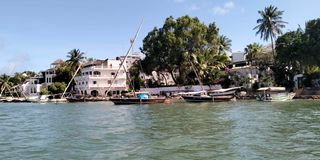
Tourists line up with their boats to watch sunset at the Majlis area along the Ras Kitau beach in Lamu.
Photo credit: Kalume Kazungu | Nation Media Group
The award recognises that despite operating in a fragile environment, Lamu has developed a system that strengthens resilience, builds trust between communities and government, and reduces the risk of conflict escalation.
More than 100 local governments from across the world submitted applications for the award, with only five shortlisted as finalists.
Speaking shortly after receiving the award, Governor Issa Timamy described the recognition as a historic achievement for the county, Kenya and the African continent.
Mr Timamy emphasised that the award belongs to the people of Lamu and all stakeholders contributing to the peace efforts.
"They all worked tirelessly to build a peaceful and resilient county. Today, the world has recognised that local governments can be powerful architects of lasting peace," said Mr Timamy.
He further noted that Lamu's experience demonstrates that sustainable peace is achieved not only through security interventions but also through strong institutions, inclusive governance, resilient public services and active citizen participation.
Chief Officer for Public Service Management Ms Khadija Fumo stressed that, as the 2026 UCLG Peace Prize winner, Lamu County will continue sharing its experience with cities and regions across the world while strengthening partnerships that advance peace, resilience, climate adaptation and sustainable development.
Can the strategy be replicated in other conflict zones?
The global recognition of the Lamu Peace Model has sparked a bigger question on whether a county that once symbolised terrorism and insecurity can become the blueprint for peace in other conflict-prone regions of Kenya and beyond.
Security experts interviewed by the Nation offered differing views on whether the model can be successfully replicated elsewhere.
Mr Suleiman Abdi, a retired security officer, cited a localised National Crime Mapping and Community Policing study by the National Crime Research Centre (NCRC), which indicates that successful crime prevention strategies must be tailored to the specific challenges of each county.
"Even if some regions might appear to be facing almost similar challenges, we always stress that it's important to understand distinct regional crime hotspots just to ensure proper resource allocation and multi-agency intelligence gathering to fully solve problems in such areas," said Mr Abdi.
Mr Francis Wanyama, another security analyst, said that while the Lamu Peace Model can work in other counties facing conflict, it should be adapted rather than copied. He noted that every county has unique historical, cultural, geographical and security dynamics.
According to him, what works in Lamu cannot simply be replicated word for word in Turkana, Marsabit, Isiolo, West Pokot, Mandera, Wajir, Garissa or Tana River.
However, Lamu Director of Peacebuilding Shee Kupi, believes that the underlying principles of the county's Peace Model are transferable.
"These can be applied through institutionalising peacebuilding through policy and legislation, building strong multi-agency coordination between county governments, the national government, security agencies and development partners, among others," said Mr Kupi.
He added that investing in prevention rather than crisis response is crucial, especially by giving communities ownership of peace processes and integrating peacebuilding with development, climate resilience, disaster risk management and livelihood programmes.