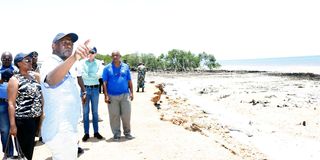
From a distance, 48-year-old Lucy Ndegwa sits under a tree outside her temporary structure in the remote village of Bobo in Hindi, Lamu County.
For Lucy and many others in Bobo and neighbouring villages, the promise of becoming millionaires from the Sh210 billion Lokichar–Lamu Crude Oil Pipeline project compensation once seemed real.
But years later, the dream has faded, leaving behind uncertainty and frustration.
Since the project was announced, she says she has avoided making any major developments on her land—such as building a permanent house—for fear she may be evicted to make way for the pipeline.
“Several years have passed without me doing anything meaningful with my land. You cannot even plant fruits like mangoes, cashews, or coconuts,” she said.
She added: “I’m forced to live in this temporary structure. Some of my neighbours live in makeshift shelters, all because we thought we would be compensated and required to vacate. The state raised our hopes, but we no longer get updates on whether this project is viable or not.”
Her story mirrors the plight of hundreds of families whose land lies along the proposed pipeline corridor.
The project gained momentum around 2016 and 2017 when discussions on a Joint Venture Agreement between the government and oil companies began. Between 2018 and 2020, public consultations were held through an Environmental and Social Impact Assessment.
Stakeholders during an engagement meeting on Lokichar-Lamu Crude Oil Pipeline at KEFRI hall in Mokowe, Lamu West.
Photo credit: Kalume Kazungu | Nation
According to the Ministry of Energy and Petroleum, the pipeline was initially expected to be completed by 2021. But more than a decade later, nothing has materialised.
Residents accuse the government of failing to fast-track the venture or provide updates to affected communities.
Bobo assistant village elder Francis Siembi, 51, who has lived in the area for 23 years, voiced his frustration.
“Let the government come forward and reveal the fate of this project. We have been left in the dark. Is the project viable, or was it just a plan to stall development? We have land but cannot develop it because we don’t know if we woill be forced to leave,” said Siembi.
The pipeline was designed to cut across six counties—Turkana, Samburu, Isiolo, Meru, Garissa and Lamu. In Lamu, it was expected to pass through Kililana (site of the Lamu Port), Bobo, Roka, Bargoni and Bodhei Junction before proceeding through Garissa, Isiolo and Moyale to Lokichar in Turkana.
In Lamu County alone, a corridor 23 kilometres long and 500 metres wide was to be set aside for the pipeline.
Lilian Mwai, a youth representative from Roka Village in Hindi said they had expected the project to create jobs and end years of marginalisation in Lamu.
“The pipeline was supposed to be a game-changer, not just for Lamu but for all the counties along its route. It would have created jobs and opportunities for young people. Let the government speed it up,” she said.
Salim Gubo, an elder from the Boni minority community in Bargoni warned that compensation processes often attract fake landowners seeking payouts.
“We welcome this and other national projects for the benefit of Lamu and the region. But they must be fast-tracked, otherwise our lands will be grabbed or invaded by fraudsters pretending to be legitimate claimants,” said Gubo.
Petroleum Commissioner Joseph Otieno said it was premature for residents to question the project’s viability.
“The Lokichar-Lamu Crude Oil Pipeline, an onshore pipeline, is still a proposed project. We're yet to get approvals on the field development plan that will provide appropriate guidelines on the right model to be used to transport crude oil from the production fields in South Lokichar to the marine export facility at the Port of Lamu,” Mr Otieno explaind.
“At Lamu Port, the crude oil will be stored before being exported to international markets. The pipeline is meant to connect upstream oil fields with the global market,” he added.
The 824-kilometre pipeline is a key component of the Lamu Port–South Sudan–Ethiopia Transport (Lapsset) Corridor project. It is expected to transport between 80,000 and 100,000 barrels of crude oil daily once commercial production begins.
Construction was projected to take two to three years, using trench-and-backfill methods, with the pipeline buried at least one metre underground. The pipe itself was designed to be 18 to 20 inches in diameter.
For now, however, the billion-shilling dream remains just that—a dream.