Lamu residents are welcoming plans by Africa's richest man, Aliko Dangote, to build the largest oil refinery in East Africa in the county, but their optimism is tempered by painful memories of previous mega projects that left many locals feeling excluded and uncompensated.
While many see the proposed refinery as a transformative investment that could create jobs and unlock new economic opportunities, residents and leaders insist that transparency, meaningful public participation and fair compensation must be at the centre of the project from the outset.
Nigeria's Dangote Group this week announced plans to finance a proposed 700,000 barrel per day oil refinery in Lamu. The investment will be financed through internal cash flow, bonds and an initial public offering.
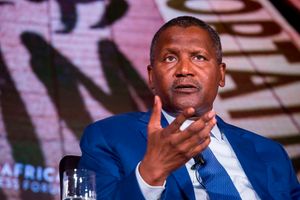
Dangote Group founder Aliko Dangote.
Photo credit: Pool
However, drawing from lessons learned during the construction of the Sh310 billion Lamu Port, which disrupted fishermen's livelihoods and triggered lengthy court battles for compensation, residents have demanded transparency and full public participation from Dangote Group.
Although many agree that the planned oil refinery will benefit the region, they want to be fully involved in the planning and implementation process. The facility is expected to take up to three years to build and will supply refined petroleum products to Kenya and neighbouring countries, helping reduce East Africa's dependence on imported fuels.
Leaders and residents interviewed by the Nation welcomed the project and pledged their full cooperation but insisted they must be consulted at every stage from the very beginning.
Deputy Governor Dr Mbarak Salim said Mr Dangote's decision to choose Lamu as the preferred location for the mega refinery is both strategic and welcome.
According to Dr Salim, the county stands out as a unique emerging economic hub that offers a blend of peaceful, safe and culture-rich island life alongside enormous untapped economic potential for both investors and local communities.
"As a government and the people of Lamu, we commit to cooperate on key matters of environmental safety, as well as empowerment of locals on economic opportunities that shall arise from this great investment," said Dr Salim.
Former Lamu East MP and former County Assembly Speaker Mohamed Hashim also welcomed the planned oil refinery but was quick to stress the need for meaningful public participation.
Mr Hashim said early consultations help ensure projects meet the actual needs of communities while fostering local ownership.
Former Lamu East MP and former County Assembly Speaker Mohamed Hashim Fumo addressing journalists in Mombasa in July 20, 2014.
Photo credit: File|Nation Media Group
"We welcome Mr Dangote's oil refinery project. We expect such a venture to create massive employment opportunities for our local youth. Our only hope is that public participation forums will be held so that the Lamu people are briefed about what that venture is all about and the meaning of it being in Lamu," said Mr Hashim.
He added, "We insist on public participation. We don't want a repeat of what happened during the implementation of the Lapsset projects, which resulted in us, the local community, lacking a voice."
Mr Hashim was referring to concerns that local communities were not meaningfully involved in key decisions during the early planning and implementation of the Lamu Port South Sudan Ethiopia Transport (Lapsset) project, particularly construction of the port in Kililana.
In a landmark 2018 judgment, the High Court found that project proponents had failed to conduct adequate public participation as required by the Constitution and environmental laws, ordering a fresh and more inclusive consultation process. The court also directed compensation for affected fishermen and stronger engagement with local communities.
Lamu branch Council of Imams and Preachers of Kenya (CIPK) Organising Secretary Mohamed Abdulkadir said it is essential for such a mega project to undertake robust Corporate Social Responsibility (CSR) initiatives that directly benefit local communities.
"To ensure it receives full blessings from us, the local community, let the investor engage us in CSR projects so that our real needs are addressed. We want to see improved healthcare, education, and clean water distribution in villages surrounding the project site. The investor should also consider skills development, including our youth being given scholarships for various courses," said Mr Abdulkadir.
Former Lamu Municipality Mayor Famau Ahmed described the project as a game changer for the region. He however added that projects such as the proposed oil refinery are less likely to face disruptions when residents are involved in the planning process.
"We support the project provided we're fully consulted so that the investor can identify pressing community needs. We would be happy if 70 per cent of the jobs created at the intended Lamu oil refinery are directed to our local youth," said Mr Ahmed.
Similar sentiments were shared by Environmental activist and Executive Director of the Lamu Women Alliance (LAWA) Raya Famau, who called for all project-affected persons to be fully compensated before construction begins.
She said the implementation of other mega projects in Lamu previously left a bitter legacy, with many residents facing delayed or inadequate compensation for their ancestral land. Ms Famau said the experience has fuelled apprehension that the same bureaucracy and unfulfilled promises could undermine the new venture.
Ms Famau also stressed the need for a comprehensive Environmental and Social Impact Assessment (ESIA) before the refinery is established.
"We agree that the Dangote project is beneficial to us. We know our youth will get employment. But we can't deny the fact that as locals, we're caught between the promise of jobs and the already lingering trauma of the Lapsset project. Up to now, some Lapsset project-affected persons are still crying for compensation," said Ms Famau.
She added, "Dangote oil refinery will bring economic potential to the region, but our deep anxieties around land acquisition and fair, timely compensation are completely valid and need effective redress."
An oil refinery was one of the seven components of the Lapsset Corridor Project. However, its fate became bleak after Gulf Energy, which acquired the Turkana oil fields from Tullow Oil Plc, settled on trucking the crude oil to Mombasa port instead of the initial plan of constructing a more than 800-kilometre Lokichar to Lamu crude oil pipeline.
According to the plan by Gulf Energy, crude oil for export will be trucked from Turkana to the Kenya Pipeline Refineries Limited (KPRL) facility in Changamwe and exported through Mombasa port. It will be handled through the Kipevu Oil Terminal, where vessels will dock for loading.
The announcement by Dangote Group this week has therefore resuscitated hopes for Lamu to reap from the lucrative oil sector. However, residents who had surrendered their land for the crude oil pipeline remain stranded with unresolved land compensation claims.
The other major infrastructure components of Lapsset, apart from the Lamu Port and oil pipeline, are a Standard Gauge Railway (SGR), road network, international airports and resort cities.
Lamu Port General Manager Abdulaziz Mzee appealed to residents, leaders and activists to embrace the proposed investment, describing it as a blessing for the county. Mr Mzee said the implementation of such a large project would attract more investment and accelerate development in the region.
He cautioned residents and leaders against politicising the project, noting that it would also boost business at Lamu Port.
"We welcome the project with open arms. It will increase the number of ships that will dock at Lamu Port to deliver, unload and load oil barrels, thus boosting revenue and trade at the Port of Lamu," said Mr Mzee.
Although the exact location of the refinery is yet to be confirmed, government sources disclosed that it is expected to be established in the Magogoni area near Lamu Port in Kililana, Lamu West. This is at the mainland in Lamu County.
Once completed, it will supply refined petroleum products to Kenya and neighbouring countries, reducing East Africa's dependence on imported oil.
The investment is part of Mr Dangote's broader strategy to expand oil refining capacity across Africa following the establishment of his 650,000 barrel per day refinery in Lagos, Nigeria.
Over the past four months, Mr Dangote has expressed interest in building a large oil refinery in East Africa. His company initially considered investing in Tanga, Tanzania, before opting for Kenya after taking into account infrastructure and market considerations.
Lamu Port has a natural deep harbour that allows it to accommodate larger ships than many regional ports, including Mombasa.
Its first three operational berths are 17.5 metres deep and 400 metres long, compared to Mombasa Port's 15-metre-deep, 300-metre-long berths. As a result, Lamu Port can handle larger vessels carrying up to 12,000 Twenty-foot Equivalent Units (TEUs) or containers, while Mombasa Port accommodates ships of up to 10,000 TEUs.
Other projects which previously faced delays, legal challenges or public opposition in the county include the proposed Sh200 billion coal-fired power plant in Hindi, Lamu West, which was permanently halted after the courts upheld the cancellation of its environmental licence.
The proposed Sh21 billion Baharini Wind Power Project in Mpeketoni has also stalled over land acquisition, compensation disputes and unresolved power purchase agreements. Similarly, the Manda Bay military base has faced resistance from some residents over forced evictions, ancestral land disputes and concerns about its expanding security footprint.