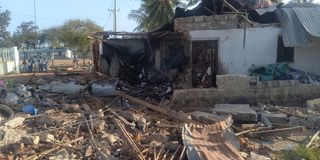
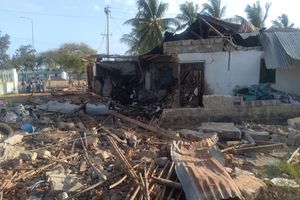
When news about the bombing of a building in Kiunga, at the Kenya-Somalia border in Lamu County, broke in the early hours of Friday, it seemed like another terror attack in the fragile town.
However, the bombing of the commercial building revealed a pattern of incidents that have raised eyebrows in the past two weeks, with sources linking them to anti-terrorism operations.
Investigations by Nation showed that at 7pm on Thursday, the woman who owns the building, where she also lived and ran a wholesale shop, was taken together with her children by people believed to be police officers. The bombing took place at around 1:45am, and the family was released at 3am, just hours after the attack, according to sources.
Curiously, earlier that evening, the UK government had updated its travel advisory against Kenya, warning citizens “against all travel to areas in the east of Kenya, including the border with Somalia.” These areas include parts of Lamu, Garissa, Wajir and Mandera counties that border Somalia.
Highly placed security sources said the bombed building had been on their radar for suspicious activities.
The bombed building in Lamu's Kiunga Town on the Kenya-Somalia border on Friday, September 19, 2025.
Photo credit: Kalume Kazungu | Nation Media Group
An officer who requested anonymity due to the sensitivity of the matter said it was suspected that some of the shop’s items were supplies used to support terror activities, and that the people who often visited the building were believed to be Al-Shabaab sympathisers.
While commenting on the incident, Lamu East Deputy County Commissioner Mr George Kubai sought to ease public fears, without linking the bombing to a terror attack.
“Our officers, including police and the military, are already on the ground to ascertain what actually transpired. In the meantime, citizens shouldn’t be worried. Let’s share information with our security apparatus to aid in the investigation so that the perpetrators can be brought to book,” he said.
This is not the first time a civilian building has been bombed in Kiunga Town. In December 2021, a shop owned by a businessman was attacked with explosives by unknown assailants at around 2am. In both incidents, no casualties or looting, which characterise terror attacks in the region, occurred.
Mohammed Obo who was allegedly abducted by people believed to be security agencies in Kiunga Town on the Kenya-Somalia border
Photo credit: Kalume Kazungu | Nation Media Group
The Friday's bombing came just two weeks after another trader disappeared mysteriously. The family of Mr Mohamed Obo, 41, said he had travelled to Kiunga last month to resolve issues surrounding his boat, which he had hired out.
While in Kiunga, he set up a temporary base where he continued his fish business, buying catches from local fishermen in the border town and ferrying them to other dealers, restaurants and retailers in Lamu Island.
His elder brother, Mr Ali Omar, revealed that last month the businessman had received a summons from the Directorate of Criminal Investigations (DCI) in Kiunga town. According to Mr Omar, it was alleged that since his brother’s arrival, suspicious insecurity incidents were being orchestrated or witnessed in the town.
The family dismissed the allegations linking their kin to insecurity, believing it was a setup by rivals. Mr Omar said some competing fish dealers in Kiunga were unhappy with Mr Obo’s entry into the market.
“My brother had recently introduced new prices for the fish he buys from local fishermen, from the initial Sh120 to Sh150 per kilogram. Maybe this offended some of his business competitors who resorted to setting him up with the security agencies,” he said.
Mr Obo, a father of seven, was forcibly taken by armed men on Friday, September 12, at around 8:30pm while chewing khat with a friend. His wife, Ms Tima Hassan, was also present at the time.
The heavily armed and masked abductors reportedly overpowered them, beating and knocking down the friend before locking Obo’s wife in a room. They then bundled him into a vehicle parked some metres away and vanished with him to an unknown destination.
“I believe the abductors are security agents because they were in uniform and armed. They even had a vehicle on standby. Kiunga is a well-secured border town. It doesn’t add up that criminals can come and whisk a resident away just like that without any response from the many security agencies operating within,” said Mr Omar.
Ms Hassan, the businessman’s wife, recounted the horrifying events of that day, saying the abductors were about six heavily armed men.
“They were heavily built men. They forced the door open, entered, and beat my husband’s friend on the face with the butt of a gun just to scare him. They reached where I was standing, pushed me into the room and locked it from the outside. They then took my husband and vanished,” said Ms Hassan.
She reiterated that her husband is innocent, adding that in all their years together, Mr Obo has never once been arrested for breaking the law.
The family has unsuccessfully visited police stations in Kiunga, Kizingitini, Mokowe, Mpeketoni, Witu and even outside Lamu while searching for him. They have also filed a police report, but no information about his whereabouts has been provided.
Haki Africa Rapid Response Officer Mathias Shipeta demanded that the matter be actively investigated and that security agencies produce Mr Obo within seven days; failure to which rights groups would move to court to demand his immediate release.
The organisation’s Chief Executive Officer, Mr Yusuf Aboubakar, said that if the police deny involvement, then Inspector General of Police Douglas Kanja has an obligation to clarify the circumstances of the abduction.
Mr Kubai confirmed that a report about Obo was filed with the police and DCI, and that the matter was under intense investigation. He, however, dismissed any security involvement.
“The police and DCI are investigating the matter to find out who arrested Obo so that the man is returned and linked with his family. Let’s be patient,” said Mr Kubai.