It is early morning and sunlight, thick with specks of sawdust, penetrates through the open doorway of Mr Ali Abdalla Skanda’s workshop in the Wiyoni area of Lamu Island.
At a far corner of the workshop, Mr Skanda is fully engrossed in his craft, holding a mallet and a chisel as he carves a door. He pauses momentarily and looks keenly, testing the sharpness of a V-gouge against his thumb, then selects a wider, gently curved chisel.
With a controlled, confident stroke, he clears a curl of wood, which spirals away and joins the fragrant pile on the workshop’s dusty floor. The scent of freshly cut African mahogany hangs heavy in the air, a perfume of labour and nature.
“This is the work I’ve been doing since I was only 12 years old. I love woodcarving. I didn’t attend any formal class to acquire this skill. I learnt it from my dad, through an apprenticeship,” says Mr Skanda.
Mr Skanda, 53, is the son of the late Mzee Abdalla Ali Skanda, a household name across the archipelago. Mzee Skanda was one of Lamu’s finest and most gifted artisans in woodcarving.
The renowned Lamu woodcarver, artisan Ali Abdalla Ali Skanda.
Photo credit: Pool
He was one of the brains behind the decorations of the doors of the old parliament building in Kenya and almost 90 per cent of the door decorations in Lamu’s main buildings.
“I can say this is the 41st year of my doing woodcarving. It’s a profession that requires patience, keenness, resilience and passion in equal measure,” he explains.
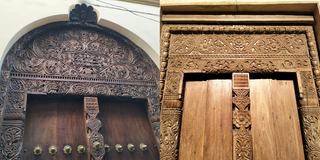
The Lamu Old Town is renowned for these intricately carved wooden doors, a signature element of its unique Swahili architecture, featuring elaborate geometric and floral patterns from the 18th and 19th centuries.
The doors can cost between Sh120,000 to Sh500,000, depending on the carving designs, type of timber, size, among other factors.
The carved, decorated doors of Lamu are shown in these photos taken on December 4, 2025.
Photo credit: Kalume Kazungu| Nation Media Group
The curator with the National Museums of Kenya in charge of Lamu, Mr Mohammed Ali Mwenje, said the external carved wooden doors of Lamu are distinctive decorative features along the Swahili Coast, stretching from Mogadishu in Somalia to Sofala in Mozambique, including islands like Madagascar, Comoros, Zanzibar, Pemba and Lamu.
Mr Mwenje said the intricate carvings often found on the doors are also well established within the Islamic world, seen in mosques and royal palaces. Communities here describe the Lamu doors as “talking,” noting that their appearance is impressive and sends indirect messages to observers.
In Swahili traditions, the doors symbolise identity and social status. The door to a house is a marker of its owner’s rank, wealth and honour. To some, carvings of spiritual words in Arabic serve as a deterrent to bad omens in the house.
“One explorer once said the grandeur of a door directly correlates with the dignity and power of its owner. The higher the tenement, the bigger the door, the heavier the padlock and the huger the iron studs which nail the door of heavy timber, the greater the owner’s dignity,” said Mr Mwenje.
There are at least eight distinct styles of such carved wooden doors identified by architectural historians. The styles are named after the areas or peoples with which they are most associated, reflecting the town’s history as a major trading hub with diverse cultural influences.
The carved, decorated doors of Lamu are shown in these photos taken on December 4, 2025.
Photo credit: Kalume Kazungu| Nation Media Group
They include Lamu style (local style), Siyu doors (named after the settlement of Siyu on Pate Island), Bajuni doors (associated with the Bajuni people) and unframed doors.
Others are Omani doors (introduced by the Omani Arabs and among the earliest styles in the region), Gujerati doors (of Indian origin), Zanzibar style doors (also of Indian origin but with unique patterns and richer decorative elements) and Indian neoclassical doors.
The last one is the Kijumwa style, developed by the famous Lamu-born carver Ahmed Abubakar Omar Kijumwa. The style features unique floral patterns with abstract V shapes blending Omani and Zanzibar elements with his own motifs.
Today, Kijumwa’s patterns are celebrated and replicated by modern woodcarvers, who continue his legacy in Lamu.
For one to qualify as a woodcarver, it takes about six months, especially for those who are truly interested in the craft. It takes a maximum of two months for a standard carved door to be completed.
Mr Mohamed Bakari Juma, another renowned carved door maker in Mkomani, Lamu Old Town, says he started woodcarving when he was 25 years old. Today, Mr Bakari, 51, vows never to leave the job.
Mr Bakari does not own a workshop like Mr Skanda but is employed by someone else. The skill has enabled him to earn at least Sh1,000 per day.
“I am a father of two. I value this craft so much. I acquired it through an apprenticeship shortly after dropping out of school at class six,” said Mr Bakari.
The carved, decorated doors of Lamu are shown in these photos taken on December 4, 2025.
Photo credit: Kalume Kzungu| Nation Media Group
“As an artisan, you have to be up to date always about the carving door patterns, designs and styles. They keep evolving almost daily in this fast-moving world. Be innovative as a woodcarver. If clients realise you’re outdated with such issues, they leave you for someone else,” said Mr Bakari.
Mr Mohamed Lali, a woodcarver and door maker in Lamu, cites other factors that influence the quality of Lamu carved doors. One such factor is the amount of money that a client is ready to offer for a door.
He adds that quality doors require a high level of skill and expertise from the woodcarver. Clients might ask for round, square or arched lintels for their doorframes. Some might direct that their doorframe, lintel and centre posts be fully decorated, while the door panels feature sharp brass spikes for ornamentation.
Others ask the woodcarver to use durable hardwoods like teak, African mahogany or ebony. Some clients want their doors massive, thick or giant-sized.
“There are those who would want proper locking systems fixed to their doors. Our quotations, therefore, rely on all these specifications,” said Mr Lali.
To survive in the trade, a woodcarver must have at least a set of six or more tools of different designs, sizes and patterns.
As modern construction trends spread across the Coast region and the country in general, Lamu’s master carvers remain determined to safeguard this centuries-old art form. Their meticulous and time-consuming work, rooted in ancestral knowledge, ensures that the island’s cultural soul is not lost to time.