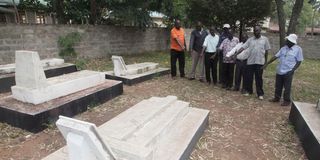
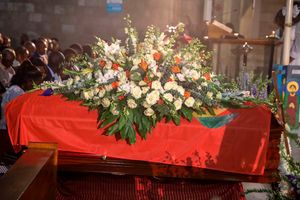
When Washington Omore from Kakrao Sub-Location, Migori County, passed away in 2011, his wife and children found themselves at odds with certain clan elders over the location of his final resting place.
While the family preferred a designated section of the compound set aside as a cemetery, the elders insisted that he be interred behind his house, to the right-hand side, as dictated by Luo traditions.
“We were simply honouring our father's wishes, as he had expressed a clear preference during his lifetime,” said David Omore, Washington’s eldest son.
Mr Omore revealed that the dispute was eventually resolved through the intervention of the church. “My father was a devout Christian who did not observe traditional cultural rites. It would have been inappropriate to conduct his burial according to customs he did not believe in,” he explained.
In Western Kenya, particularly within the Luo community, an emerging trend is taking root among families who are increasingly setting aside designated areas within their homesteads to serve as private cemeteries.
This emerging practice is steadily gaining acceptance, though not without controversy. Proponents argue that designated burial grounds bring order and efficient land use, in contrast to traditional customs where deceased relatives are interred near family houses, often leaving homesteads with cluttered and scattered graves.
Burial preparations are underway for fire victims in Upanda village, Sigomere, Siaya County, in this photo taken on May 7, 2025.
Photo credit: Alex Odhiambo | Nation
According to Ker Odungi Randa, Chairman of the Luo Council of Elders, traditional burial practices were strictly defined by age, gender and marital status.
“There are long-established rites determining where a child, woman, adult, or elder should be laid to rest,” he explained.
Typically, adult Luos are transported to their ancestral land for burial, unless they had established a recognised homestead elsewhere. Men are generally buried on the right-hand side of the homestead, facing inward; women on the left. Unmarried daughters are often buried near the fence, symbolising their unattached status.
Traditionally, clan elders would determine specific burial sites within the homestead. However, this practice is evolving due to urbanisation, population growth and limited land availability. Some families are now opting for collective burial areas, or external cemeteries, regardless of gender or customary status.
Modernisation and land scarcity
“We live in a modern world. Land is diminishing, and we’re encouraging our people to set aside designated cemeteries to prevent unnecessary use of space,” he said.
Despite these changes, burial within the homestead remains deeply symbolic.
“It maintains spiritual connection. We believe the deceased remain among us, some even communicate through dreams and visions,” added Mr Randa.
In Usenge, Siaya County, a tale is recounted of a family that interred their relative on a remote parcel of land, only to be compelled to exhume the body and rebury it within the homestead after the deceased persistently appeared to them in dreams.
Mr Randa cited Kango ka Jaramogi, the homestead of Kenya’s first Vice President, Jaramogi Oginga Odinga, now a national museum. Beyond Jaramogi’s mausoleum at the centre of the homestead, there is a designated cemetery where other family members, including the late Fidel Odinga, son of former Prime Minister Raila Odinga, are interred - even though Mr Odinga has a separate home at Opoda Farm.
“If a son of Jaramogi dies, he will still be buried at the family cemetery,” Mr Randa noted.
Peter Gwengi of Nyangera Daho Village in Usenge, Bondo Sub-county, shared a similar perspective. His family adopted this approach years ago due to pressure on available land.
“For large families like ours, scattered graves consume land needed for housing and farming. As the head of my family, I prioritised space for my sons’ houses. We simply couldn’t afford to keep interring relatives across the compound,” said Mr Gwengi.
As towns expand and land becomes increasingly scarce, maintaining burial grounds within homesteads has become challenging. Many Luo families in urban areas are turning to cemeteries or other designated spaces outside their compounds.
A traditional Luo homestead at the National Museums of Kenya in Kisumu.
Photo credit: Tom Otieno | Nation Media Group
In Kisumu, the county government has begun enforcing a bylaw prohibiting burials and cremations within the city limits in a bid to instill order and manage land use.
Kisumu City Manager, Abala Wanga, affirmed that burials will now only be permitted in official public cemeteries or crematoria.
“While Luo culture values memory and legacy, our city is growing. Many of these residential areas are becoming commercial. The practice, though respected, now conflicts with urban planning,” he said.
The directive affects several neighbourhoods where unauthorised burials had become common, including Mamboleo, Manyatta B, Market Milimani, Nyamasaria, Railways, Kanyakwar, Obunga, Shaurimoyo, Kondele, Bandani and Nyalenda B Ward.
Historian, journalist and researcher Levin Odhiambo Opiyo also supports cemetery burials. He acknowledged the long-held belief that the dead maintain spiritual ties with the living, which traditionally justified burial within the homestead. However, his outlook has evolved.
“Like many Africans, I once viewed cemetery burials as abandonment. But now, I see value in having a dedicated, physical space for remembrance. Unlike homesteads, cemeteries endure, providing future generations with a place to honour their ancestors,” he wrote in a social media post.
He noted that graves in family compounds are often lost over time due to changing land ownership and the construction of new homes.
“Well-planned cemeteries, with landscaping and gardens, offer a serene space for mourning and reflection,” he added.
Despite this shift, many families remain committed to preserving traditional burial rites, navigating the delicate balance between cultural heritage and modern realities.